The emails and texts you send after Black Friday decide whether the customers you won over the sale ever order again. Too often, those weeks go on extended Cyber Monday deals, gift guides and holiday campaigns sent to the whole list, so the people who just bought hear the same promotions as everyone else.
That misses how much holiday shopping is for someone else. Consumers in the National Retail Federation's October 2025 survey planned to spend $627.93 of their $890.49 holiday budgets on gifts, so a refill reminder can easily reach someone who bought the product as a present and has never used it.
The window for a second order is short, too. In BS&Co's analysis of 40,397 repeat buyers, half came back within 30 days of their first order and three-quarters within three months. With Black Friday on November 27 this year, the first half of that window runs through Christmas, when your messages compete with every other store's.
A post-Black Friday email and SMS strategy fixes this by following each order instead of the promotional calendar. This playbook shows how to segment holiday buyers, then walks through each message from the order confirmation to the second order: when it goes, which channel carries it, what it says and what it shouldn't do.
What should a post-Black Friday email strategy do?
A post-Black Friday email strategy should turn the customers you won over the sale into repeat customers without teaching them to wait for the next discount. In practice, that means messages triggered by each order's dispatch, delivery, first use and the date the product runs out, rather than campaigns sent to the whole list.
These buyers need the extra care. In Tresl's study of 106 Shopify stores, new customers acquired over BFCM 2024 had a 13.95% repeat rate over the next six months, against 19.2% for new customers acquired at other times of year. Tresl's advice is a dedicated six-week post-purchase series for them.
The sequence below builds that out and adds what a standard post-purchase flow leaves out: messages for gift buyers and the people who receive their gifts. Our Black Friday ecommerce strategy covers the planning before the sale.
The same rules apply to every message:
- Each message follows an event in the order's life, not the sale calendar.
- Each segment gets only the messages that fit it.
- A discount is a deliberate choice for one segment, never the default.
How should you segment Black Friday buyers?
Before the first post-purchase message goes out, split Black Friday buyers by whether they're new or existing customers, whether they bought a gift or something for themselves and whether they only ever buy on discount. Each answer changes what they should hear next:
| Segment | How to spot them | What they need next | What to leave out |
|---|---|---|---|
| First-time buyers | First order placed between Thanksgiving and Cyber Monday | An introduction, help using the product and a second order timed to use | A stream of sale campaigns |
| Existing customers | One or more orders before the sale | Delivery updates and their usual program | A welcome series written for strangers |
| Gift buyers | Gift wrap or a gift note, or a "yes" when asked | Delivery certainty, a gift receipt and exchange help | Refill reminders for a product they don't use |
| Self-purchasers | Everyone who didn't buy a gift | Setup and use, then the refill or next product | Gift guides as their only messages |
| Discount-only buyers | Every past order used a promotion, or they came back after a year or more away | An offer tested against a holdout group | Untested discounts |
Existing customers are often the bigger group. In Bluecore's data from 144 retail brands, repeat buyers made up 53% of Black Friday 2025 buyers, and 12% were reactivated shoppers, back after at least a year away. A welcome series sent to every Black Friday buyer would talk down to most of them.
The segments overlap: a first-time buyer can also be a gift buyer. Build them as tags rather than separate lists, and let the gift and discount tags override the default messages.
How can you tell a gift from a self-purchase?
The surest way to tell a gift from a self-purchase is to ask, because order data only hints at it. Gift wrap and a gift message are strong signals. A shipping address that differs from the billing address is weaker, since people ship to offices and to family they're visiting for the holidays.
Ask once, at checkout or in the order confirmation, with a one-tap answer. Tag the order rather than the customer, because someone who buys a gift in November may buy for themselves in March.
Who counts as a discount-only buyer?
A discount-only buyer is a customer whose every order has used a promotion: a sale price, a code or a free-gift threshold. Look for them in your order history from the rest of the year, since nearly everyone bought on discount over Black Friday weekend.
Lapsed customers who came back for the sale belong here until they show otherwise. None of these customers are a problem to fix: they're the one segment where a targeted offer may be what earns the second order, so it's worth knowing who they are before you send one.
What does the post-Black Friday sequence look like?
The post-Black Friday sequence runs from the order confirmation to a second-order message between late December and late February, with each step triggered by the order rather than the calendar. Here's how it plays out for an order placed on Black Friday 2026, November 27:
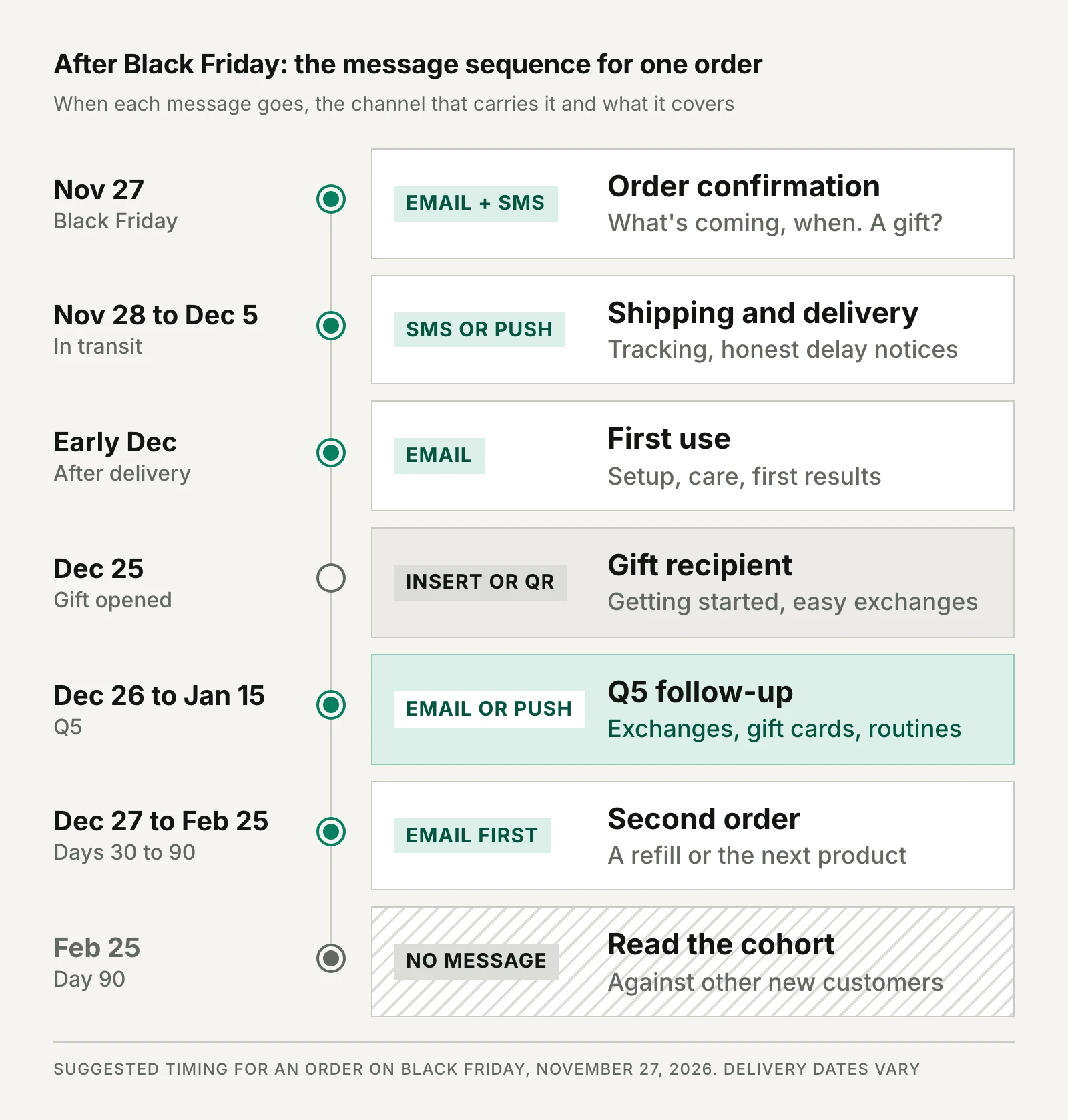
Here's what each message does, at a glance:
| Message | When | Channel | Who gets it | It should | It shouldn't |
|---|---|---|---|---|---|
| Order confirmation | Minutes after the order | Email, plus SMS for opted-in customers | Every buyer | Confirm items, delivery date and returns, and ask if it's a gift | Carry a discount or product grid |
| Shipping and delivery | Dispatch, out for delivery, delivered, any delay | SMS or push, with email as backup | Every buyer | Give tracking and an honest date | Hide delays or slip in promotions |
| First use | Two to seven days after delivery | Email, or push for app users | Self-purchasers | Explain setup, care and what good results look like | Ask for a review or a second order yet |
| Gift buyer follow-up | After delivery, before December 25 | Gift buyers | Confirm arrival and share a gift receipt and exchange terms | Send refill reminders for the gift | |
| Gift recipient | When the gift is opened | Insert card, QR code or gift receipt | Recipients | Point to getting-started help and easy exchanges | Add them to marketing without asking |
| Q5 | December 26 to mid-January | Email, or push for app users | Each segment, separately | Help with exchanges, gift cards and new routines | Default to a sitewide sale |
| Second order | Days 30 to 90, by product | Email first, then SMS or push | Self-purchasers | Offer the refill or next product when it's due | Lead with a discount |
What should you send Black Friday buyers?
Every message in the post-Black Friday sequence has its own timing, channel and purpose. Each one below ends with an illustrative example of the copy, to adapt with your own products, dates and policies.
1. Order confirmation
The order confirmation goes within minutes of the purchase, by email to everyone and by text to customers who agreed to order updates by SMS. The customer is waiting for it, so keep it to what they need to know: what's coming, when it should arrive given holiday volumes and how returns and exchanges work.
For first-time buyers, add a line on who you are. The confirmation is also the best place to ask whether the order is a gift.
Don't add a discount code for the next order or a grid of products. Besides competing with the information, promotional content can make an order email count as marketing, which matters for both consent rules and your frequency limits.
Illustrative example: order confirmation email
Subject: Order confirmed: arriving by December 4
Thanks for your order, Sam. Your Morning Routine Set ships within two business days, and we'll send tracking as soon as it's on its way.
Is this a gift? [Yes, it's a gift] [No, it's for me]
Gift orders get a gift receipt, and exchanges stay open until January 31.
2. Shipping and delivery updates
Shipping updates go at dispatch, when the parcel is out for delivery, when it's delivered and as soon as anything runs late. Text or push suits them for customers who've opted in, because the news is short and time-sensitive; email covers everyone else and anyone who wants detail.
Customers watch these closely. Consumers reported checking order tracking an average of 2.8 times per order in 2023, according to Pitney Bowes' BOXpoll surveys, and the option of SMS updates was among their top three tracking priorities.
A delay notice is the message most worth getting right, because a gift that arrives late is a poor start with a new customer. Say what happened, give the new date and tell the customer what you'll do if it misses.
For gift orders, confirm delivery to the buyer, who may not be at the address. Keep promotions out of all of these, and pause campaigns for anyone whose order is delayed.
Illustrative example: delay text
[Brand]: Your order is running two days behind because of carrier volume. New delivery date: Thursday, December 10. Track it here: [link]. Questions? Just reply.
3. The first-use message
The first-use message goes two to seven days after delivery, once the customer has had a chance to open the box, and it's for self-purchasers only. Email gives it room. If you have an app, a push notification can link straight to the same guide.
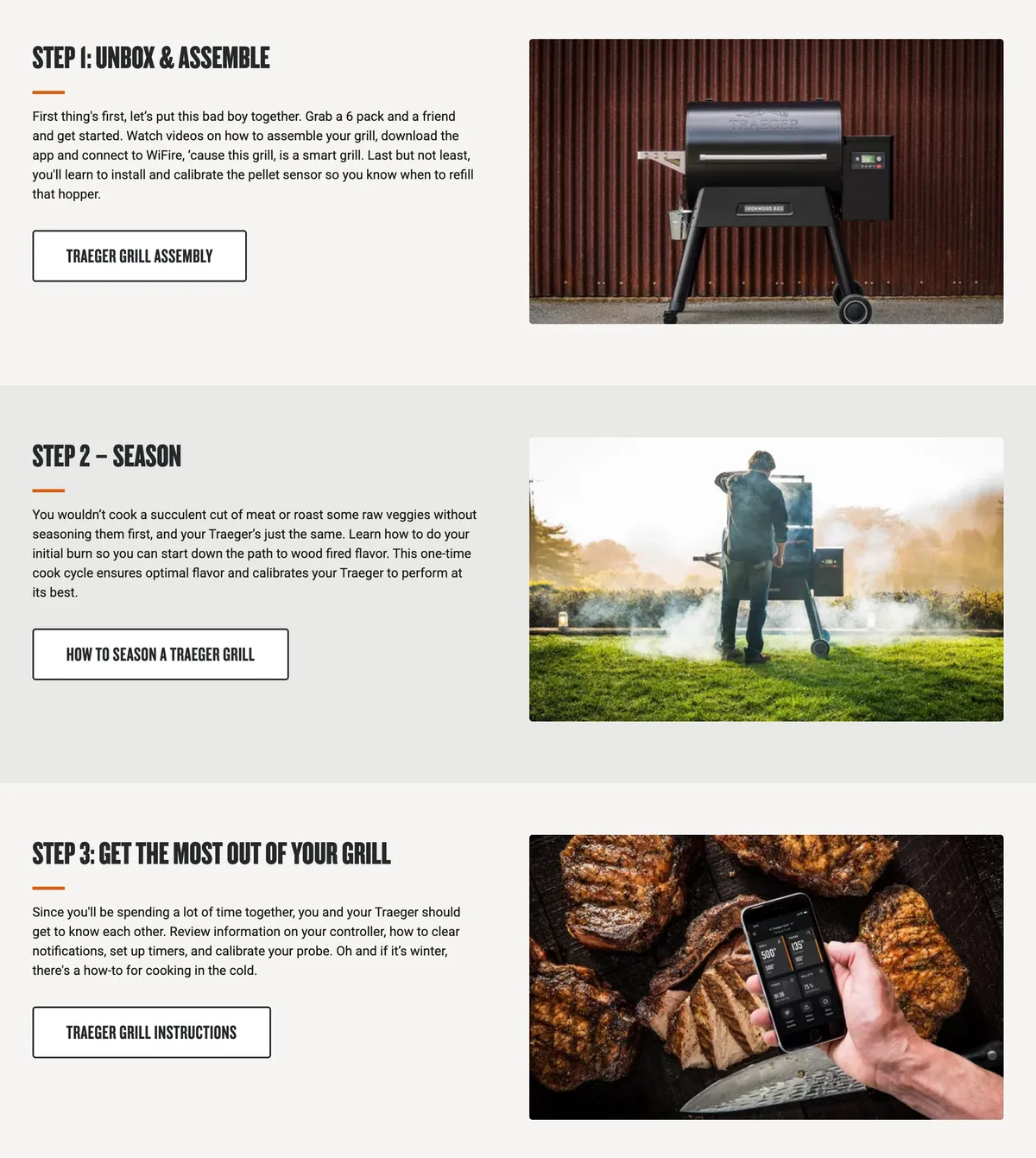
It should help the customer get a good first result: setup, care, how much to use and how long it lasts. For a product with a learning curve, link to the getting-started content you already have. Traeger's getting-started page is a good model of what a first-use email can point to:
Hold off on review requests and second-order pitches here, because someone who hasn't used the product yet can't judge it.
Illustrative example: first-use email for a coffee brand
Subject: Getting the most from your first bag
Start with 15 grams of coffee to 250 ml of water, and if it tastes bitter, grind a little coarser next time. Keep the bag sealed and away from light. A 340-gram bag makes about 22 cups, so we'll check in around the time it runs low.
4. The gift buyer's follow-up
The gift buyer's follow-up goes by email once the parcel is delivered and before December 25. It should make the buyer look good: confirm the gift arrived, share a gift receipt they can tuck in the box and explain how the recipient can exchange it without involving them.
After that, hand the buyer back to your regular program with the gift tag attached. The next message that fits them might be the next gifting occasion, or a simple question in January about whether they'd like something for themselves. Leave out refill reminders and how-to content for a product they aren't using.
Illustrative example: gift buyer email
Subject: Your gift has arrived
Your order was delivered on December 3, so it's ready to wrap. Here's a gift receipt to print or forward: the recipient can swap sizes or colors until January 31, and we'll handle it directly with them.
5. The gift recipient's first contact
The gift recipient is a new customer you have no way to email. You reach them through the package and through your returns flow, so those are where the first message lives: an insert card, a gift receipt or a QR code that leads to a getting-started page with an easy way to exchange.
Returns software already handles part of this. In Loop's gift returns, a recipient can start a return with the order number and shipping ZIP code, or from a gift-receipt QR code, and choose store credit or an exchange rather than a refund to the giver.
Make that page helpful in its own right, because for many recipients it's their first visit to your site.
Invite recipients to sign up for setup tips or warranty registration, and if they do, start them on their own first-use message rather than the buyer's sequence. Don't add them to marketing without asking, and don't tell the buyer what they exchanged.
Illustrative example: gift insert card
Someone thought you'd like this. Scan the code for a two-minute setup guide, or to swap the size or color by January 31. Want tips on getting the most from it? You can sign up there, too.
6. Q5: late December to mid-January
Q5 is the stretch between late December and mid-January, after the holiday peak and before normal trading resumes; Meta has published guidance on advertising in it. For retention it's a service period. Gifts get opened, exchanged and used, and gift cards get spent:
1 in 7
Holiday-season returns in 2025 that came between December 26 and 31, a period when returns rose 4.7% on the year before
47%
Consumers who'd like to receive gift cards this holiday season, still the top item on wish lists in October 2026
Send each segment the Q5 message that fits it. Gift buyers get a reminder that exchanges are open and how they work. Customers redeeming a gift card are often new to you, so treat their first order as the start of the sequence, with a first-use message after delivery.
For self-purchasers of things people use daily, such as supplements, skincare or fitness gear, the new year is a natural moment for content on building the product into a routine.
Email carries most of this, with push for app users. Save texts for real deadlines, such as an exchange window closing, and only for customers who opted in.
What Q5 shouldn't be, by default, is a sitewide sale sent to everyone. Customers who paid a Black Friday price a month earlier are the last people who should see it beaten.
Illustrative example: Q5 email to gift buyers
Subject: Wrong size? Exchanges are open until January 31
If the gift you sent doesn't fit, the recipient can swap it in a few clicks with the gift receipt, and we'll ship the new one free. There's nothing you need to do.
7. The second-order message
The second-order message goes when the product's natural cycle says the customer is ready, which for most products lands between day 30 and day 90. By day 90, most second orders have already arrived. BS&Co's February 2026 analysis of DTC repeat buyers shows how quickly they come and how the timing shifts by category:
50.3%
Second orders placed within 30 days of the first, across 40,397 repeat buyers
76.4%
Second orders placed within three months of the first
27 to 68 days
Where time to a second purchase clusters at consumable brands, against medians of 15 to 27 days in fashion and apparel
For a consumable bought on Black Friday, that puts the reorder message somewhere between late December and early February. Time it to when the product should run out, using the pack size and typical use, rather than to a fixed day.
Fashion customers come back sooner, which BS&Co says is likely driven by seasonal needs and gifting cycles. For them, a "buy again" for the item that fit, or the piece that completes it, works better than a general new-arrivals email.
Durable goods lead to accessories and the things they consume, like the pellets Traeger's sensor tells owners when to refill.
Send the email first. Follow with a text or push a few days later only to customers who opted in and haven't ordered, and stop the moment they buy, in your store, app or anywhere else. Our guide to how email, SMS and push work together covers that hand-off.
If there's still no second order around day 60, send one more message from a different angle, such as a related product, a subscription or a question about how it's going. For the discount-only segment, this is where a tested offer fits. After day 90, move anyone who hasn't reordered into your regular program.
Illustrative example: second-order email and text for a supplement brand
Subject: About a week of capsules left
The 60-capsule bottle you ordered in November should be running low around now. Reorder in one tap, or switch to a delivery every two months so you don't run out.
Text, four days later, if no order: [Brand]: Running low on [product]? Reorder in one tap: [link]
Should you keep discounting after Black Friday?
You shouldn't keep discounting Black Friday buyers by default. A customer who has just bought on discount and receives another offer weeks later learns that the sale price is the real one, and you give away margin on second orders many of them would have placed anyway.
Andrew Maff, founder of BlueTuskr, made the case on our podcast that steep BFCM discounts often backfire, and talked through what to do instead, from subscription tactics to post-purchase plays.
Tresl takes a different view for first-time Black Friday buyers who haven't come back, suggesting strong discounts by the second month. The fair test is to try it on the discount-only segment, with a random holdout that gets the same messages without the offer.
Keep the discount only if the extra second orders pay for it. Our guide to offsetting CAC with retention marketing shows how to weigh a repeat order against what it cost.
For everyone else, offer something that costs less than a percentage off:
- Help, such as setup guides, care tips and an easy exchange.
- Convenience, such as a one-tap reorder or a subscription they can skip or cancel.
- Access, such as early entry to a January launch for existing customers.
- A gift with the second order, which suits brands with a product people want to try.
- Loyalty points that make the second order worth more than the first.
Which channel should carry each message?
Email should carry most of the post-Black Friday sequence, because it reaches every buyer, costs least and has room to explain. SMS is best suited to short, time-sensitive news such as tracking, delays and reorder nudges, and only for customers who opted in.
Push is ideal for app users, where a notification can open the right screen directly. Our comparison of email, SMS and push covers costs and consent rules, and our push notification guide covers how to earn the opt-in.
Set one frequency limit across email, SMS and push. December inboxes are crowded, and a buyer who receives a campaign email, a text and a push in one day won't count them separately.
How do you know the sequence is working?
A post-Black Friday sequence is working if the buyers who receive it place second orders at a higher rate than a holdout group who don't, measured at day 60 and day 90 from the first order.
Hold out a random slice of first-time buyers from everything except order and delivery updates, and compare like with like: the same products, the same window and the same follow-up period. Watch a few other numbers alongside it:
- The discount cost per second order, for any segment that received an offer.
- Unsubscribes and spam complaints by segment, to see which messages cost you subscribers.
- The share of gift returns that become exchanges or store credit rather than refunds.
- How many gift recipients sign up from an insert or QR code.
Beyond the holdout, compare this year's Black Friday cohort with your other new customers, as our strategy guide suggests, and with last year's Black Friday cohort. Our guide to customer retention rate covers how to measure first-to-second purchase retention consistently.
Final thoughts
The weeks after Black Friday are when a discounted first order becomes a customer relationship or quietly doesn't. Most of the messages that make the difference aren't promotions at all: a clear confirmation, an honest delay notice, help getting started and a reorder reminder that arrives when the product runs out.
Build the segments before the sale, write the messages in November and let each order's progress decide what goes next. If you reach the end of Q5 having sent fewer offers and more help, you've done more to earn a second order than another discount would.
Frequently asked questions
What should you send Black Friday subscribers who didn't buy?
Subscribers who signed up over Black Friday but didn't buy belong in your welcome series, not the post-purchase sequence. Once the sale ends, introduce the brand and its best-known products at their usual prices rather than extending the deal.
If they haven't opened or clicked anything after a couple of months, stop emailing them, because inactive addresses hurt how well the rest of your list gets delivered.
Should Black Friday buyers still get your regular campaigns?
Black Friday buyers can still get your regular campaigns, but hold first-time buyers out of promotional sends until their order has arrived and the first-use message has gone. Existing customers can stay in the normal program. Keep anyone with a delayed order or an open return out of promotions until it's resolved.
When should you ask holiday buyers for a review?
Ask holiday buyers for a review once they've had time to use the product, usually one to three weeks after delivery and longer for products that take time to show results. Gift buyers can't review something they haven't used, so either skip the request or ask about the gifting experience, such as delivery and packaging, instead.
What should you send customers who return a Black Friday order?
Customers who return a Black Friday order should get a clear confirmation of their refund or exchange, followed by a pause from promotions rather than a discount to win them back. If they exchanged, treat the replacement as a new start: delivery updates, then the first-use message.
If they took a refund, one short question a few weeks later about what didn't work is often more useful than an offer. Our ecommerce returns statistics cover how much comes back after the holidays.
Does the same sequence work after other big sales?
Most of the sequence works after any big sale, because the confirmation, delivery updates, first-use message and second-order message follow the order rather than the date. The gift buyer and recipient steps and the Q5 follow-up are specific to the holidays, so drop them after a summer or anniversary sale.
Keep the gift steps for gifting occasions such as Mother's Day and Father's Day. Whatever the sale, move anyone who hasn't reordered by day 90 into your regular email program, including win-back.