
Shopify's themes and apps take a store a long way on their own. But a replatform, a custom subscription flow, a wholesale store or an ERP connection needs Shopify experts who build on the platform every day.
The store an agency builds decides how fast your pages load, how easily your team can change them and how well the features your repeat customers use, such as accounts, loyalty and subscriptions, actually work.
We've rounded up the best Shopify development companies for growing brands below. All of them currently hold Shopify's Platinum partner tier, and between them they cover everything from on-demand fixes to full enterprise replatforms.
For each agency you'll find what it builds, who it suits, what it publishes about price and a client result from its case studies. After the list, we cover Shopify's new partner tiers for 2027, what an agency costs and how to choose one.
What are the best Shopify development companies?
The best Shopify development companies for growing brands include Arctic Grey, Ask Phill, Diff, Domaine and Swanky, all of them Shopify Platinum partners with a decade or more on the platform.
These agencies all design, build and migrate Shopify stores, and most stay on after launch, but they suit different brands. Only two publish their prices, so for the rest a quote starts with a scoping call.
| Agency | Based in | Published pricing (November 2026) | Best for |
|---|---|---|---|
| Arctic Grey | New York | $179.99 to $220 an hour | Ongoing development help without a long project |
| Ask Phill | Amsterdam | From €20,000 for a theme migration | European fashion, lifestyle and beauty brands moving to Shopify Plus |
| Diff | Montreal | On request | Stores tied to an ERP, OMS or custom subscription system |
| Domaine | New York | On request | Mid-market and enterprise migrations from another platform |
| Swanky | Exeter, UK | On request | Subscription brands that want a build and growth support |
| Process Creative | Sydney | On request | Design-led brands, especially in Australia |
| Absolute Web | Miami | On request | Development and marketing from one agency |
1. Arctic Grey
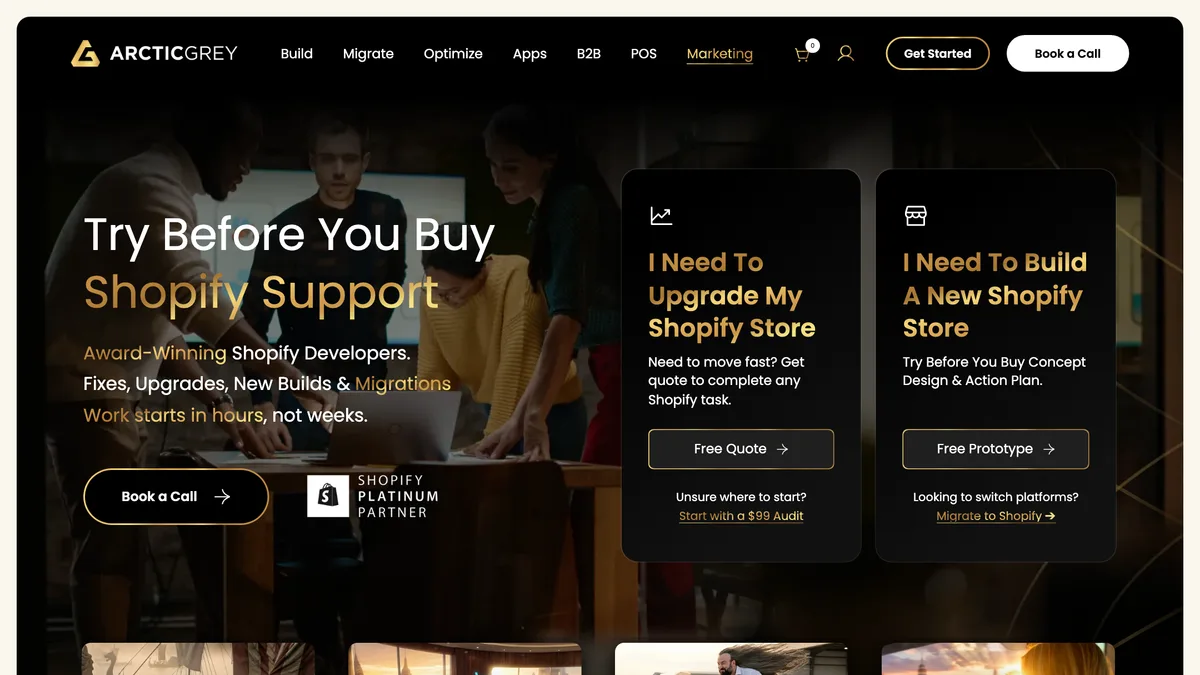
Arctic Grey is a New York-based Shopify Plus agency that builds new stores, migrates brands from other platforms and takes on smaller jobs such as fixes, theme changes and speed work. The agency says it has supported more than 1,000 Shopify stores across DTC, B2B, wholesale and point of sale.
It's easy to start small with Arctic Grey. You can buy development by the hour, and for a new store it offers a free concept design and action plan first.
For EBY, the subscription underwear brand co-founded by Sofia Vergara, Arctic Grey moved more than 70,000 monthly subscribers from Magento to Shopify and Recharge. Arctic Grey's case study credits the new store with an 86% increase in conversions and a 46% uptick in returning customers.
- Pricing: builds and migrations quoted on request; Bulk Hours cost $220 an hour as a one-off purchase, or $179.99 an hour on a subscription, as of November 2026
- Shopify Partner Directory: Platinum, a partner since 2013, with an estimated team of 11 to 50
- Best for: Shopify brands that want ongoing development help, or a low-risk way to try an agency before a full build
2. Ask Phill

Ask Phill is an Amsterdam agency that builds and migrates Shopify Plus stores for European fashion, lifestyle and beauty brands. The agency says it has launched more than 200 Shopify stores, and it's now part of Happy Horizon.
Most of its work moves brands from Salesforce Commerce Cloud, Magento or Centra onto Shopify Plus, as B2C and B2B stores on custom Liquid themes or headless Hydrogen builds. Clients include Patta, OBEY and American Eagle Europe.
The menswear brand Shaping New Tomorrow had Ask Phill rework navigation and cross-selling on its Shopify Plus store as it grew into new markets. Ask Phill's Yotpo reviews integration alone led to a 29% rise in sales from frequent customers and an 18% increase in repeat customer engagement, the agency reports.
- Pricing: published on its own site, from €20,000 for a no-code or theme migration as of November 2026
- Shopify Partner Directory: Platinum, a partner since 2016, with an estimated team of 51 to 200
- Best for: European fashion, lifestyle and beauty brands replatforming to Shopify Plus
3. Diff

Diff is a Montreal agency that has been a Shopify partner since 2011 and is now part of WPP Enterprise Solutions.
Diff is strongest on the systems behind a store. Its case studies center on ERP, order management and subscription systems for brands such as PopSockets, Sakara Life and Boll & Branch.
For Boll & Branch, Diff built a NetSuite ERP integration with eight custom APIs that keep data in sync and route orders to fulfillment centers or made-to-order factories. The bedding brand earns over $116 million a year on Shopify alone, according to Diff's case study.
- Pricing: quoted on request
- Shopify Partner Directory: Platinum, listed as WPP Enterprise Solutions, with an estimated team of 51 to 200
- Best for: brands whose Shopify store has to work with an ERP, OMS or custom subscription system
4. Domaine
Domaine describes itself as the world's largest independent Shopify design and development partner. The New York agency says it has launched more than 750 Shopify sites and has over 300 full-time staff.
The agency specializes in large migrations to Shopify from platforms such as Salesforce Commerce Cloud and Magento, for brands including Timex, Arhaus and Laura Mercier. Its Domaine Studio division works with emerging and mid-market brands.
When Domaine moved Creed's UK and European store from Magento to Shopify, it put all of the fragrance house's localized stores on a single theme. Domaine's case study puts the rise in returning customers at 17% in the US and 19% in the UK.
- Pricing: quoted on request
- Shopify Partner Directory: Platinum, a partner since 2014, with an estimated team of more than 200; Domaine Studio has its own Platinum listing
- Best for: mid-market and enterprise brands migrating from another platform, particularly in fashion, beauty and home
5. Swanky
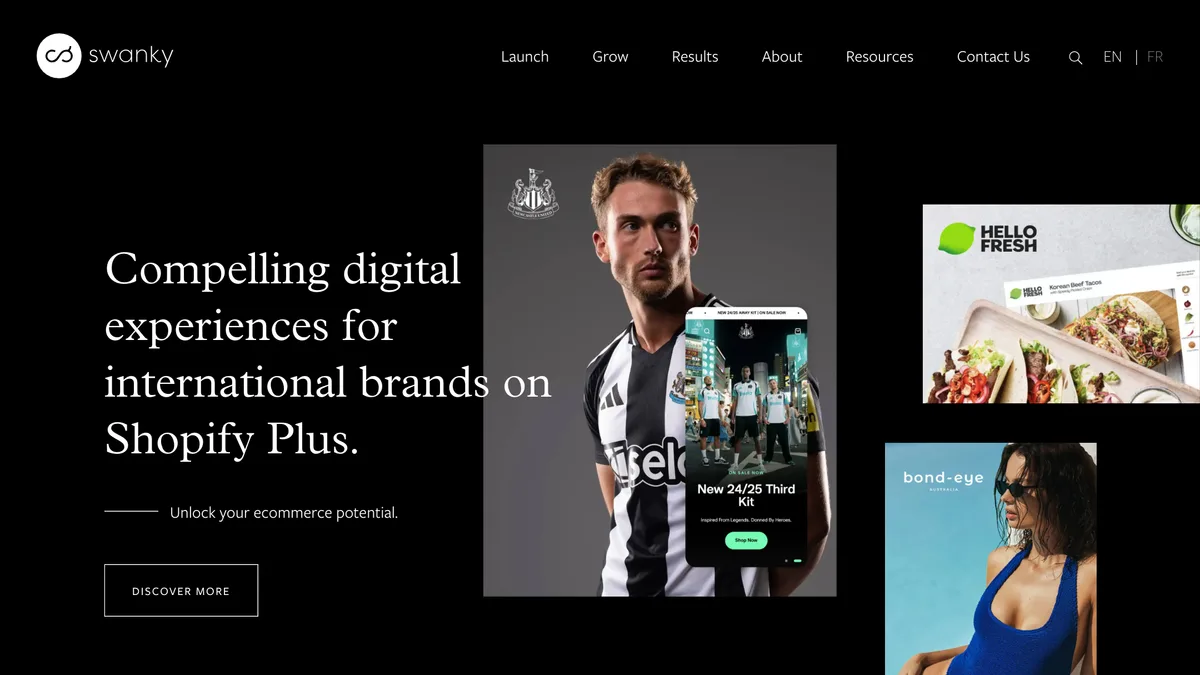
Swanky is a Shopify Plus agency based in Exeter, in the UK, with teams in Australia and France. The agency helps brands replatform to Shopify, then supports their growth with conversion testing, analytics, email, paid media and SEO.
Subscriptions run through much of its work, from HelloFresh's launch in Japan to FutureYou Cambridge's move to Shopify and Recharge.
Swanky launched a standalone Shopify Plus store for the pet supplement brand YuMOVE in 2020. Over the next three years, it ran more than 80 A/B tests, many aimed at moving shoppers from one-time purchases to subscriptions. Subscriber numbers grew by more than 1,000% in that time, its case study says.
- Pricing: quoted on request
- Shopify Partner Directory: Platinum, a partner since 2011, with an estimated team of 51 to 200
- Best for: subscription brands that want a build and long-term growth support from one team
6. Process Creative
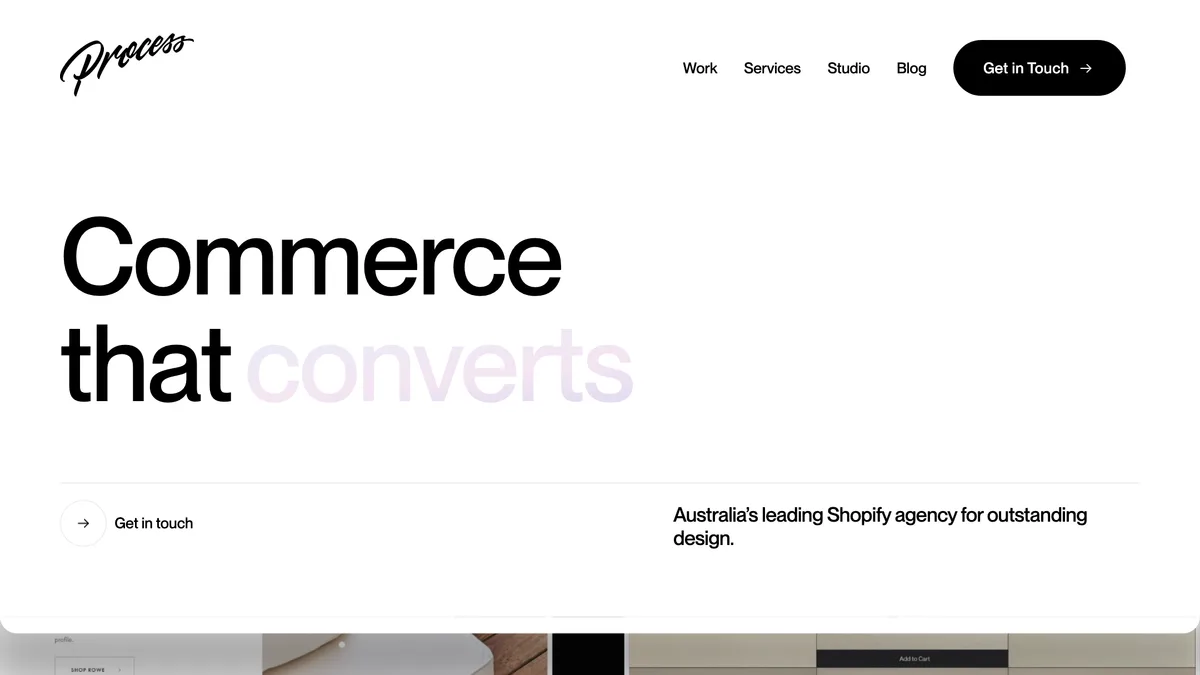
Process Creative is a Sydney agency that calls itself Australia's leading Shopify agency for outstanding design. The agency splits its work into design, build and growth, and its site says it has completed 204 builds.
Design leads its projects, and its clients include lifestyle, beauty and fashion brands such as Bondi Sands, Rollie and Ninja Kitchen.
Process moved the baby apparel brand Snuggle Hunny from Neto to Shopify Plus, adding its Snuggle Rewards program, a gift registry and a separate B2B store. The project page lists 30% year-over-year sales growth among the results.
- Pricing: quoted on request
- Shopify Partner Directory: Platinum, listed as Process, a partner since 2012, with an estimated team of 11 to 50
- Best for: design-led brands, especially in Australia, that want the store to carry the brand
7. Absolute Web
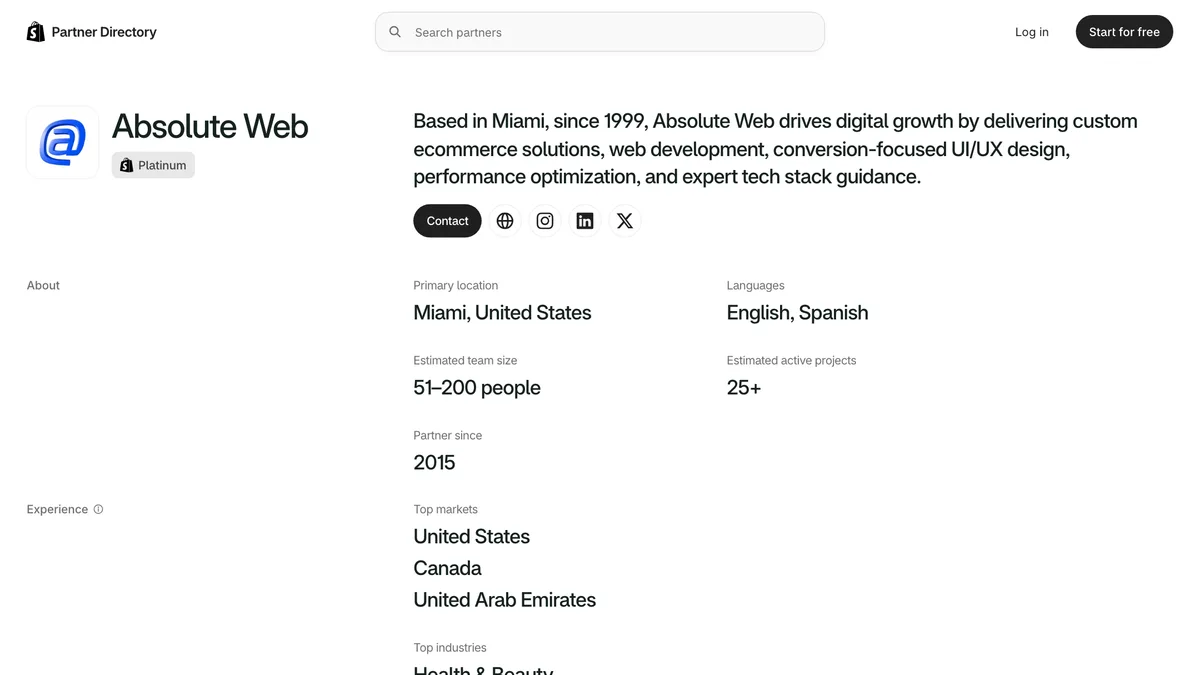
Absolute Web is a Miami agency, founded in 1999, that builds on Shopify as well as Adobe Commerce and BigCommerce. Alongside development and UX design, it runs SEO, paid media, email and SMS and conversion testing.
Many of its Shopify clients are health and beauty brands, including Summer Fridays, Glo Skin Beauty, Swanson Vitamins and Lashify.
For Four Sigmatic, Absolute Web moved the store from a headless frontend to Shopify's native one to cut operating costs and speed up releases. The case study also describes a Rebuy smart cart that lets shoppers switch one-time purchases to subscriptions.
- Pricing: quoted on request
- Shopify Partner Directory: Platinum, a partner since 2015, with an estimated team of 51 to 200
- Best for: brands that want development, conversion testing and marketing from one agency
What a Shopify development company does
A Shopify development company designs, builds and maintains Shopify stores, from theme customization to custom apps, integrations and full migrations from another platform. The larger agencies also handle strategy, UX research and post-launch work such as conversion testing.
Most projects fall into a few types:
- Store builds and redesigns, on a customized Shopify theme or a custom one built from scratch
- Migrations from Magento, Salesforce Commerce Cloud, BigCommerce or a custom platform
- Integrations with ERP, order management, warehouse, subscription and loyalty systems
- Custom apps and headless builds for features a theme can't handle
- Ongoing development, from fixes and speed work to A/B testing
For brands that rely on repeat purchases, the build matters as much as the design. Customer accounts, subscriptions, loyalty programs and site speed all depend on how the store and its apps are put together.
A migration also has to carry customer data and active subscriptions across without disrupting them, and most of that work runs through apps. A good agency knows the Shopify Plus apps your stack depends on as well as it knows Shopify.
How Shopify's partner tiers change in 2027
Shopify's partner tiers change on January 1, 2027. From that date, Shopify ranks agencies as Silver, Gold, Platinum or Diamond partners by the sales and number of stores it credits to them, according to its Help Center. The Select, Plus and Premier tiers retire on the same day.
Until January 1, the current Select, Plus, Premier and Platinum tiers stay in place, with Platinum at the top, and every agency in this guide is Platinum.
Each tier sets a minimum for sales and a minimum for stores, and an agency has to meet both. An agency's attributed shops are the stores it launched or transferred to a merchant, on any Shopify plan. Its attributed GMV is the total sales of those stores, net of refunds.
| Tier from January 1, 2027 | Minimum sales (attributed GMV) | Minimum stores (attributed shops) | Measured over |
|---|---|---|---|
| Silver | $25,000 | 1 | 1 year |
| Gold | $5 million | 5 | 4 years |
| Platinum | $50 million | 20 | 4 years |
| Diamond | $500 million | 25 | 4 years |
So from 2027, a Platinum agency will have launched or transferred at least 20 stores that sold $50 million or more between them over four years. The tier counts volume only, so it says nothing about the quality of the work or whether the agency suits a store your size.
On January 1, 2027, every partner moves to the tier its results earn, which might be higher, lower or the same as today. It then keeps that tier for at least six months. Check each agency's Partner Directory profile in 2027 to see where it landed.
From 2027, an agency also needs at least the Silver tier to be eligible for the directory. Partners on the starting Registered tier, which has no minimums, won't be listed.
How much does a Shopify development company cost?
Only one agency in this guide publishes what a store build costs, so for the others a quote comes after a scoping call. As of November 2026, Ask Phill's site puts no-code or theme migrations at €20,000 to €60,000, mid-market custom theme builds at €50,000 to €200,000 and custom enterprise work at €200,000 or more.
A published range is a guide, not a quote, because the final number depends on scope:
- How much is custom, from a customized theme to a custom design or a separate headless frontend
- What you're migrating: products, customers, order history and active subscriptions, from one store or several
- Integrations with an ERP, OMS, 3PL or custom middleware
- How many countries, languages and expansion stores you sell through
- Whether you need B2B features, such as wholesale pricing and company accounts
Agencies usually price ongoing work separately from the build. Arctic Grey sells development by the hour, for example, while Swanky and Absolute Web run growth work after launch. Ask for both the build quote and the cost of a typical month afterward.
Should you hire an agency, a freelancer or an in-house developer?
A Shopify agency is the best fit for a new build, a migration or anything that needs design, development and project management together. A freelancer suits smaller, well-defined jobs, and an in-house developer suits a steady stream of changes to a store you'll keep.
| Shopify agency | Freelance developer | In-house developer | |
|---|---|---|---|
| Best for | Builds, migrations and complex integrations | Fixes, theme changes and single features | Frequent changes to an established store |
| How you pay | A project fee, then hourly blocks or a retainer | An hourly or project rate | A salary and benefits |
| Strengths | Strategy, design, development and testing from one team | Lower cost and direct contact with the person doing the work | Knows your store, products and customers day to day |
| Watch out for | Minimum project sizes, and senior people who only appear in the pitch | One person's availability, and gaps in design or testing | One hire can't cover every skill a large project needs |
Plenty of brands combine them: an agency for the build or replatform, then an in-house developer or a freelancer for day-to-day changes.
A smaller project doesn't need a Platinum agency, either. Shopify says small and medium-sized businesses typically choose its Select partners. Select retires on January 1, 2027, and from then on the tiers below Platinum are Silver and Gold.
How to choose a Shopify development company
The right Shopify development company is one that has built stores like yours, at your size, and can introduce you to the people who'll work on yours. Start with what you need built, then narrow the list by fit, evidence and terms.
Questions to ask before you hire
Ask every Shopify agency on your shortlist the same questions, so you can compare the answers:
- Who will design and build the store, and who supports it after launch?
- Will you customize an existing theme or build a custom one, and can our team edit pages without a developer?
- Which features will use apps, and which need custom code?
- How will you move customer accounts, order history and active subscriptions, and how will you test them?
- How do you test speed, accessibility and checkout before launch?
- What does support cost after launch, and how quickly do you respond?
The answers show who will do the work, what you'll own and what the store will cost to run.
How to judge an agency's case studies
A Shopify agency's case study is most useful when it says what the agency built and gives the result a period or a baseline. Many published results have neither, including most of those in this guide, such as Arctic Grey's 86% rise in conversions for EBY. Ask the agency for the period and the baseline.
Look for brands like yours in size, category and the platform they moved from, and check what the agency actually did: a theme, a migration, an integration or months of testing. Then ask to speak to a client.
The Partner Directory can back up a client list. Some profiles show featured clients, and Shopify has verified each one's relationship with the agency. Absolute Web's profile lists Summer Fridays and Glo Skin Beauty, for example.
Red flags to watch for
The warning signs in a Shopify development proposal are usually about scope and ownership:
- A fixed quote before the agency has seen your apps, integrations and data
- A launch date with no time set aside for testing
- No plan for redirects, or for moving customer accounts and subscriptions
- Custom code for features a well-supported app already handles
- Your store, domain or app accounts set up in the agency's name instead of yours
- No written terms for support after launch
Each of these signs points to a project planned before the agency understands your store, or to one that would be hard to take elsewhere later.
Final thoughts
The agency you hire builds the store your repeat customers come back to, and its choices about speed, accounts and subscriptions stay with you long after launch. So choose an agency for its fit with your store rather than for its tier badge.
For help without a long project, Arctic Grey's hourly blocks are the easiest way in. A European fashion or beauty brand moving to Shopify Plus should start with Ask Phill, and a larger brand leaving Salesforce Commerce Cloud or Magento should talk to Domaine.
If your project hinges on an ERP connection or a custom subscription setup, Diff is the closest match. Subscription brands that want the same team testing after launch should look at Swanky. Process Creative suits a design-led brand, especially in Australia, while Absolute Web suits one that wants marketing and development together.
Whatever tier an agency holds in 2027, ask to see stores like yours before you sign.
Frequently asked questions
Can a Shopify development company build a headless store?
Most Shopify development companies can build a headless store, where a custom frontend sits on top of Shopify's backend. Ask Phill builds headless storefronts on Shopify's Hydrogen framework, and Arctic Grey offers migrations to Hydrogen.
Headless adds cost and upkeep, so it's best suited to needs a theme can't meet. Ask Phill says a production-grade Hydrogen storefront starts at €200,000 and recommends a custom Liquid theme unless the brief requires headless.
Who owns the store and the code after an agency builds it?
Your brand should own the Shopify store, the domain and every app account, with the agency working through a collaborator account. Shopify lets store owners add collaborator accounts for Shopify Partners and limit which sections of the store they can access.
Custom theme code and apps are a contract question, so agree in writing who owns them.
What's the difference between a Shopify development company and a marketing agency?
A Shopify development company builds and changes the store itself, while a marketing agency brings customers to it through ads, email, SEO and social media. Some agencies do both, such as Swanky and Absolute Web.
If you need traffic and campaigns more than a new store, an ecommerce growth agency is the better place to start.
How do you find a Shopify developer in the Partner Directory?
You can find a Shopify developer in the Shopify Partner Directory by browsing a service, such as store building or migrations. Then filter by tier, location, language, years as a partner, markets and industry. Each profile shows the partner's tier, main services, top markets and industries, years on Shopify and estimated team size.