
Hiring an agency usually starts with a problem your current team can't give enough time or expertise to. You might need better results from paid media, a store that converts more of its traffic or a stronger plan for bringing customers back.
Finding the right partner means understanding which of those problems matters most. Agencies can use similar language to describe very different services, and a good fit for one brand may be a poor fit for another.
The five agencies below offer different kinds of ecommerce support. Here's what each focuses on and when it may make sense to include it in your shortlist.
Which ecommerce growth agencies are worth considering?
Common Thread Collective is a useful starting point for brands looking to connect growth planning with financial performance. Tinuiti has a broad media and commerce offering, while Groove Commerce and Fuel Made combine store improvements with marketing services. Power Digital brings multiple marketing disciplines and measurement capabilities together.
| Agency | Main strengths | Consider it when you need |
|---|---|---|
| Common Thread Collective | DTC growth planning, forecasting and execution | A clearer connection between marketing decisions and business performance |
| Tinuiti | Performance media, retail media and measurement | Support across DTC, marketplaces and a wider media mix |
| Groove Commerce | Ecommerce development, B2B and marketing | Technical store work and marketing under one roof |
| Power Digital | Growth marketing, creative and data analysis | Several marketing channels managed through a coordinated plan |
| Fuel Made | Shopify, conversion optimization and Klaviyo | Better store performance and customer retention |
A closer look at the five agencies
The service model matters as much as the list of capabilities. As you compare these agencies, consider how their work would connect with the people and systems already running your business.
1. Common Thread Collective
Common Thread Collective specializes in connecting ecommerce growth with the financial performance of the business. Forecasting, marketing execution and creative planning form part of the same approach, with revenue and cost data used to guide decisions.
Its Prophit Engine offering puts an operator at the center of that work. The operator owns the forecast and daily execution, supported by the agency's technology and specialist team. The model is intended to give a brand a clear person responsible for translating the plan into action and responding when performance moves off course.
That focus is useful when your team has plenty of advertising reports but less clarity about what it can afford to spend or how marketing supports the wider growth target. Creative requirements and budget decisions can then be considered in the context of the same business plan.
CTC is worth a conversation if you need that connection between planning and execution. Ask how its approach would account for your margins, inventory and returning-customer revenue to understand how the model would work for your brand.
2. Tinuiti
Tinuiti brings a broad media and commerce offering to brands selling across several channels. Its services span paid search and social, Amazon, retail media, streaming, audio and display, supported by creative, conversion optimization, email and SMS.
The commerce work is especially relevant if your products sell through your own store and other retailers. A customer may discover you in one place and buy in another, so channel decisions benefit from a view of the whole relationship. Tinuiti's range gives brands access to specialists across those different buying environments.
Measurement is another substantial part of the offering. Its capabilities include incrementality testing and media mix modeling, which can help investigate whether marketing is generating additional demand and how different investments contribute to results.
That makes Tinuiti a candidate when a growing media mix has become difficult to coordinate through separate partners. The engagement is likely to be most useful when you need both execution across channels and a clearer basis for deciding where the next portion of your budget should go.
3. Groove Commerce
Groove Commerce combines the technical work of building an ecommerce store with the marketing needed to grow it. Design and development sit alongside SEO, paid media, email and SMS, while its B2B practice addresses the requirements of businesses moving wholesale and other business purchasing online.
The development services include migrations, custom themes, integrations and improvements to existing sites. That combination is useful when a marketing problem is partly a storefront problem. Your campaigns may need a better buying experience, or your plans may depend on a platform that can support more complex customer and operational needs.
Groove's published portfolio includes BigCommerce work for the US Open Shop and Dippin' Dots, giving merchants a place to explore how it approaches established retail businesses. Those examples are especially relevant if you're considering a redesign or migration alongside ongoing marketing.
For a store owner, the attraction is having development and marketing expertise available within the same agency. It can make sense when the team responsible for bringing people to your store also needs a practical route to improving what they find there.
4. Power Digital
Power Digital offers a broad set of growth marketing services, including paid media, SEO, content, influencer marketing, email and SMS, and conversion optimization. Creative production and data capabilities support that work, giving brands several disciplines they can bring into one engagement.
The breadth is useful when a growth opportunity crosses departmental boundaries. A product launch might need a clear message, new creative, a suitable landing page and follow-up for interested customers. Having those capabilities together creates the possibility of planning the whole journey around the same audience and offer.
Power Digital also provides marketing measurement, incrementality work, marketing mix modeling and data infrastructure services. That adds a way to examine how the activity contributes to performance and whether the information behind your decisions is reliable.
It's worth considering when your brand needs a coordinated marketing program with creative and analytical support. A focused scope still matters: understanding which specialists will work on your account helps you judge whether the agency's range translates into the specific capacity your team needs.
5. Fuel Made
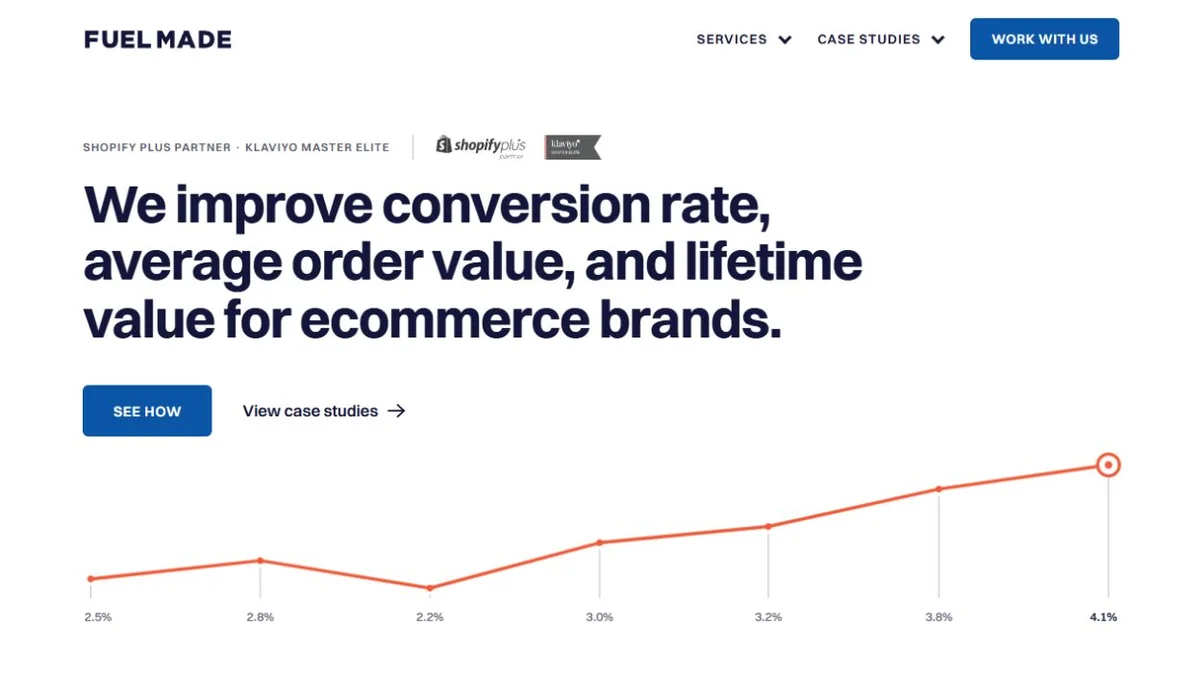
Fuel Made concentrates on Shopify stores and Klaviyo marketing, with services across design, development and conversion optimization. Its web work includes strategy, user experience and custom Shopify development; its marketing work covers email and SMS automation, segmentation and personalization.
That combination makes it particularly relevant when you want more value from the customers and traffic you already have. A clearer product page can support the first order, while a better welcome sequence or more relevant follow-up can help continue the relationship. The store and messaging work can be planned with the same customer journey in mind.
Fuel Made also offers audits, analysis and ongoing A/B testing, giving brands a way to investigate and improve specific parts of the buying experience. Its published projects include both Shopify redesigns and Klaviyo flow improvements, reflecting those two areas of focus.
For a Shopify brand that needs implementation help as well as recommendations, that specialization is appealing. It gives you a partner focused on the storefront and lifecycle marketing tools your team uses, with the technical and creative skills to make changes within them.
How to choose the right agency for your brand
Once you have a shortlist, the most useful conversations are about your business. A good proposal should make sense in the context of your customers, products, team and economics.
Start with the problem you need help solving
“We want to grow” leaves too much room for interpretation. You may need more first-time buyers, better conversion from existing traffic or a stronger contribution from returning customers. Those needs call for different kinds of work.
If the problem is repeat purchasing, for example, look beyond the number of emails an agency promises to send. The discussion should include your product's buying cycle, the customer experience and how the team would measure customer retention.
Understand who will do the work
An agency's sales presentation doesn't tell you how the relationship will run. Meet the people responsible for strategy and execution, and ask how they would work with your internal team.
It helps to discuss an ordinary week: who identifies a problem, who approves a change, who produces the assets and who implements it. Those details reveal whether the engagement adds capacity in the places you need it.
Compare the full scope and cost
Agency fees can cover very different things. One proposal may include creative production and implementation; another may assume your team will provide both.
Compare the work included alongside media spend, software costs and any internal resources you'll need. You should also understand the contract term, ownership of accounts and assets, and what happens when the engagement ends. A clear agreement makes it easier for both sides to focus on the work.
Ask for relevant examples
A case study is more informative when the starting conditions resemble yours. Similar products, margins, purchase cycles and channel mixes make it easier to judge whether the agency understands your situation.
Ask what changed, what the agency did and what the client's team contributed. The explanation should help you see how the result happened and whether the same approach makes sense for your brand.
Final thoughts
The right ecommerce growth agency brings expertise and capacity to a problem your business needs to solve. The strongest fit comes from matching that problem with the agency's work, team and service model.
Use this list to start a focused conversation. When both sides understand the goal, the responsibilities and the economics, you have a much better foundation for a productive relationship.