
A loyalty program is simple to run when every order comes through one online store. Customers earn points at checkout, see their balance in their account and spend it on the next order.
It gets harder once those customers also buy in your stores, on your site for another country or from a second brand you own. Now the program needs one balance at the counter and at checkout. It needs rules and currencies that change by market, plus a connection to every system an order passes through.
Your marketing team still needs to change all of that without waiting on a developer. That's the job of a loyalty platform: it runs as its own engine beside your ecommerce platform, POS and email tools, and connects to each of them through pre-built connectors or an API.
We've rounded up the best loyalty platforms for mid-market ecommerce brands. You'll see what each one does and how they compare, when a Shopify app is still the better choice, how these platforms are priced and how to pick one.
What are the best loyalty platforms for ecommerce brands?
The best loyalty platforms for mid-market ecommerce brands include Antavo, Yotpo Loyalty, Open Loyalty and Talon.One.
They all cover points, tiers, referrals and rewards, and they can all run one program online and in store. Where they differ is in how they plug into your stack, whether they also run your promotions and how they charge.
Some come with ready-made connectors for Shopify, Adobe Commerce or Salesforce Commerce Cloud. Others are API-first engines that your developers connect to whatever you run. A few handle coupons and promotions in the same engine as loyalty, and only two publish their prices.
| Platform | How it connects | Starting price (November 2026) | Best for |
|---|---|---|---|
| Antavo | Connectors and API | Quote | Brands outgrowing a loyalty app that want a richer program |
| Yotpo Loyalty | Native on Shopify and BigCommerce | Free, Pro from $199/month | Shopify and BigCommerce brands with stores or several storefronts |
| Open Loyalty | API | Quote | Headless and custom stacks with developers |
| Talon.One | API and connectors | Quote | Multi-market brands that want loyalty and promotions together |
| Voucherify | API and connectors | $650/month | Loyalty and promotions together at a published price |
| Annex Cloud | Connectors and API | Quote | Retailers with several brands or regions |
| TrueLoyal | Connectors | Quote | Brands that also sell through retailers |
1. Antavo
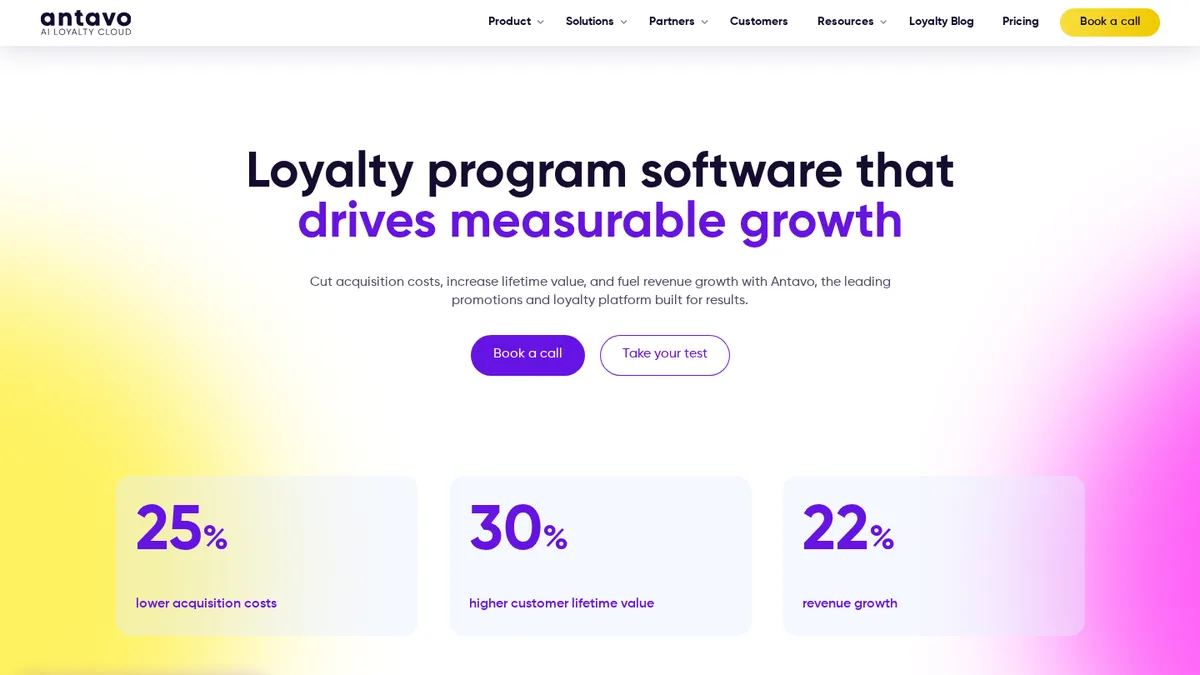
Antavo is a loyalty and promotions platform. Programs can combine points, tiers, clubs, challenges, referrals, receipt scanning and digital wallet passes.
It's API-first, with ready-made integrations for ecommerce platforms, CRMs and marketing tools. The same program runs online and in store, and members can carry their card in a mobile wallet. Tier perks don't have to be discounts: Antavo suggests free shipping and extended returns by membership status.
Connecting your store takes some technical help at the start, but Antavo is built for the marketing team to run day to day. Some of its customers went live in six weeks. Its MCP server also connects the platform to Claude, ChatGPT and other AI assistants, so your team can run the program by asking.
- Pricing: Start, Grow and Enterprise plans, priced by customer activity and quoted on request
- Works with: Shopify and Shopify Plus, Magento 2, Salesforce Commerce Cloud, Klaviyo and Bloomreach, among others
- Best for: brands outgrowing a loyalty app that want tiers, clubs and challenges their marketing team can run
2. Yotpo Loyalty
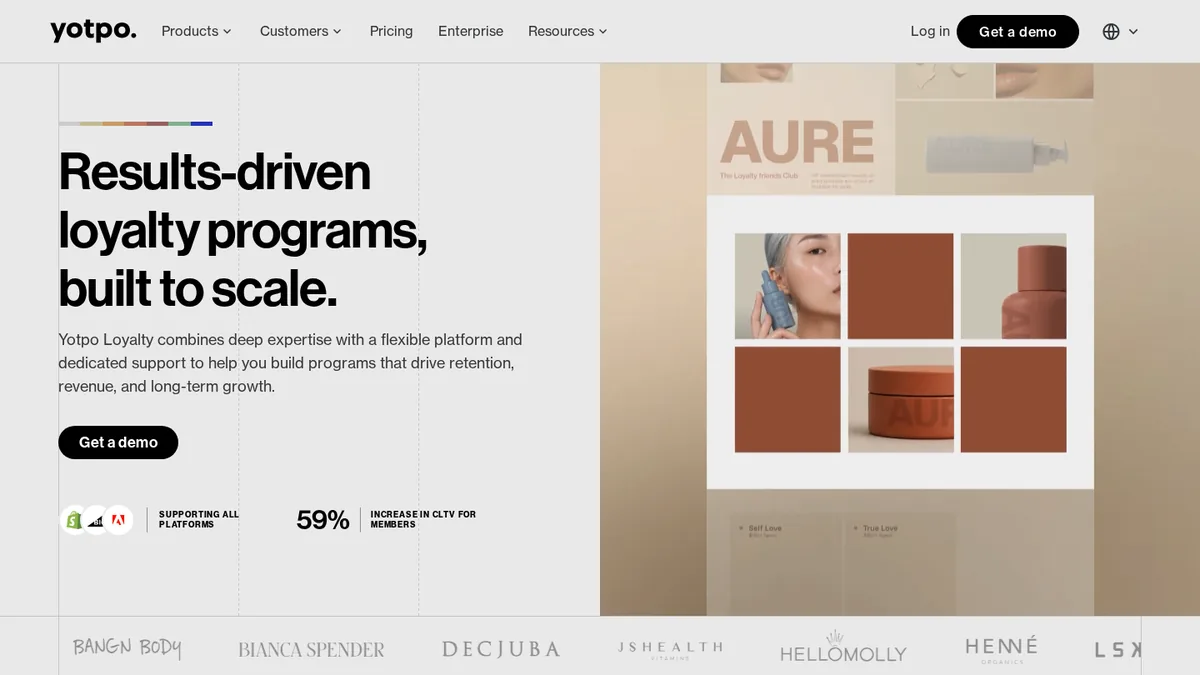
Yotpo Loyalty is the loyalty and referrals product from Yotpo, which also sells product reviews. It covers points, VIP tiers, referrals and rewards for actions such as writing a review or reaching a milestone.
Customers can earn and redeem in store, online and with a loyalty card in Apple Wallet or Google Pay. Yotpo supports several brands, stores, languages and currencies. It runs natively on Shopify, Shopify POS and BigCommerce, while Adobe Commerce, Salesforce Commerce Cloud and other platforms connect through its generic integration.
If you're moving from another program, Yotpo's team migrates the program data and keeps members' point balances. It also connects to Klaviyo, Attentive, Recharge and Gorgias.
- Pricing: free plan, then Pro from $199/month for up to 599 monthly orders, rising with volume to $599/month at 5,000 orders, with Premium and Enterprise quoted on request
- Works with: Shopify, Shopify POS and BigCommerce, plus a generic integration for other platforms
- Best for: Shopify and BigCommerce brands with stores or several storefronts, especially those already using Yotpo Reviews
3. Open Loyalty
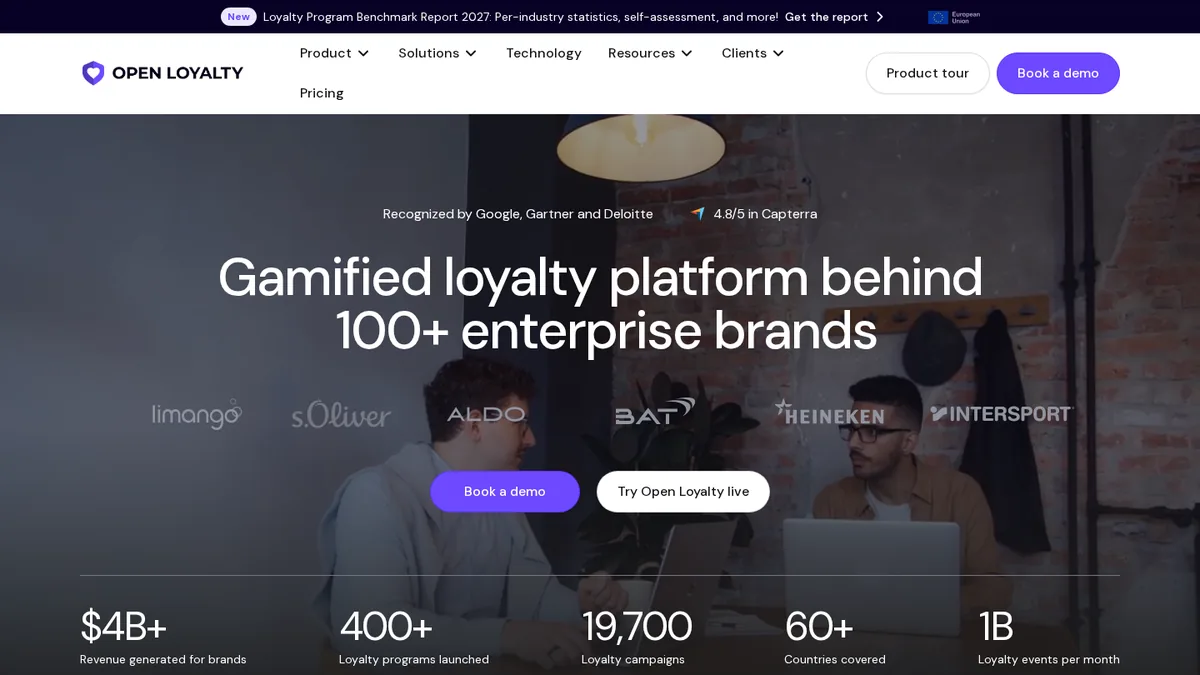
Open Loyalty is an API-first loyalty engine with a strong focus on gamification. Alongside tiers and referrals, it offers points held in several wallets per member, challenges, badges, leaderboards and games such as spin the wheel.
Your developers connect it to your ecommerce platform, CRM, POS and CDP through a REST API and webhooks, and your marketers then run campaigns from a no-code admin panel.
Open Loyalty doesn't build the screens your members see: your team or a partner builds them on its API. That fits a headless storefront, where you already own the front end.
You can host your data in Europe, APAC or North America, and try the full platform in a time-boxed test environment before you sign.
- Pricing: a one-time onboarding fee plus a platform fee, a support plan and an allowance set by monthly active members, quoted on request
- Works with: any ecommerce platform, POS or CRM, through its API and webhooks
- Best for: brands with developers and a headless or custom stack that want gamified mechanics
4. Talon.One
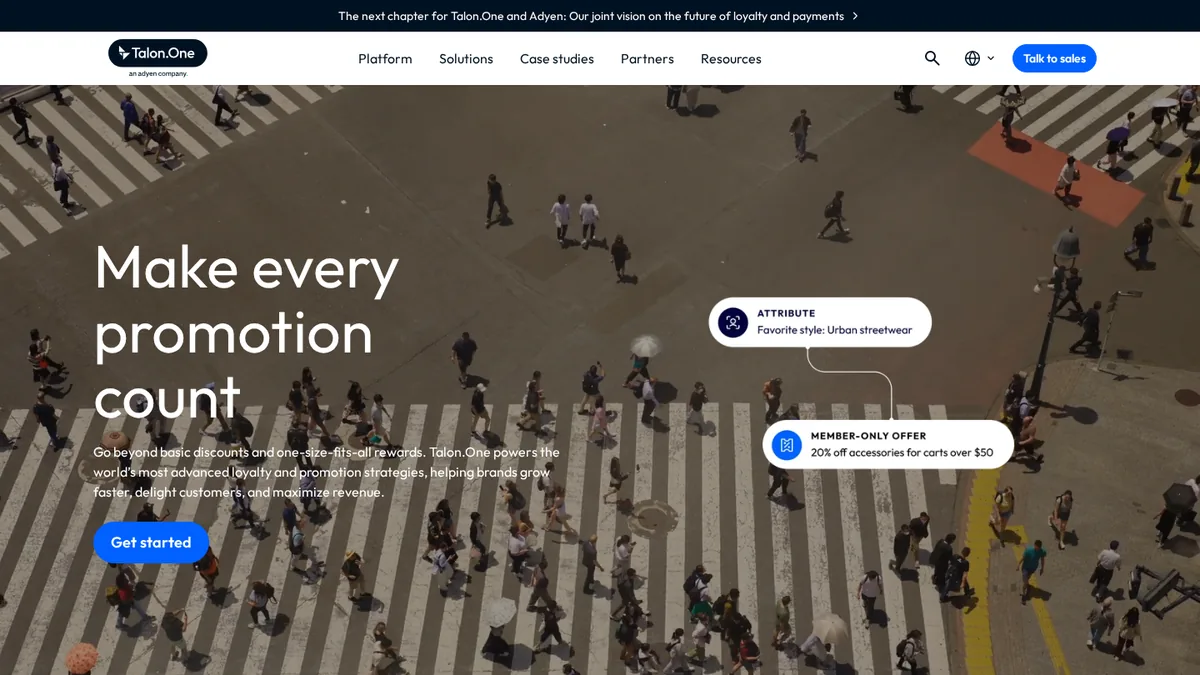
Talon.One is a loyalty and promotions engine, now part of Adyen, the payments company. It runs points, tiers, paid memberships, gamification and partner programs, along with coupons, bundles and personalized offers.
It's built for multi-market, multi-brand and multi-currency programs, with more than 170 API endpoints, including connections to store POS systems. Its integration for Shopify Plus and Shopify Enterprise runs one program across your website, app and Shopify POS. Local teams can run campaigns for their own market while head office keeps oversight.
- Pricing: Starter, Professional and Enterprise plans, priced on data volume and quoted on request
- Works with: Shopify, Salesforce, Braze, Iterable, Segment, Oracle Retail Xstore and NewStore, among others
- Best for: brands selling in several markets that want loyalty and promotions in one engine, with technical resources to set it up
5. Voucherify
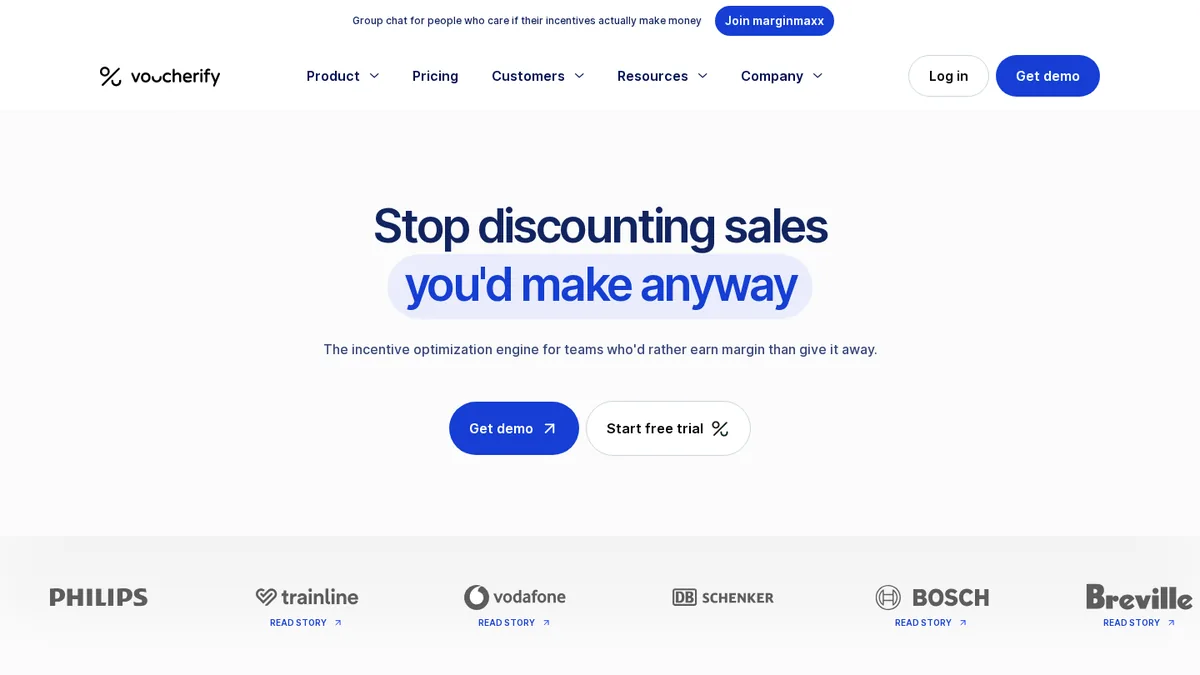
Voucherify is an API-first incentive engine that runs coupons, promotions, gift cards and loyalty in one place. Its pitch is spending less on discounts for sales you'd have made anyway.
One loyalty program can hold several point currencies and let a household pool its points. You can set tiers by points earned, spend or number of actions. It works at the POS as well as online.
Each project has its own currency and time zone, which makes it straightforward to split markets. Its AI agent, Vincent, analyzes your loyalty data to show which earning rules drive repeat purchases and which tiers underperform.
- Pricing: Business $650/month for 25,000 API calls and three projects, Organization $1,300/month for 50,000 calls and five projects, plus custom Enterprise plans, all with a 60-day free trial and unlimited users and campaigns
- Works with: Shopify, commercetools, BigCommerce, Adobe Commerce, Klaviyo and Braze, among others
- Best for: brands that want loyalty and promotions in one engine at a published price
6. Annex Cloud
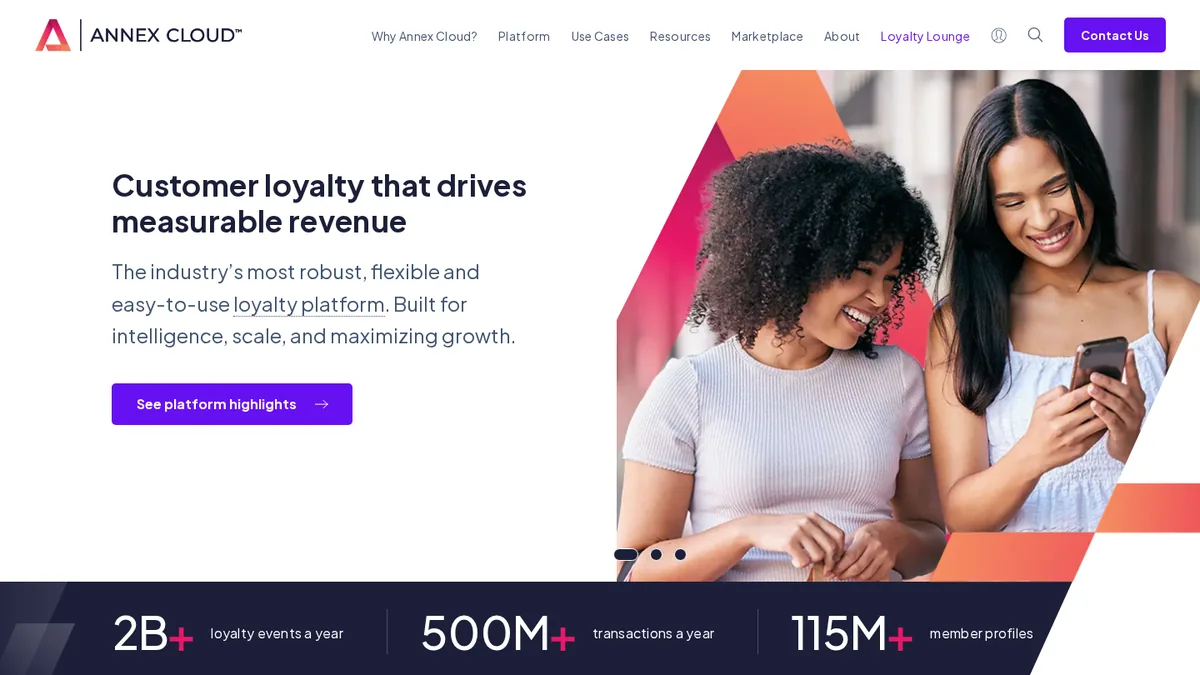
Annex Cloud is an enterprise loyalty platform covering points, tiers, paid programs, referrals, gamification and receipt scanning.
One platform runs programs across brands, regions and languages, and a template means a new market doesn't start from scratch. Members keep the same balance and tier online, in store and in your app. Marketers build and edit campaigns themselves.
Annex Cloud has more than 125 ready-made integrations, including certified extensions for Adobe Commerce and Shopify Plus, plus BigCommerce, Salesforce Commerce Cloud and Klaviyo. When you move from another platform, it brings members' points, tiers and history across.
- Pricing: quoted on request
- Works with: Adobe Commerce, Shopify Plus, BigCommerce, Salesforce Commerce Cloud and Klaviyo, among others
- Best for: retailers running several brands or regions from one program
7. TrueLoyal (formerly Zinrelo)
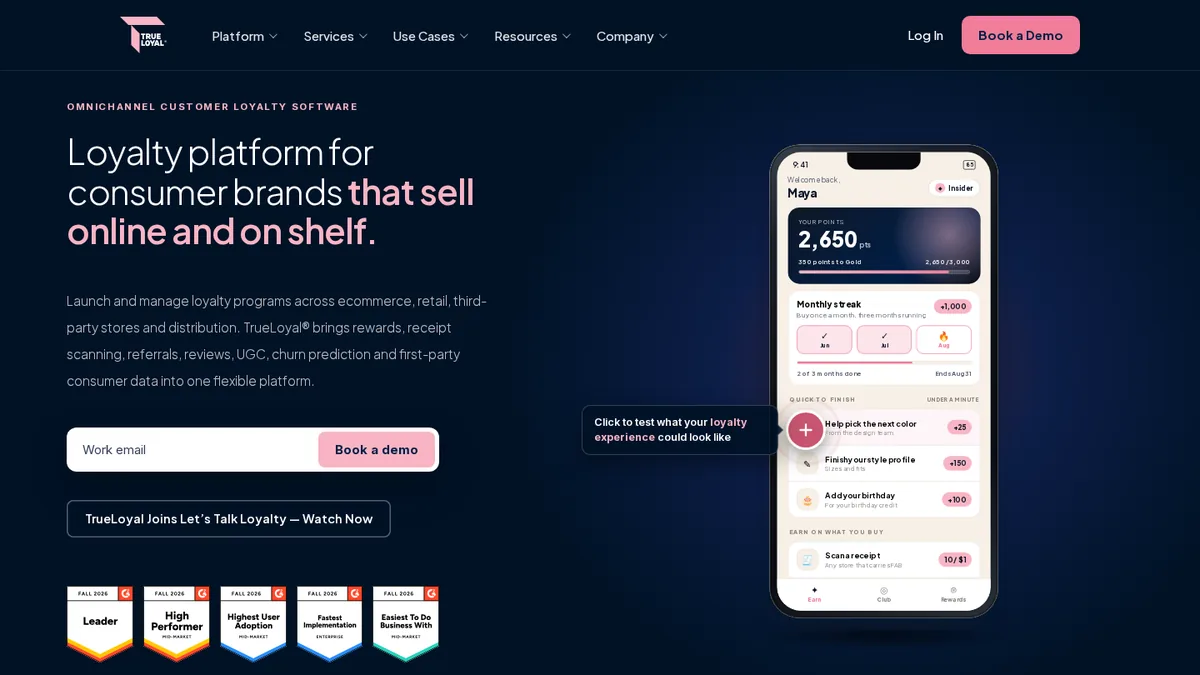
TrueLoyal is the new name for Zinrelo, which was combined with two other companies, TINT and Vesta. It's built for mid-market consumer brands that sell through retailers as well as online.
It covers rewards and tiers, referrals, reviews and user-generated content, churn prediction and receipt scanning. Receipt scanning lets customers earn points on purchases they make at a retailer, which also tells you who those buyers are.
TrueLoyal sells strategy and managed services alongside the software, up to running the program for you day to day. Most programs launch in four to eight weeks.
- Pricing: custom quote
- Works with: Shopify, BigCommerce, Magento, WooCommerce, VTEX, Salesforce, NetSuite, Klaviyo, Attentive and Lightspeed, among others
- Best for: brands that sell through retailers or distributors as well as online
When is a Shopify loyalty app enough?
A Shopify loyalty app is enough while your program runs in one Shopify store, plus Shopify POS if you have stores, and points, tiers and referrals cover what you want to reward.
Apps such as Smile, LoyaltyLion and Joy start on free plans, install from the Shopify App Store and don't need a developer. Even Open Loyalty says on its pricing page that very small programs usually fit better with a ready-made app.
A loyalty platform starts to earn its cost when your setup goes beyond one store:
- You run several storefronts or markets, each with its own currency, language or rules.
- Your stores use a POS other than Shopify POS, and members expect the same balance at the counter and at checkout.
- Your storefront is headless, or you sell on an ecommerce platform other than Shopify.
- You want loyalty and promotions to run from one engine with one set of rules.
- You want mechanics apps rarely offer, such as clubs, partner rewards or receipt scanning.
Each of those means the program has to read and update member data in more than one system, and that's where an app built for one store runs out. The balance is the hardest part, because loyalty points need to sync in real time or close to it wherever a customer can spend them.
Platforms are built for that, even at large scale. Health and wellness brand BioTechUSA moved more than a million members onto Talon.One alongside Shopify in two months, according to Talon.One. And the Otto Group's family shopping site limango runs its program on Open Loyalty for more than 8 million members in four countries.
How much does a loyalty platform cost?
Most loyalty platforms don't publish their prices. Yotpo Loyalty's Pro plan starts at $199 a month and Voucherify at $650 a month, while Antavo, Open Loyalty, Talon.One, Annex Cloud and TrueLoyal quote after a demo.
What you pay depends on a different measure at each one:
| Platform | Published price (November 2026) | What the price depends on |
|---|---|---|
| Antavo | No | Customer activity |
| Yotpo Loyalty | Free, then Pro from $199/month | Monthly orders |
| Open Loyalty | No | Monthly active members, plus onboarding and support |
| Talon.One | No | Data volume |
| Voucherify | From $650/month | API calls |
| Annex Cloud | No | Not published |
| TrueLoyal | No | Program goals, scale and integrations |
Yotpo prices the way Shopify loyalty apps do, by monthly orders. Its $199 Pro plan covers up to 599 orders a month, and the price steps up with volume until it becomes a custom quote at 6,000 orders.
Yotpo Loyalty Pro plan price by monthly orders, November 2026
Two of the quote-only platforms charge for activity rather than sign-ups. Antavo bills on customer activity, and Open Loyalty counts a member only in a month when they earn or spend points or claim a reward, so members who never come back don't add to the bill.
The subscription isn't the whole cost, though. Open Loyalty charges a one-time onboarding fee, and most platforms here need integration work at the start, from your own developers or a partner. Ask each vendor for the setup cost as well as the subscription before you compare quotes.
How to choose a loyalty platform
The right loyalty platform connects to the systems your orders already pass through, suits the people who'll run the program and charges in a way that fits how your membership will grow. A few checks narrow the list quickly:
- Design the program first. Decide how members earn points and what each one is worth, plus any tiers, clubs or paid membership, before you sit through demos.
- Map every system an order touches. List your storefronts, POS, email and SMS tools and customer data platform, then check which have a ready-made connector and which need API work.
- Decide who runs it. If marketers will change the program each week, test the admin console yourself. If developers will build the member experience, have them read the API docs.
- Price it at next year's volume. Ask for a quote at the active members, orders or API calls you expect in your busiest month.
- Check the migration. Ask how members' balances, tiers and history move across, and how long members are without the program.
- Test before you sign. Open Loyalty offers a proof of concept in a test environment and Voucherify a 60-day free trial, so ask every vendor on your list what it can offer.
Those checks should leave you with a short list. If you need a place to start it, match your setup to a row below.
| If your brand… | Start with |
|---|---|
| Runs on Shopify or BigCommerce and is adding stores or storefronts | Yotpo Loyalty |
| Wants a richer program its marketing team can run | Antavo |
| Has developers and a headless or custom stack | Open Loyalty |
| Sells in several markets and wants loyalty and promotions together | Talon.One |
| Wants loyalty and promotions together at a published price | Voucherify |
| Runs several brands or regions | Annex Cloud |
| Sells through retailers as well as online | TrueLoyal |
Final thoughts
Once a loyalty program spans stores, markets and systems, the platform behind it decides what you can offer members and how quickly you can change it. So the best choice depends more on your setup than on any feature list.
If you're on Shopify or BigCommerce and adding stores or storefronts, Yotpo Loyalty is the smallest step up, with a published price.
If you're outgrowing an app and want a richer program your marketing team can run, look at Antavo first. A brand with its own developers and a headless storefront will get the most from Open Loyalty.
If you want promotions and loyalty in one engine, Talon.One is built for global scale, while Voucherify gives you a published price and a free trial. Annex Cloud suits retailers running several brands or regions, and TrueLoyal suits brands that sell through other retailers as well as their own site.
Frequently asked questions
What's the difference between a loyalty platform and a loyalty app?
A loyalty app runs inside one ecommerce platform, such as Shopify, while a loyalty platform is a separate engine that connects to several storefronts, POS systems and marketing tools. Apps usually price by monthly orders and work out of the box.
Platforms charge by active members, usage or custom quote and take integration work, so they suit brands whose program has outgrown a single store.
Can a loyalty platform issue digital loyalty cards?
Several loyalty platforms can issue digital loyalty cards that members keep in Apple Wallet or Google Wallet. Yotpo Loyalty lets members save their tier and points balance to Apple Wallet or Google Pay, and Antavo offers mobile passes and digital wallets.
A wallet card replaces a plastic card at the counter, which matters most if you have stores.
How long does it take to launch a loyalty platform?
Launching a loyalty platform usually takes from about six weeks to a few months. Antavo says some customers went live in six weeks, and TrueLoyal says most programs launch in four to eight weeks. Programs with several markets, integrations or custom rules take longer.
Can you move to a loyalty platform without customers losing their points?
You can usually move to a loyalty platform without customers losing their points, because the platforms import members and their balances. Yotpo's team migrates program data and keeps point balances, and Annex Cloud brings points, tiers and history across. Ask how long the switch takes and tell members before it happens.
Do you need developers to run a loyalty platform?
You need developer time to set up a loyalty platform, but not always to run it. Antavo and Annex Cloud are built for marketers to manage day to day once the integrations are in place. Open Loyalty, by contrast, expects your team or a partner to build the screens members see.