
Getting customers to buy again is the real key to growth in ecommerce. But it rarely happens on its own.
It takes a follow-up that arrives while the product is still in use, rewards worth coming back for and a subscription that's easy to pause instead of cancel. When something doesn't fit, it takes an exchange instead of a refund.
No team can do all of that by hand for thousands of customers. That's where customer retention software comes in.
We've rounded up the best customer retention software for ecommerce brands, from email, SMS and mobile apps to loyalty, subscriptions, support, returns and analytics. Whichever part of retention you want to improve first, you'll find a tool for it below.
What is customer retention software?
Customer retention software is any tool that helps a business keep existing customers buying, by automating the messages, rewards, subscriptions and service that lead to another purchase.
In ecommerce it covers several kinds of tools rather than one: email and SMS platforms, mobile apps, loyalty programs, review platforms, subscription apps, helpdesks, returns software and analytics.
Search for the term and you'll also find customer success platforms built for software companies, which track account health and renewals. This guide covers tools for online stores, most of which connect directly to Shopify.
What are the best customer retention software tools for ecommerce?
The best customer retention software tools for ecommerce brands are Klaviyo, MobiLoud, Postscript, Smile.io, Okendo, Recharge, Gorgias, Loop and Lifetimely. Each covers a different part of retention, so most brands use several of them together.
Here's a quick summary of the options:
| App | Rating | Starting price | Best for |
|---|---|---|---|
| Klaviyo | 4.7 from 3,413 reviews | Free, then from $20/month | Brands that want email and SMS flows built on purchase data |
| MobiLoud | 4.7 from 124 reviews | $799/month | Brands that want a mobile app and push notifications without the cost of custom development |
| Postscript | 4.7 from 1,205 reviews | $0/month plus messages, with a $49 minimum spend | Shopify brands that want SMS priced by message rather than list size |
| Smile.io | 4.9 from 4,650 reviews | Free, then from $15/month | Brands that want a points or VIP program, starting free |
| Okendo | 4.8 from 1,444 reviews | Free, then from $19/month (Reviews) | Shopify brands that want reviews, loyalty and referrals from one vendor |
| Recharge | 4.8 from 3,146 reviews | $99/month plus 1.49% + 19¢ per transaction | Brands selling consumables, where cancellations and failed payments are the main leaks |
| Gorgias | 4.3 from 708 reviews | $10/month | Brands that want support to save subscriptions and fix orders |
| Loop | 4.6 from 449 reviews | Free (Checkout+), or from $155/month | Brands with high return volumes that want exchanges instead of refunds |
| Lifetimely | 4.9 from 577 reviews | Free, then from $49/month | Brands that want to see lifetime value and repeat behavior by cohort |
Best retention tools for email, SMS and push
Email, SMS and push notifications carry most of the messages that bring customers back, from abandoned cart reminders to win-back offers. The tools below cover each of those channels.
Our guide to how email, SMS and push notifications work together covers how to split the work between them.
1. Klaviyo
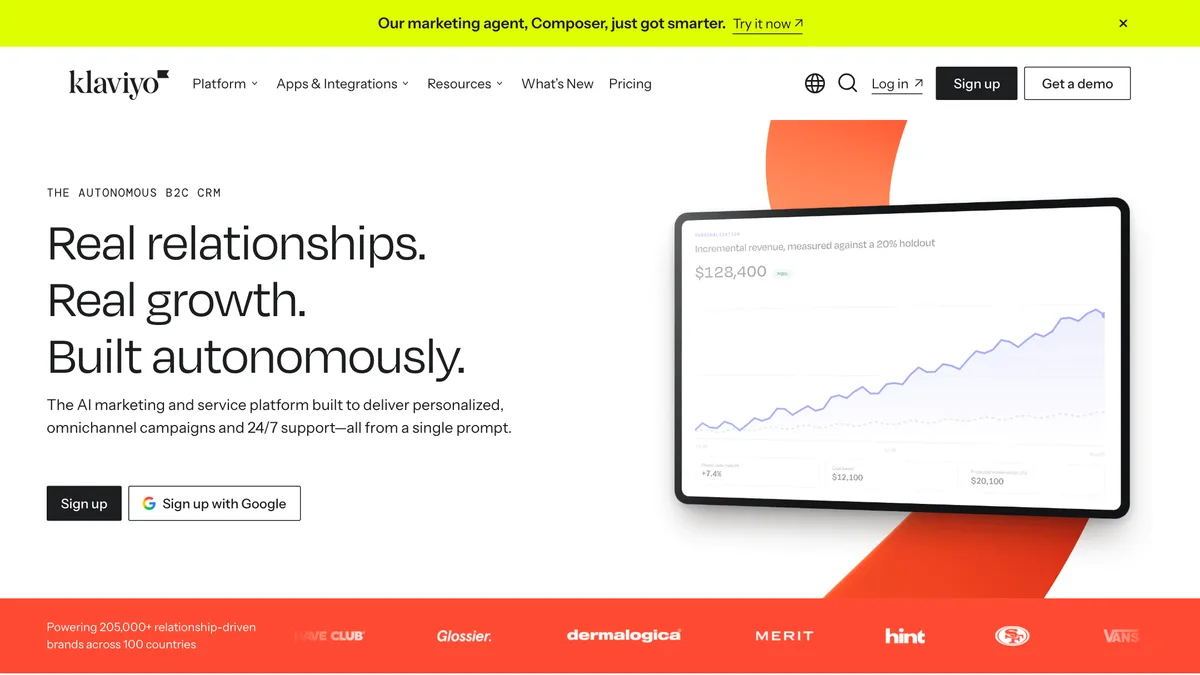
Klaviyo is an email and SMS marketing platform that uses your store's customer and order data to decide who gets which message and when. It also sends WhatsApp messages and push notifications, and now describes itself as an autonomous B2C CRM.
Its automated flows include browse and cart abandonment, back-in-stock and price-drop alerts and win-back emails. Predictive analytics, AI-built segments and personalized product recommendations shape who receives what.
Boston Proper, a DTC apparel brand with a cohort of loyal customers who buy every two to three weeks, earned 78% of its ecommerce conversions in 2025 from repeat purchasers, according to Klaviyo.
- Pricing: free up to 250 active profiles and 500 emails a month, then Email from $20 and Email + SMS from $35 a month, scaling with active profiles and sends
- Shopify App Store rating: 4.7 from 3,413 reviews
- Best for: brands that want email and SMS flows built on purchase data as the core of their retention program
2. MobiLoud
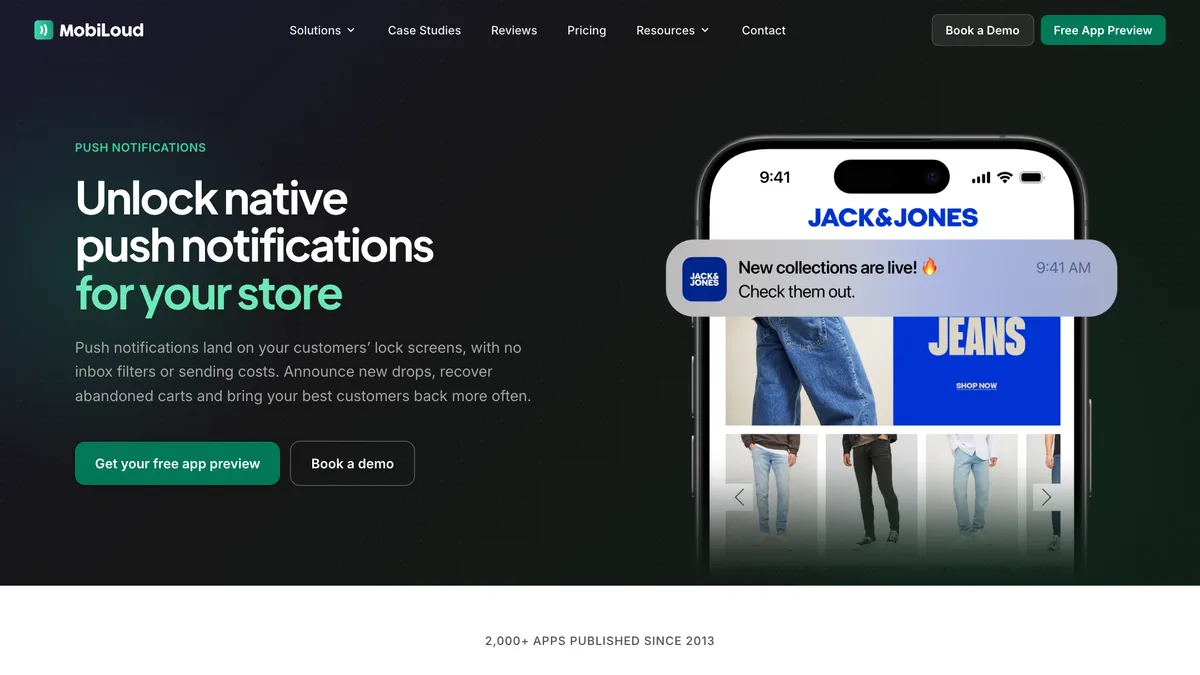
MobiLoud transforms your website into native iOS and Android apps, which gives you a retention channel you own: push notifications on your customers' lock screens, with no cost per message.
Its team builds the app from your existing site, so your checkout, loyalty program, reviews and subscriptions work in the app as they do on the web. MobiLoud also maintains the app after launch.
Push runs through OneSignal, or Klaviyo on Enterprise plans, with automated abandoned cart reminders, segments and scheduled campaigns.
Kiokii, a Canadian beauty brand on Shopify, now earns 35% of its online revenue through its app, from about 10% of its users. That's just one example of the impact that an app can have for your brand.
- Pricing: Growth $799 a month ($679 billed annually) with 5,000 monthly active users, Business $1,499 a month and custom Enterprise pricing, with no share of app revenue
- Ratings: 4.7 from 109 reviews on Capterra and 4.9 from 15 on G2
- Best for: brands built around repeat purchases, who want push notifications and an app their best customers keep on their home screen
3. Postscript
Postscript is an SMS marketing platform for Shopify brands that now sends RCS messages too, with email rolling out to brands in phases. Automated flows cover cart and browse abandonment, welcome and upsell messages, and win-back campaigns target lapsed buyers.
Its Shopper suite answers questions, recommends products and sends one-to-one texts, while segments draw on your Shopify data. Compared with Klaviyo, whose plans are tiered by active profiles, Postscript charges per message, so a large list doesn't push up your base fee.
CHOMPS, the meat snack brand, sees twice the average subscriber lifetime value from Postscript compared with its other marketing channels, according to Postscript. Our SMS marketing statistics show typical results for the channel.
- Pricing: Starter $0 a month with a $49 minimum spend, Growth $100 and Professional $500 a month, plus $0.007 to $0.009 per SMS and carrier fees, with a 30-day trial
- Shopify App Store rating: 4.7 from 1,205 reviews
- Best for: Shopify brands that want SMS as a main retention channel, priced by message rather than list size
Best retention tools for loyalty, reviews and subscriptions
Loyalty programs, reviews and subscriptions make it easier for customers to choose you again over a competitor, whether through points to spend, confidence from other buyers or an order that arrives without being placed.
4. Smile.io
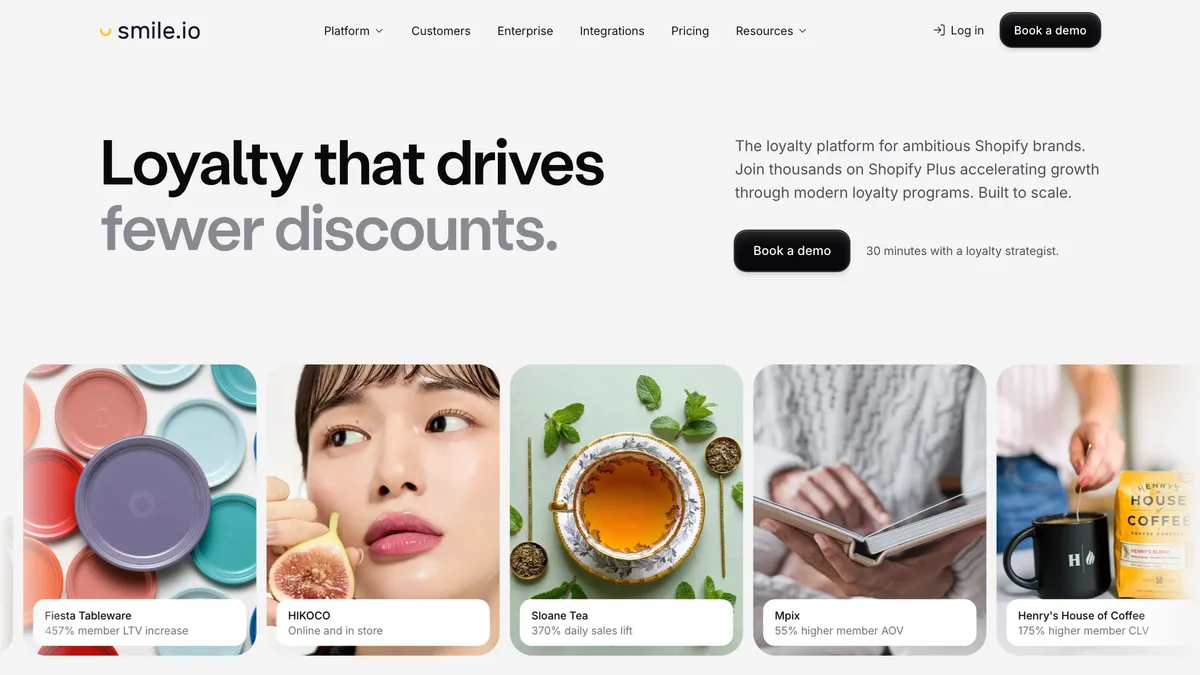
Smile.io is a loyalty app for points programs, VIP tiers and referrals. A Loyalty Hub sits inside customer accounts, on-site nudges remind shoppers of their points and Shopify Plus stores can let customers redeem points at checkout.
Points expiry, ROI and lifetime value reports and a Klaviyo integration help keep the program working after launch. Smile.io also supports Shopify POS for brands with stores, and it won a 2026 Shopify Build Award.
Applied Nutrition's loyalty members are worth 215% more in lifetime value than non-members and buy 76% more often, according to Smile.io.
Members tend to be your keenest customers to begin with, so treat comparisons like this as an upper bound. Our guide to running a Shopify loyalty program covers how to measure what yours is worth.
- Pricing: free up to 200 orders a month, then Essential $15 (500 orders), Standard $79 (1,000) and Growth $199 a month (2,500), with Smile Plus at $999 a month billed annually
- Shopify App Store rating: 4.9 from 4,650 reviews
- Best for: Shopify and BigCommerce brands that want a points or VIP program, starting free
5. Okendo
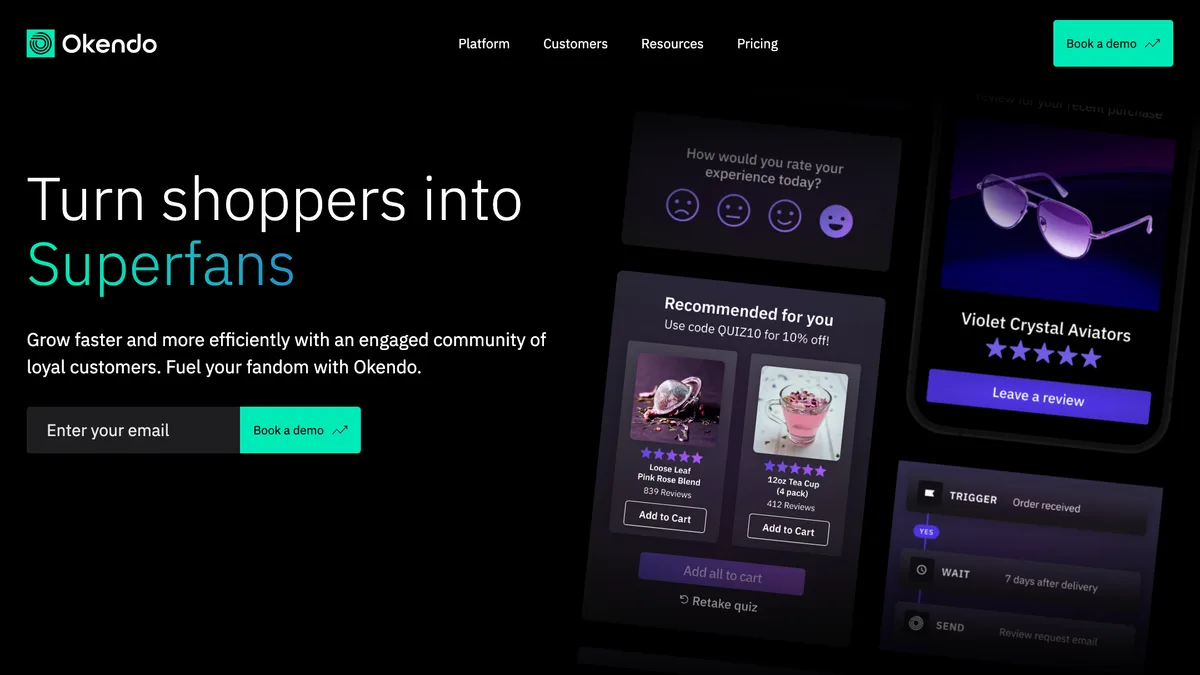
Okendo is a customer marketing platform with connected apps for reviews, loyalty, referrals, surveys and quizzes, which brands can use on their own or together.
For retention, it sends automated review requests with optional rewards and runs referral and loyalty programs with points, VIP tiers and store credit. Loyalty rewards also work on subscriptions run through Recharge, Skio, Stay and Smartrr, and points are taken back when items are returned.
At athletic brand NOBULL, 32.2% of loyalty members made a repeat purchase compared with 14.9% of non-members after its program launched in January 2025, according to Okendo.
- Pricing: Reviews free up to 50 orders a month, then Essential $19 (200 orders), Growth $119 (1,500) and Power $299 a month (3,500), with loyalty, referrals, surveys and quizzes priced separately or in bundles
- Shopify App Store rating: 4.8 from 1,444 reviews
- Best for: Shopify brands that want reviews, loyalty and referrals from one vendor
6. Recharge
Recharge is a subscription platform for Shopify that says it powers 71% of subscriptions sold on Shopify stores. It acquired rival Skio in April 2026, and both platforms continue to run.
Subscribers can skip, swap and reschedule orders in a customer portal, while cancellation prevention offers alternatives before they leave. Failed payment recovery retries declined cards, which Recharge says recovers up to 88% of failed payments.
Win-back flows target former subscribers, and the Plus plan adds loyalty rewards, referrals and SMS.
Skin prep brand POV Beauty cut churn by 54% in its first year while selling more than $1 million in subscriptions, according to Recharge.
- Pricing: Starter $99 a month plus 1.49% + 19¢ per transaction with a 60-day trial and Plus $499 a month plus 1.34% + 19¢, with custom volume pricing above that
- Shopify App Store rating: 4.8 from 3,146 reviews
- Best for: brands selling consumables such as coffee, supplements, skincare or pet food, where cancellations and failed payments are the main leaks
Best retention tools for support and returns
Support and returns decide how customers feel about a problem, and that feeling often decides whether they buy again. Good helpdesk and returns software turns those moments into saves, with a paused subscription instead of a cancellation or an exchange instead of a refund.
7. Gorgias
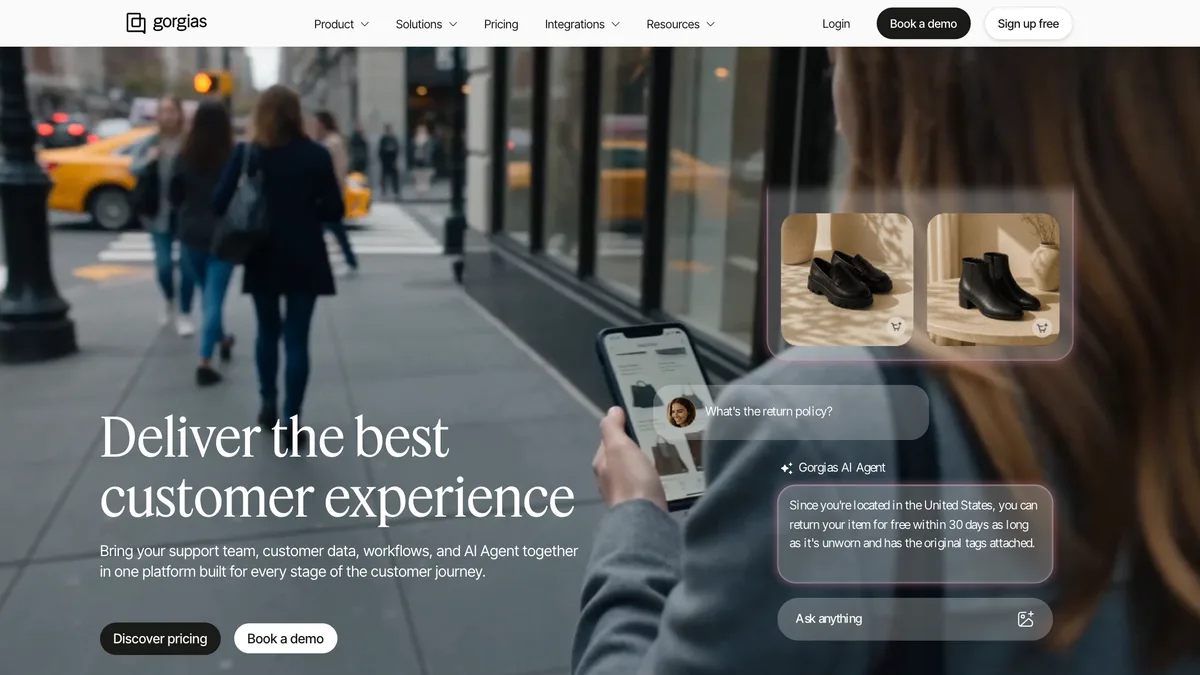
Gorgias is a helpdesk built for ecommerce that brings email, chat, SMS, social and voice conversations into one inbox, alongside each customer's order data. Agents can edit, refund or cancel orders without leaving the ticket.
Its AI Agent answers order, shipping and return questions, and Actions let it pause, skip or cancel subscriptions. That matters for retention, because a customer who writes in to cancel can be offered a pause instead. Gorgias connects with Recharge, Loop and Klaviyo.
UKLASH doubled its subscription save rate once AI Agent could take those actions, according to Gorgias.
- Pricing: Starter $10 a month (50 tickets), Basic $60 (300), Pro $360 (2,000) and Advanced $900 (5,000), plus $0.85 to $1.00 per AI Agent interaction, never priced per agent
- Shopify App Store rating: 4.3 from 708 reviews
- Best for: growing brands that want support to save subscriptions and fix orders, not just answer questions
8. Loop
Loop is a post-purchase platform for returns, exchanges, order editing and tracking. It began on Shopify and now works on other platforms too.
Instant Exchange, Shop Now and Bonus Credit encourage customers to swap an item or take store credit instead of a refund, which keeps the revenue and the customer. Workflows set different return policies by customer type.
Since September 2026, integrations with Smile.io, Yotpo and Rivo let loyalty tiers shape those policies, so a VIP can get a longer return window or an instant exchange that a first-time buyer doesn't.
At Boody, 36.4% of returned value converts to an exchange or store credit, according to Loop. Our ecommerce returns statistics show how returns affect repeat purchases.
- Pricing: Checkout+ free, Essential from $155 a month and Advanced from $340 a month
- Shopify App Store rating: 4.6 from 449 reviews
- Best for: brands with high return volumes, especially in apparel and footwear, that want to turn refunds into exchanges
Best retention tool for measuring repeat purchases
Retention analytics show which customers come back, how soon and what they're worth, so you can tell whether the other tools on this list are working.
9. Lifetimely
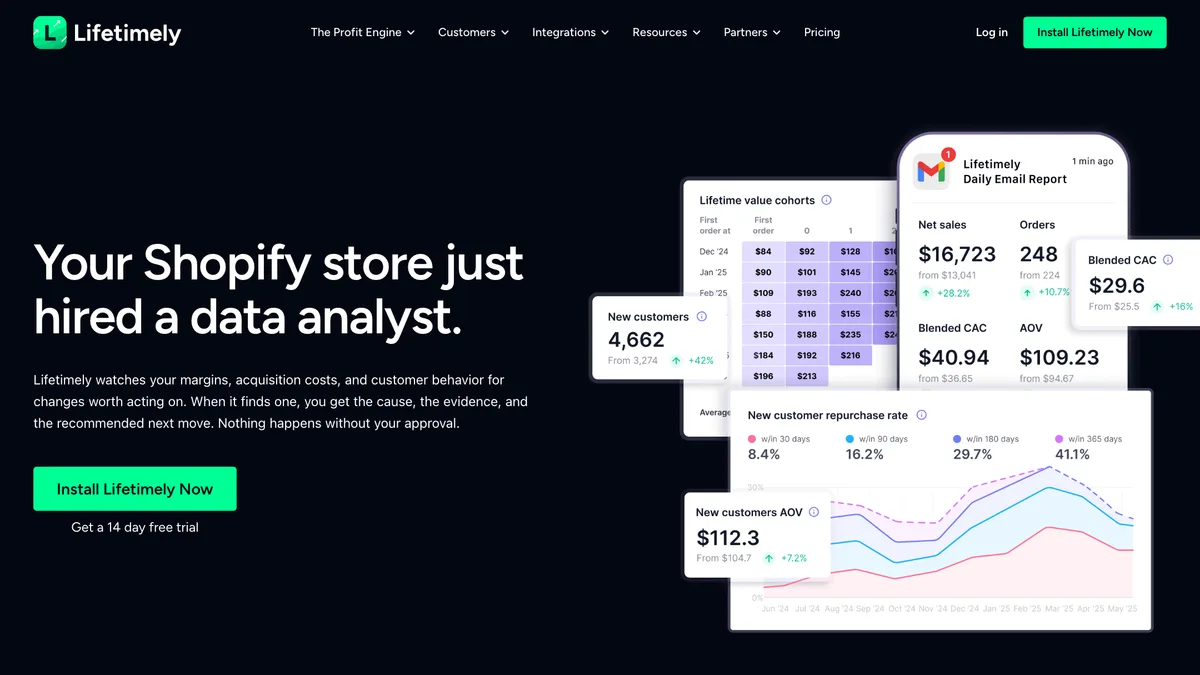
Lifetimely, part of AMP, is a profit and lifetime value analytics app for Shopify. It reports cohorts by segment and channel, actual and predicted lifetime value and how long customers take to buy again.
It can send segments based on lifetime value, churn risk and profitability to Klaviyo, so the analysis feeds straight into your messages. On paid plans, its Profit Agent recommends a next move from the data and waits for your approval before acting.
Our guide to customer lifetime value explains the metric it's built around.
- Pricing: free up to 50 orders a month, then S $49 (500 orders), M $149 (3,000) and L $299 (7,000), up to $999 a month for unlimited orders
- Shopify App Store rating: 4.9 from 577 reviews
- Best for: brands that want to see lifetime value and repeat behavior by cohort before deciding where to invest
Which customer retention software do you need first?
Most ecommerce brands need email and SMS automation first, because flows such as abandoned cart, post-purchase and win-back cover the most retention moments for the least ongoing effort. What comes next depends on what you sell and where customers drop away.
| If your main problem is… | Start with |
|---|---|
| Customers buy once and never hear from you again | Klaviyo |
| You want push notifications on your best customers' phones without paying per message | MobiLoud |
| SMS is, or should be, a main revenue channel | Postscript |
| Repeat customers get nothing for choosing you again | Smile.io or Okendo |
| Product pages lack reviews and customer photos | Okendo |
| Subscribers cancel or their payments fail | Recharge |
| Support is buried in order and subscription questions | Gorgias |
| Returns keep turning into refunds | Loop |
| You can't tell which customers or channels bring repeat buyers | Lifetimely |
Measure before and after each addition. Comparing your customer retention rate for cohorts acquired before and after a change tells you more about whether it worked than any vendor's dashboard.
Which retention tools overlap?
Several customer retention tools overlap, so decide which one handles each task before adding another. Two tools sending the same customer competing messages or rewards undo each other.
| Area | Tools that cover it | What to decide |
|---|---|---|
| SMS | Klaviyo, Postscript | Which platform sends texts, so customers don't get duplicates |
| Push notifications | MobiLoud, Klaviyo | Which tool sends app push and how it lines up with email |
| Loyalty and referrals | Smile.io, Okendo, Recharge (Plus plan) | Which program customers see and where their points live |
| Subscription saves | Recharge, Gorgias | Whether cancellations are handled in the portal, by support or both |
| Store credit | Loop, Okendo | Whether credit from returns and from loyalty is tracked together |
Overlap isn't always a problem. A specialist usually goes deeper in its own area than an all-in-one platform does, as long as each tool has a clear owner.
How much does customer retention software cost?
Most customer retention software for ecommerce starts free or under $100 a month and scales with your store, whether by contacts, orders, tickets or messages. Mobile apps and returns platforms start higher, at $799 and $155 a month for MobiLoud and Loop's paid plans.
| App | Free plan | What the price scales with |
|---|---|---|
| Klaviyo | Yes, up to 250 active profiles | Active profiles and sends |
| MobiLoud | No | Monthly active app users |
| Postscript | No, $49 minimum spend on Starter | Messages sent |
| Smile.io | Yes, up to 200 orders a month | Monthly orders |
| Okendo | Yes, Reviews up to 50 orders a month | Monthly orders and apps used |
| Recharge | No, 60-day trial | Transactions processed |
| Gorgias | No | Tickets and AI Agent interactions |
| Loop | Checkout+ only | Plan tier |
| Lifetimely | Yes, up to 50 orders a month | Monthly orders |
How a tool prices matters as much as its starting price. Profile-based pricing grows with your list even when you message it less, while per-message pricing grows with how often you send.
Ask each vendor for the cost at your expected volume a year from now.
Final thoughts
Customer retention software works best as a small set of tools that each handle one part of retention: one to send messages, one to reward loyalty, one to keep subscribers and one to show what's working.
Start with the part that loses you the most repeat customers today, and add the next tool once you can measure the first.
The tools matter less than what you do with them. A well-timed message and an easy exchange will bring back more customers than a stack of apps nobody owns.
Frequently asked questions
What's the difference between customer retention software and a CRM?
A CRM stores your customer records and history, while customer retention software acts on that data to bring customers back, through messages, rewards, subscriptions or service. The line has blurred in ecommerce: Klaviyo now calls itself a B2C CRM because its customer profiles power its own email and SMS.
Is customer retention software worth it for a small store?
Customer retention software is worth it for most small stores, because several leading tools have free plans sized for them. Klaviyo is free up to 250 active profiles, Smile.io up to 200 orders a month and Okendo Reviews and Lifetimely up to 50 orders a month.
Start with email flows, and add paid tools once repeat customers make up a meaningful share of your orders.
Do these retention tools work on platforms other than Shopify?
Several of these retention tools work beyond Shopify: Klaviyo, MobiLoud, Gorgias and Loop support other platforms, including BigCommerce and WooCommerce. Smile.io supports Shopify and BigCommerce, while Postscript, Okendo, Recharge and Lifetimely are built mainly for Shopify stores.
How do you know if retention software is working?
You know retention software is working when repeat purchase rates and lifetime value rise for customer cohorts acquired after you added it, compared with earlier cohorts.
Vendor dashboards tend to credit the tool with sales that would have happened anyway, so compare cohorts or hold back a test group. Our guide to measuring customer retention rate shows how.
Can one platform handle all of customer retention?
No single platform covers every part of ecommerce retention, though some cover several. Klaviyo handles email, SMS and push, and Okendo combines reviews, loyalty, referrals and surveys. Subscriptions, support and returns still tend to need specialist tools, which is why the overlap table above matters.