
The messages that bring customers back work best when they're built on what you know about each person: what they bought, where they bought it and how they like to hear from you.
When every tool you use reads from the same customer profile, a customer who just bought in your store doesn't get a "we miss you" email that afternoon. A subscriber of three years doesn't get a first-order discount, and your ads stop chasing people who bought yesterday.
A customer data platform (CDP) keeps that profile up to date and sends it to each tool.
We've rounded up the best CDP software for ecommerce brands. Below, you'll see what each platform does and how they compare, what they cost and how to choose between them. If you're still working out whether you need one at all, start with how a CDP differs from a CRM.
What are the best CDP platforms for ecommerce brands?
The best CDP platforms for ecommerce brands are Klaviyo's data platform, Twilio Segment, Bloomreach, Insider One, Hightouch and RudderStack.
They come in three types, and picking the type narrows the choice quickly. Klaviyo's data platform sits inside the email and SMS tool that many Shopify brands already use as their marketing CRM.
Segment, Hightouch and RudderStack are standalone CDPs that feed every tool you run, and the last two work on data in your own warehouse. Bloomreach and Insider One pair a CDP with their own marketing channels.
| Platform | Type | How it gets your Shopify data | Starting price (November 2026) | Best for |
|---|---|---|---|---|
| Klaviyo Advanced KDP | Built into your email platform | Klaviyo's Shopify integration | $500/month for 100,000 profiles | Brands already on Klaviyo |
| Twilio Segment | Standalone | Shopify app, or Littledata for server-side events | Pipeline from $120/month, CDP by quote | Brands with several data sources and no warehouse |
| Bloomreach | CDP with channels | Loomi for Shopify, through Data hub | From $60,000/year | Larger brands replacing several marketing tools |
| Insider One | CDP with channels | Shopify app | Quote | Brands that want many channels in one platform |
| Hightouch | Standalone, on your warehouse | Your warehouse, plus a Shopify destination | Free reverse ETL tier, CDP by quote | Brands with a warehouse and a data team |
| RudderStack | Standalone, on your warehouse | Shopify pixel app or custom pixel | Free, Growth from $265/month, Enterprise by quote | Data teams that want events and profiles in their warehouse |
1. Klaviyo Data Platform (Advanced KDP)
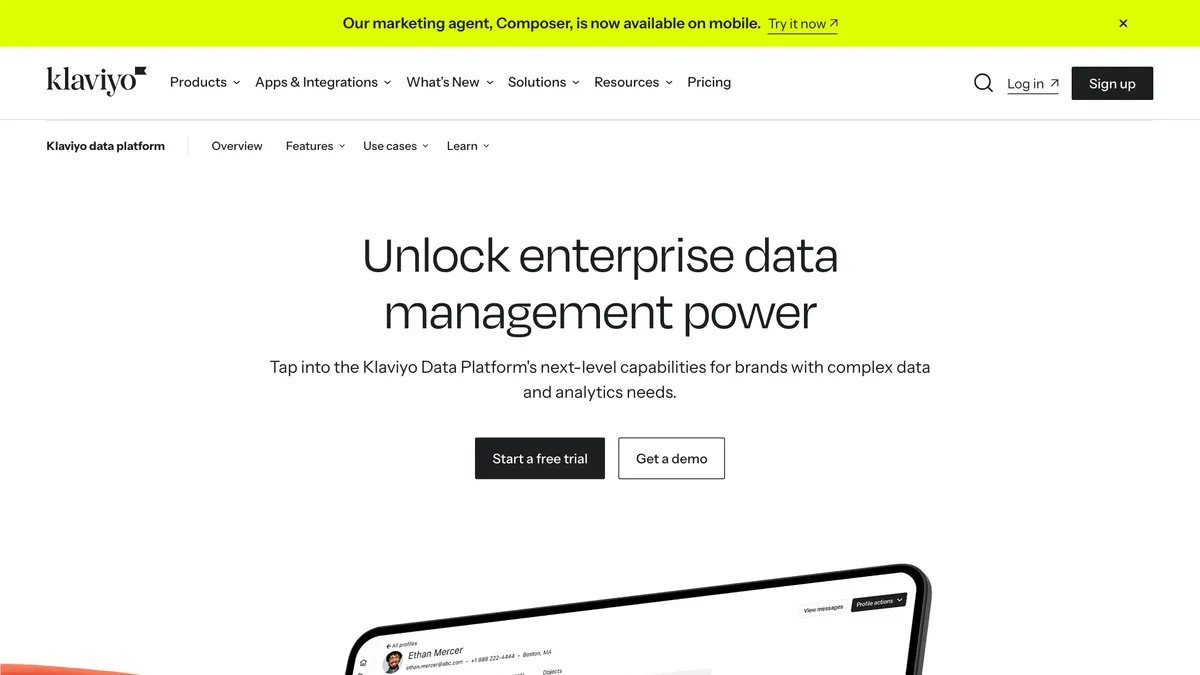
The Klaviyo Data Platform (KDP) is the customer data layer inside Klaviyo, the email, SMS and service platform. Every Klaviyo account gets the standard version, with profiles, segments, predictive analytics, integrations and data storage. Advanced KDP is the paid upgrade for brands with more complex data.
Klaviyo builds each profile from your Shopify store and their 400+ integrations. Advanced KDP automatically merges duplicate profiles caused by email typos or aliases, and adds no-code tools that clean and reformat incoming data.
It also adds custom objects, so a subscription or a household can be its own record, linked to the people in it.
Klaviyo's own email, SMS and service tools use those profiles with no extra setup. Advanced KDP also syncs data both ways with Snowflake, BigQuery and Databricks, and sends events to other tools through webhooks. Klaviyo says most of their data platform is ready to use within hours.
- Pricing: $500/month for 100,000 total profiles, rising to $4,765/month for 1 million
- Shopify connection: Klaviyo's own Shopify integration
- Best for: brands that already run their marketing on Klaviyo and need cleaner, richer profiles
2. Twilio Segment
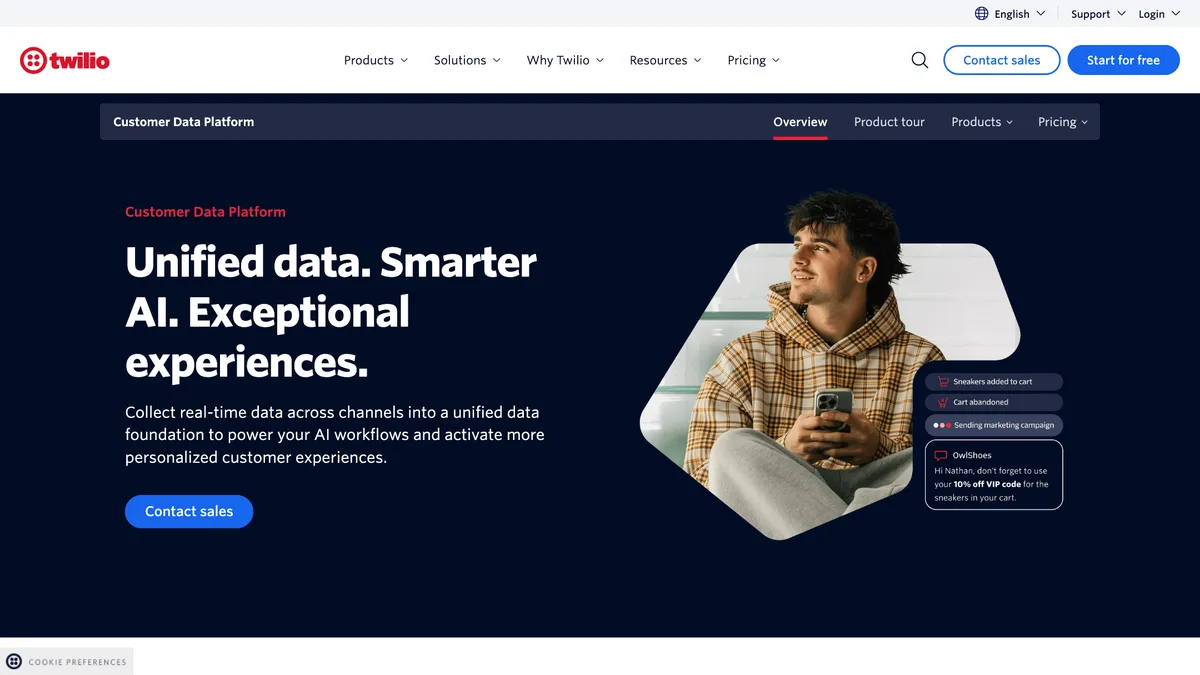
Twilio Segment is a standalone CDP used by more than 25,000 companies. Segment's data pipeline, Connections, collects events from your website, app, servers and cloud tools and sends them to 700+ apps. The full Segment CDP adds two products, Unify and Engage.
Unify builds identity-resolved profiles. It joins web, mobile, server and third-party activity into one person, including what visitors did before they logged in. Segment works with the sources you already have, so you don't need a data warehouse, though they can enrich profiles from one if you do.
Engage turns those profiles into audiences and journeys and sends them to your email platform, ad accounts and other tools. Because every source sends its own events, someone on your team needs to own the tracking plan: the list of events, their names and the data each one carries.
- Pricing: Team pipeline from $120/month, including 10,000 monthly tracked users; CDP plans quoted on monthly tracked users
- Shopify connection: a free Shopify app that sends browser events; Shopify by Littledata, a paid source, adds server-side and post-purchase events
- Best for: brands with customer data in several places, such as an app or a second storefront, and no warehouse
3. Bloomreach
Bloomreach is a commerce marketing platform built on one pool of customer data. They cover email, marketing automation across 17 channels and product search, all powered by their AI, Loomi.
Bloomreach builds a single customer view from your website, CRM, data warehouse and offline sources. On Shopify, email is the main identifier, with the Shopify customer ID and cart token as supporting ones. Loomi predicts each customer's likelihood to buy, churn or return a product.
Because Bloomreach also sends your messages, you'll use most of their profiles inside the platform. They also have more than 175 integrations, including Shopify, BigCommerce, Snowflake and Segment, and onboarding is part of every plan.
- Pricing: from $60,000 a year for smaller brands, billed annually and quoted on your audience, the products you use and volume
- Shopify connection: Loomi for Shopify, set up through Bloomreach's Data hub
- Best for: brands with hundreds of thousands of monthly visitors that want to replace several marketing tools with one
4. Insider One
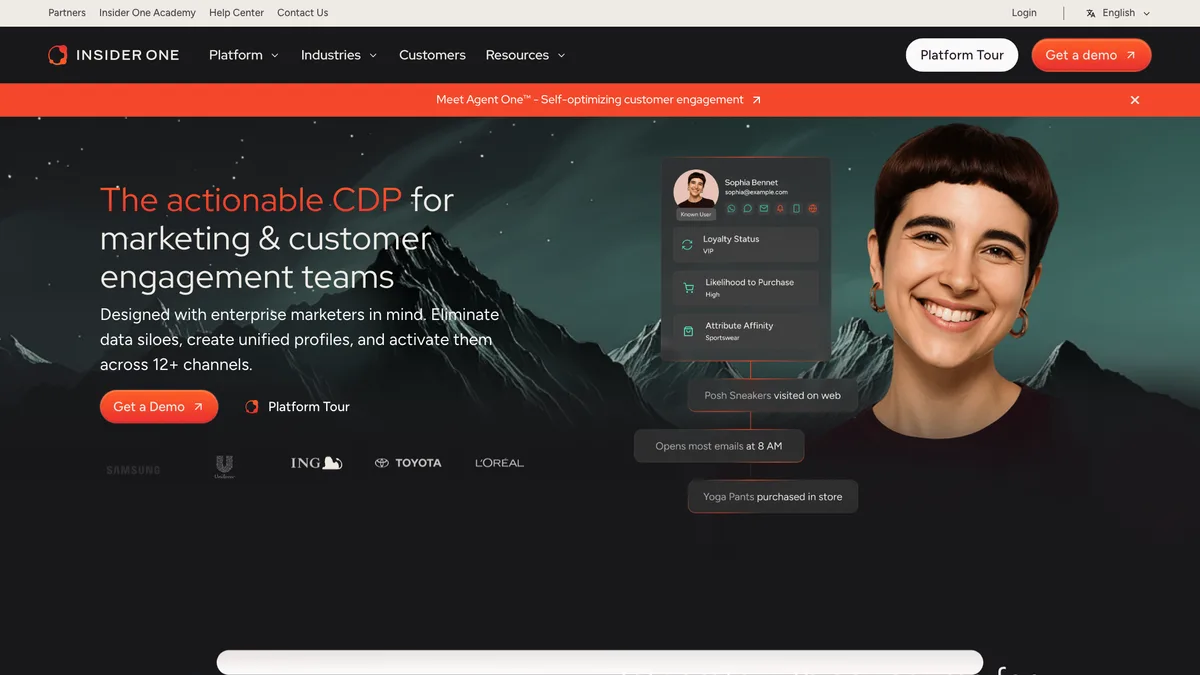
Insider One is a customer engagement platform with a built-in CDP. They run email, SMS, WhatsApp, web personalization, in-app messages, push notifications and site search from the same profiles.
Insider One takes in data through more than 100 integrations, including CRMs, analytics tools and ad platforms. They can also read from your warehouse and send data back to it. On Shopify, they identify customers by email address, phone number and Shopify ID, and they sync subscriptions and your product catalog.
Marketers build segments from more than 120 ready-made filters and triggers, then use them across every channel in the platform. Brands on Hydrogen or another custom storefront set up tracking with Insider One's team.
- Pricing: quoted by sales; the Shopify app is free to install
- Shopify connection: the Insider One app for Shopify
- Best for: brands that want their customer data and most of their channels in one platform
5. Hightouch
Hightouch is a composable CDP. Rather than keeping their own copy of your data, they work on the customer data in your warehouse, such as Snowflake, BigQuery or Databricks.
Their identity resolution stitches profiles together from everything in the warehouse, including online and offline purchases. You choose exact matching or probabilistic matching depending on the job. Marketers then build audiences in Customer Studio, a no-code builder, without writing SQL.
Hightouch sends audiences and data to 300+ tools, including ad platforms and email platforms. They can also write customers, products, discounts and inventory back to Shopify. You'll need a warehouse that already holds your customer data, plus someone who can model it.
- Pricing: free reverse ETL tier for up to two active syncs; CDP plans usage-based and quoted, with no limit on tracked users
- Shopify connection: reads Shopify data from your warehouse and writes back through a Shopify destination
- Best for: brands with a data team and a warehouse already in place
6. RudderStack
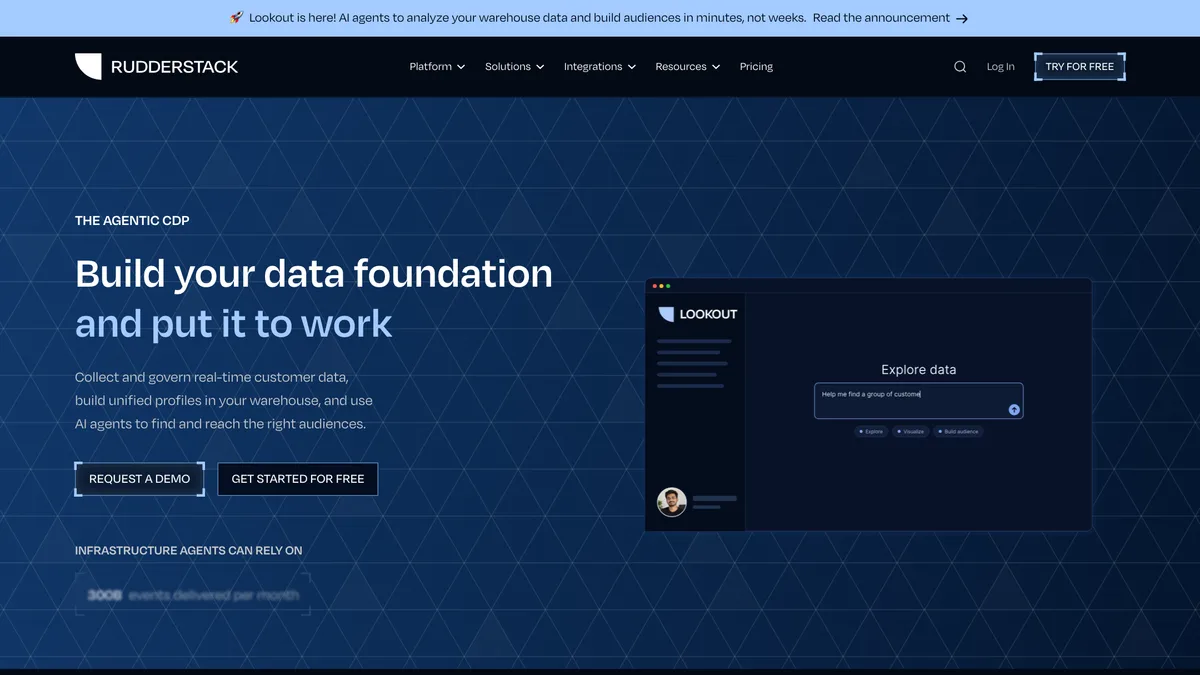
RudderStack is a CDP that keeps your customer data in your own warehouse. RudderStack Core collects events from your site, app and servers and streams them to more than 200 cloud destinations and to the warehouse.
Their Profiles feature builds an identity graph and a customer 360 table in your warehouse. Your data team writes the matching rules and customer traits as configuration files, and RudderStack turns them into SQL. Profiles is part of the Enterprise plan.
Lookout, a separate product, lets marketers build audiences from warehouse data and sync them to ad platforms, CRMs and engagement tools. RudderStack also has migration specialists for brands moving over from Segment.
- Pricing: free up to 250,000 events a month; Growth from $265/month for 1 million events; Enterprise quoted
- Shopify connection: RudderStack's Shopify Source Solution, using their pixel app or a Shopify custom pixel
- Best for: brands with a data team that want event collection and identity resolution in their own warehouse
How much does CDP software cost?
CDP software costs from about $120 a month for a data pipeline to $60,000 a year and up for an all-in-one platform. Most vendors quote their full CDP plans, so the published prices below are starting points.
$120/month
Twilio Segment Team pipeline, with 10,000 monthly tracked users (November 2026)
$265/month
RudderStack Growth, with 1 million events a month (November 2026)
$60,000/year
Bloomreach starting price for smaller brands (November 2026)
Each vendor bills on a different unit, so compare quotes at the volume you expect. Klaviyo charges by total profiles, Segment by monthly tracked users and RudderStack by events. Bloomreach prices on your audience, catalog size, the products you turn on and message volume, while Hightouch charges for usage.
Segment's Team price, for example, rises by $12 for every extra 1,000 tracked users between 10,000 and 25,000.
Klaviyo is the only full CDP here with a public price for every size. They count everyone in your account, not just the people you email, so a brand with a large list of old subscribers pays for all of them.
Klaviyo Advanced KDP monthly price by total profiles, November 2026
The subscription is rarely the whole cost. Someone has to decide what data to collect, how to match customers and which tools to connect, then keep it working as your stack changes.
Hightouch and RudderStack also need a warehouse and a person who can model the data in it, so they make most sense when you already employ one.
How to choose a CDP for your ecommerce brand
The right CDP takes in the data you're missing today, matches it to the right customers and fits the team that will run it. A few checks get you to a short list:
- List the data that lives outside Shopify and your email platform. That might be an app, retail stores, a second storefront, a subscription tool or the apps in your retention stack. Each one needs a connector on the CDP's side.
- Pick the type before the product. A data platform inside your email tool is the smallest change. A standalone CDP feeds every tool, and a CDP with channels replaces tools as well as joining them.
- Check the Shopify connection in detail. Ask whether it collects server-side or only in the browser, whether it sees post-purchase events and whether it supports a headless storefront.
- Ask how it matches customers. Find out which identifiers it uses, such as email, phone and Shopify ID, and what happens when one person has two email addresses.
- Price it at next year's volume. Get a quote on the vendor's own unit, whether that's profiles, tracked users or events, at your busiest month's numbers.
- Decide who will run it. Marketers can run Klaviyo, Bloomreach and Insider One day to day. Segment, Hightouch and RudderStack work best with someone who owns your data.
- Try it before you sign. Klaviyo, Segment and RudderStack all offer free trials, and Hightouch has a free tier.
Once you've answered those, the type of brand you are usually points to one or two platforms:
| If your brand… | Start with |
|---|---|
| Runs their marketing on Klaviyo and needs cleaner, richer profiles | Klaviyo Advanced KDP |
| Has customer data in several places and no warehouse | Twilio Segment |
| Wants to replace several marketing tools with one platform | Bloomreach or Insider One |
| Has a warehouse and a data team | Hightouch or RudderStack |
Final thoughts
The customer profile is what your retention marketing runs on. When it's split across tools or full of duplicates, customers get the wrong message, the wrong offer or the same email twice. So the CDP you choose matters less for its feature list than for how well it fits where your data already lives.
If Klaviyo is already the center of your marketing and your problem is duplicate or thin profiles, Advanced KDP is the smallest step, with a price you can see up front.
If your data comes from an app, stores or a second storefront and you don't have a warehouse, Segment collects it all and sends one profile everywhere.
Bloomreach and Insider One suit brands ready to replace their email, SMS and personalization tools with one platform, and Bloomreach's starting price points to larger brands.
If you already have a warehouse and people to run it, Hightouch and RudderStack build the profile inside that warehouse, which suits a composable stack.
Frequently asked questions
Do CDPs work with Shopify?
All the CDPs in this roundup work with Shopify, though they connect in different ways. Klaviyo and Insider One sync with the store through their own Shopify apps, and Bloomreach connects through their Data hub.
Segment and RudderStack collect store events through Shopify apps or pixels, while Hightouch reads Shopify data from your warehouse and can write back to the store.
Do you need a data warehouse to use a CDP?
You don't need a data warehouse to use most CDPs. Segment says a warehouse is optional, and Klaviyo, Bloomreach and Insider One store the data themselves. Hightouch works on the data in your warehouse, and so do RudderStack's Profiles and Lookout, so you need one for those.
What's the difference between a CDP and a customer engagement platform?
A CDP collects customer data, matches it to the right person and sends profiles to other tools, while a customer engagement platform sends the messages: email, SMS, push and on-site personalization.
Many products now do both. Bloomreach and Insider One are engagement platforms with a CDP built in, and Klaviyo's data platform sits inside their email and SMS tool.
Is a CDP worth it for a smaller brand?
A CDP is rarely worth it for a smaller brand whose customer data lives in Shopify and their email platform. Klaviyo's standard data platform already gives every account profiles, segments and predictive analytics. Even Bloomreach says they're probably not the right fit yet for a brand that's still building their audience.
Can you try a CDP before you buy?
You can try several CDPs before you buy. Klaviyo offers a 30-day free trial of Advanced KDP through their sales team, Segment a 14-day trial of their Team plan and RudderStack 30 days of their Growth plan. Hightouch has a free tier for up to two syncs, which is enough to test a connection.