Most of the marketing an ecommerce brand does is aimed at people who haven't bought yet. Ads, search, influencer posts and product launches all exist to find someone new and win their first order.
Retention marketing points the other way. It's aimed at the people who have already bought from you, and it's where the second, third and tenth orders come from. Those customers already know your products, and you can reach most of them without paying for every message.
This guide explains what retention marketing is and how it differs from the terms it's often confused with. Then it covers the channels it runs on, the programs that bring customers back, how it changes with what you sell and how to measure what it adds.
What is retention marketing?
Retention marketing is the marketing a brand aims at people who have already bought from it, to get them to buy again. It covers the messages customers get after their first order, the programs that give them a reason to return, and the offers and content inside both.
For an ecommerce brand, that usually means email and SMS flows, push notifications through an app, a loyalty or referral program and the occasional piece of direct mail. The goal is more repeat orders and a higher lifetime value from each customer, at a profit.
How retention marketing differs from customer retention, lifecycle and acquisition marketing
Retention marketing sits close to three other terms, and they're often used as if they meant the same thing. The differences matter when you decide who owns what and how to measure it.
| Term | What it covers | Who it's aimed at |
|---|---|---|
| Retention marketing | Messages, programs and offers that bring customers back | People who have already bought |
| Customer retention | Whether customers come back at all, shaped by product, delivery, service and price as well as marketing | Existing customers |
| Lifecycle marketing | Messages across the whole journey, from new subscriber to loyal customer | Subscribers and customers |
| Acquisition marketing | Paid and organic reach to win first orders | People who haven't bought yet |
Customer retention is the result, and retention marketing is one of the things that drives it. A late delivery or a disappointing product will undo the best post-purchase emails, so improving customer retention is a wider job than marketing alone.
Lifecycle marketing overlaps the most. It includes messages sent before the first order, such as a welcome series or an abandoned cart email, while retention marketing starts once someone has bought. At most brands, the same person or team runs both.
Acquisition and retention compete for the same budget, but they depend on each other. Acquisition brings in first orders, and retention decides how much each of those customers ends up being worth, so getting the balance between retention and acquisition right matters more than picking one.
Why the first 90 days after an order matter most
Most first-time buyers never place a second order, and the ones who do usually come back quickly. So the weeks after a first order are the most important stretch for retention marketing.
In BS&Co's data from the DTC brands it works with, 81% of customers never bought a second time. Bluecore's research puts the share of one-time buyers at nearly three-quarters of a retailer's customers.
The customers who do come back mostly do it fast. Of the repeat buyers in BS&Co's data, half placed their second order within 30 days of the first, and 76.4% within 90 days.
Share of repeat buyers who have placed their second order, by time since the first
Show the data
| Same day | 6.3% |
|---|---|
| 1 week | 15.9% |
| 2 weeks | 29.5% |
| 1 month | 50.3% |
| 3 months | 76.4% |
| 6 months | 87.1% |
| 1 year | 96.3% |
The second order also changes what happens next. Once someone buys twice, the likelihood they buy a third time goes up by 95%, according to Bluecore.
So the second order is where retention marketing pays off first. It's also where the cost of winning a customer starts to be earned back.
What customers buy second matters too. In BS&Co's analysis of 7,454 second purchases, 77% were a reorder of the same product. For many brands, a well-timed reminder to reorder will do more for the second order than a recommendation for something new.
Which channels does retention marketing use?
Retention marketing runs mostly on channels a brand owns, where it can reach customers without paying for each impression. Each channel suits different messages, so most brands use several together.
Email is the backbone of retention marketing for most ecommerce brands. It's cheap to send, it can carry a lot of content, and it's where most automated flows run: order follow-ups, reorder reminders, loyalty updates and win-back sequences.
Automated emails earn far more per send than scheduled campaigns. In Omnisend's 2025 data, automations made up 2% of email sends but drove 30% of email revenue, earning $2.87 per send against $0.18 for campaigns.
Most of that came from abandoned cart and welcome emails, which win first orders. The lesson carries over to retention, though: a message triggered by what a customer just did earns far more than a blast to the whole list.
SMS
SMS suits short, time-sensitive messages to customers who opted in: a shipping update, a restock alert, early access to a sale or a reminder to reorder. Texts get read quickly, which makes them strong for anything with a deadline.
Automated texts carry most of the value here too. Klaviyo's benchmarks show that SMS flows make up 7.6% of SMS sends but drive 45.2% of SMS revenue.
Each text costs money, and too many push people to unsubscribe. So SMS works best for the messages that really can't wait.
Push notifications and your app
A shopping app gives you a direct line to your most engaged customers. Push notifications cost nothing per message, and the customers who install an app tend to be the ones who already buy from you most.
Country Life Natural Foods launched an app its customers had been asking for. As Isaac Lewin explained on our podcast, the app now supports everything from its repeat purchase rate to its Country Life Plus membership.
Loyalty and referral programs
A loyalty program gives customers a running reason to buy from you rather than shop around: points toward a reward, a higher tier or early access. A referral program turns the customers who like you most into a source of new ones.
Members tend to be worth more. Across the programs on Smile's platform, members out-spend non-members by a median of 72%. Some of that gap comes from your keenest customers being the ones who join, so treat it as a sign of what members are worth rather than a forecast.
Direct mail
Direct mail reaches customers who have stopped opening your emails, and it stands out because few brands send it. A postcard, a handwritten note or a seasonal catalog lands somewhere much quieter than an inbox.
Because each piece costs more than an email or a text, direct mail is best saved for your most valuable customers, and for win-back once other channels have stopped working.
Retention channels work best when they're planned together, with email, SMS and push each doing the job it's best at, so customers don't get the same message three times.
Retention marketing programs that bring customers back
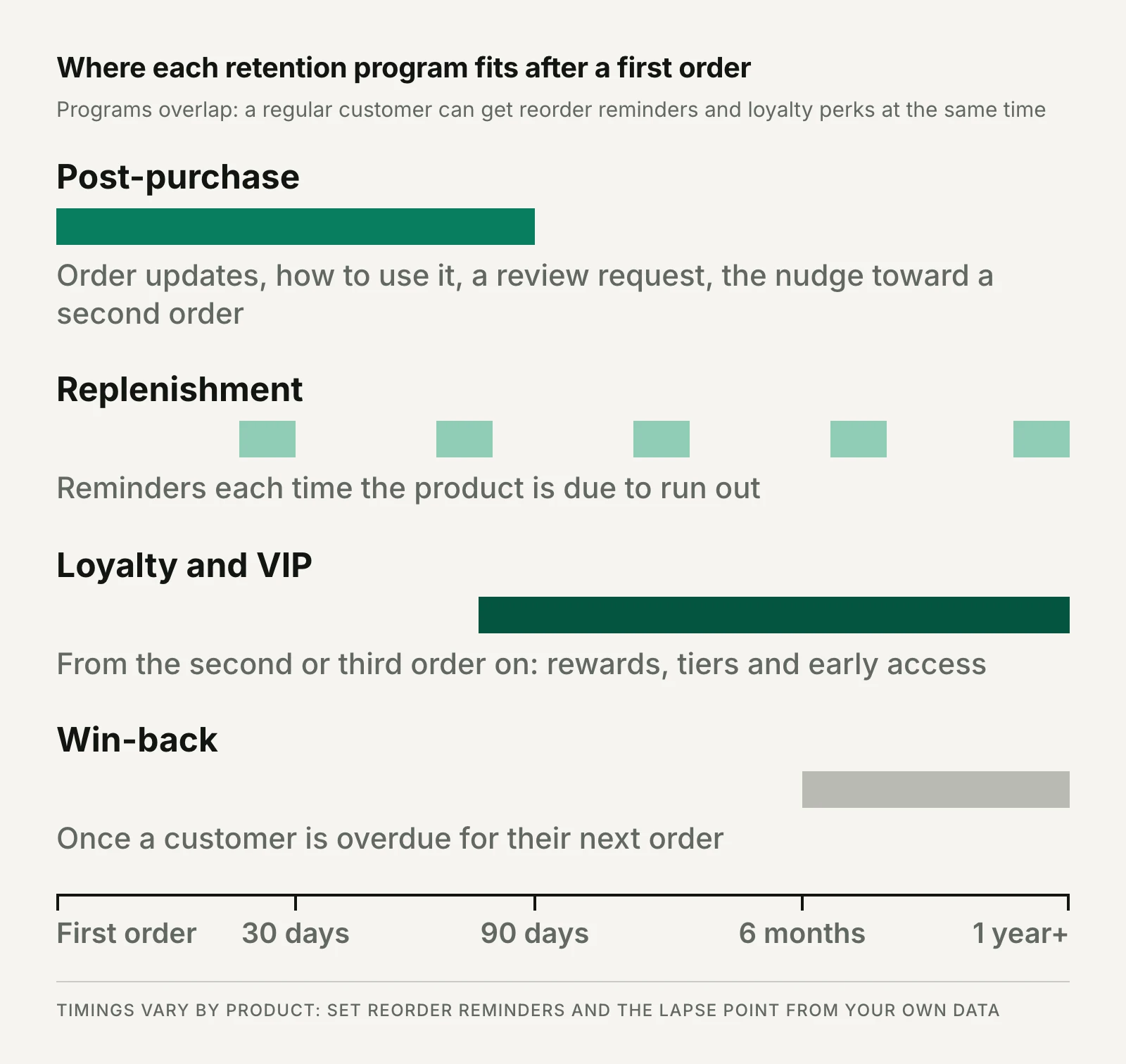
The channels are where messages go, and the programs decide what to send and when. The most useful way to plan them is by where each customer is: just bought, due to reorder, a regular, or drifting away.
If you're starting from scratch, start with the post-purchase stretch. It reaches every new customer at the moment they're most likely to buy again, and the other programs build on it.
The post-purchase stretch to the second order
The post-purchase stretch runs from the order confirmation to the second order, and it's where retention marketing has the most to gain. Start with the messages customers expect from any post-purchase email flow: the confirmation and the shipping updates.
Then help them get the most from what they bought, whether that's how to use it, care for it or style it. Once it has arrived and been used, ask for a review.
Finally, give them a reason to come back, timed to the product: around when it runs out for consumables, or within the first month for most other products.
Replenishment and subscriptions
For products that run out, the best retention marketing is a reminder at the right moment. Time it from how long the product usually lasts, and from when customers actually reorder in your own data.
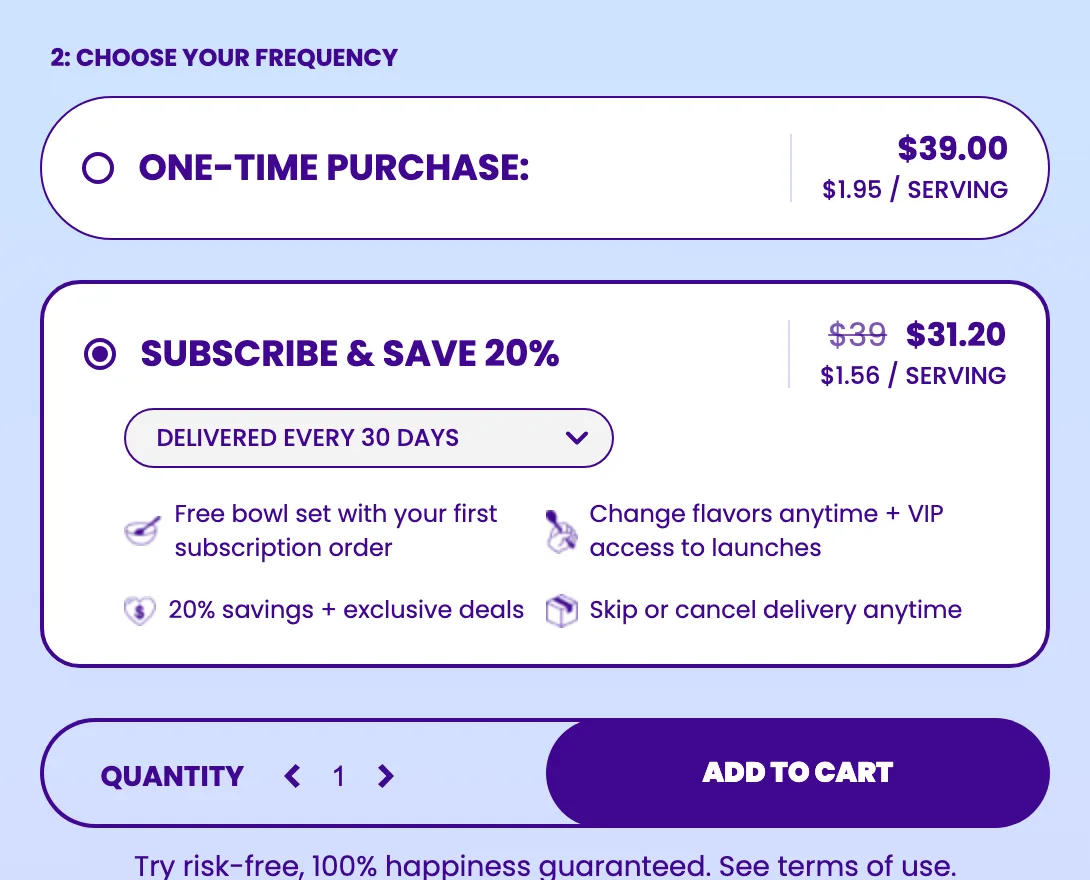
A subscribe-and-save option, which a subscription app adds to your product pages, takes the reminder a step further, because the order arrives on its own. Magic Spoon offers it right on the product page, with a lower price, a delivery schedule and a free gift on the first subscription order.
Chewy has built much of its business on subscriptions: customers who use its Autoship subscription accounted for 83.3% of its net sales in fiscal 2025, according to its annual results.
A subscription only pays off when customers stay. As Andriy Rudnyk of Good Subscription Agency explained on our podcast, the real work is getting customers to stay past the first cycle.
Loyalty tiers, VIPs and referrals
Once a customer has bought a few times, the job changes from earning the next order to keeping them close. A loyalty program does that by rewarding what you want more of: orders, reviews, referrals and birthdays.
Tiers let you treat your best customers differently, with early access, free shipping or gifts they can't get anywhere else. Referrals turn their enthusiasm into new customers.
If you're choosing an app to run all this, the main Shopify loyalty apps differ in their free plans, VIP tiers and pricing.
Win-back
Win-back messages go to customers who have stopped buying. Set the point at which a customer counts as lapsed from your own repurchase cycle. A customer who usually reorders every month is overdue at six weeks, while one who buys twice a year isn't.
Then send a short sequence across email, SMS and, for your best customers, direct mail, and tie it to why they might have left where you can.
Grind, a London coffee brand, sends subscribers different emails depending on the reason they gave for cancelling. Those emails are a key driver behind 71% of its revenue coming from repeat customers, according to Klaviyo's case study.
If someone doesn't respond to the sequence, stop emailing them. Sending to people who never open hurts your sender reputation, which pushes more of your emails into spam for everyone else.
Segments that match what customers bought
Retention marketing works better when the message fits the customer. The simplest useful split is by order count: first-time buyers, repeat customers and your best customers each need different things.
From there, segment by what people bought and by how recently, how often and how much they buy. That last approach is known as RFM (recency, frequency and monetary value), and it's a practical way to spot customers who are slipping before they're gone.
Offers that don't train customers to wait for a discount
Discounts bring customers back, but they also teach them to wait for the next one. The strongest retention programs give customers other reasons to return: early access to new products, a gift with their order, free shipping for members, useful content and the occasional surprise.
The subscription box brand BattlBox grew a $20M+ business on content, community and surprise-and-delight moments, with no endless discounts, as its CEO John Roman explained on our podcast. Discounts still have a place, as long as you use them on purpose rather than by default.
How retention marketing changes with what you sell
How often customers can reorder sets the ceiling for retention, and it changes what retention marketing should focus on. Typical repeat purchase rates differ widely by category across the DTC brands in BS&Co's data:
| Category | Typical repeat purchase rate | What retention marketing leans on |
|---|---|---|
| Consumables (supplements, food and drink, disposables) | 30% to 40% | Reorder reminders, replenishment and subscriptions |
| Fashion (apparel, beauty, jewelry) | 12% to 17% | New arrivals, early access, loyalty tiers and styling content |
| Durables and general retail (home and decor) | 10% to 15% | Accessories and add-ons, care content, referrals and the next upgrade |
Consumables have a built-in reason to come back, so the work is mostly timing. Fashion and durables have to create one, with new products, content or a reason to visit.
Brands whose products people don't buy every month can also bring customers back in person. NAADAM, the cashmere brand, uses seasonal pop-up stores to lift engagement and order frequency, as its chief revenue officer Sarah Sathaye explained on our podcast.
How do you measure retention marketing?
You measure retention marketing with repeat purchase rate, time to second order, customer retention rate and lifetime value by cohort, plus holdout tests that show what the marketing itself adds. The first four tell you how well you keep customers, and the holdout tells you how much of that is down to your marketing.
- Repeat purchase rate: the share of customers who have ordered more than once.
- Time to second order: how long new customers take to come back, which shows when your post-purchase messages need to land.
- Customer retention rate: the share of customers you keep over a period.
- Lifetime value by cohort: what a group of customers who first bought in the same month is worth over time.
Holdout tests answer the harder question. Some customers would have bought again with no reminder at all, so not every order from a returning customer is earned by your marketing.
To find out how much is, keep a random share of customers out of a flow or program, then compare their repeat orders with everyone else's. The gap between the two groups is what the marketing added.
Final thoughts
The customers you already have are the cheapest to reach and the most likely to buy, so retention marketing deserves as much planning as acquisition. Most of what it can do happens early, in the weeks after a first order.
So start with the post-purchase stretch and the second order. Then build the program your category leans on: reorder reminders and subscriptions if your products run out, new arrivals and a loyalty program if they don't, and add-ons and referrals if customers buy only once in a while.
Test each one with a holdout, so you know which programs add orders rather than just collect them.
Frequently asked questions
Is keeping a customer really 5 to 25 times cheaper than winning a new one?
The claim that keeping a customer is 5 to 25 times cheaper than winning a new one is widely quoted, but it's weakly sourced. It comes from a 2014 Harvard Business Review column, which says the figure depends "on which study you believe, and what industry you're in".
The related claim that 5% more retention lifts profits by 25% to 95% comes from Bain research that's decades old and not about ecommerce. Your own repeat purchase data is a better guide to what retention is worth to your brand.
What's the difference between retention marketing and loyalty marketing?
Loyalty marketing is one part of retention marketing. It covers the loyalty program itself: the points, tiers and rewards, and the messages that promote them. Retention marketing is wider, and also includes post-purchase messages, reorder reminders, win-back and everything else aimed at existing customers.
Who runs retention marketing at an ecommerce brand?
Retention marketing at an ecommerce brand is usually run by a retention, CRM or lifecycle marketer who owns email, SMS and the loyalty program. Larger brands may have someone on each channel, while smaller ones often bring in an agency or freelancer to build and run the flows.
Several ecommerce growth agencies run email and SMS for brands alongside their other work.
Does retention marketing mean sending more discounts?
Retention marketing doesn't have to mean more discounts, and the strongest programs rely on them least. Early access, gifts with purchase, member perks and useful content all give customers a reason to come back without teaching them to wait for a sale.
Discounts work best saved for specific moments, such as winning back a lapsed customer.
What tools do you need for retention marketing?
Most ecommerce brands need an email and SMS platform for retention marketing, plus a loyalty or subscription app if their program calls for one. A reviews app and analytics that show repeat purchases by cohort round out a basic retention stack.