When an ecommerce brand sets out to improve customer retention, the usual first move is more marketing: deeper discounts, more email flows, a points program. Some of it helps, but much of it misses what customers actually need.
A customer who's nearly out of the coffee she bought from you a month ago needs a reminder before she runs out, not a sale on products she's never bought. And if customers don't return because of a late delivery or a size that ran small, more marketing only makes every lost customer more expensive.
Improving customer retention works better the other way around. Measure where customers drop away, fix the reasons in the order customers meet them and time the follow-up to how often people actually need what you sell.
This guide covers why the second order matters most, how to measure retention and tell whether a change worked, the strategies that bring customers back and how they change for consumables, fashion and durables. It's written for established Shopify and DTC brands with enough order history to learn from.
What does customer retention mean for an ecommerce brand?
For an ecommerce brand, customer retention means customers keep buying from you after their first order: first a second purchase, then a pattern of purchases that fits how often they need what you sell.
A coffee brand might expect a reorder every few weeks, a clothing brand a visit each new season and a furniture brand a complementary purchase years later. Good retention looks different in each case, so the targets and tactics should too.
Retention isn't quite the same as loyalty: someone can keep buying because you're convenient or well priced without feeling attached to your brand. Nor is it the same as retention marketing, the emails, texts, offers and programs aimed at existing customers.
Retention is the outcome, the thing a customer retention rate puts a number on, and it depends just as much on the product, the delivery and the service.
Why does the second order matter so much?
The second order matters so much for retention because it's where the largest share of customers drop away, and the ones who get past it are far more likely to keep buying.
Across more than 100 retailers in Bluecore's 2025 Customer Growth Benchmarks, which cover 2024, nearly three-quarters of customers bought once and never came back. Once someone had bought twice, though, the likelihood of a third purchase went up by 95%.
When the second order comes, it usually comes quickly. In BS&Co's analysis of 40,397 repeat buyers at the DTC brands it works with, published in February 2026, half placed their second order within 30 days of the first and 76.4% within 90 days.
So most of the work of retention happens in the first three months, which is also where the money is. A first order often does little more than pay back what it cost to win the customer, while a second order costs far less to earn.
Take a customer whose first order leaves $25 after the cost of the product, shipping and payment, and who cost $20 in ads to win. If an offer and a few messages, costing $3 in all, bring them back for a second order just like the first, the numbers work out like this:
| Example customer | First order | Second order | After two orders |
|---|---|---|---|
| Contribution before marketing | $25 | $25 | $50 |
| Cost to win the order | $20 in ads | $3 in an offer and messages | $23 |
| Contribution after marketing | $5 | $22 | $27 |
In this example, the second order earns more than four times as much as the first, because there's no acquisition cost left to pay off.
How to measure customer retention
To measure customer retention in a way you can act on, follow groups of customers who started buying at the same time, rather than one store-wide rate. A store-wide rate mixes every group together, so a large base of loyal customers can hide the fact that this year's new customers aren't coming back.
For each group, these measures cover most of what you need:
| Measure | What it tells you |
|---|---|
| Repeat purchase rate | How many new customers come back for a second order within a set window, such as 90 days |
| Time to second order | How soon customers come back, and so when to ask for the next order |
| Cohort retention | Whether customers keep buying after the second order, month by month |
| Contribution per customer | Whether repeat orders make money after product, shipping, payment, discount, return and marketing costs |
Repeat purchase rate is the headline number, read over a window that fits how quickly your customers reorder. For time to second order, use the median, because a few customers who come back after two years can drag an average a long way.
Then split every measure by first product and by the channel or offer that brought customers in, because those splits usually explain more than the overall figure.
Contribution per customer keeps the other measures honest, because deep discounts can lift every other number in the table while making less money.
Fractional CFO Nate Littlewood, founder of Future Ready CFO, made a similar point on our podcast: lifetime gross profit is a more useful number than lifetime value, because discounts and refunds leak margin that revenue figures hide.
Why measure retention by cohort?
Measuring retention by cohort compares customers who've had the same amount of time to come back, so a change in the numbers reflects the business rather than the mix of customers.
Shopify's customer cohort analysis report groups customers by the date of their first order and can show each cohort's customer retention rate by week, month or quarter, which is enough to start with.
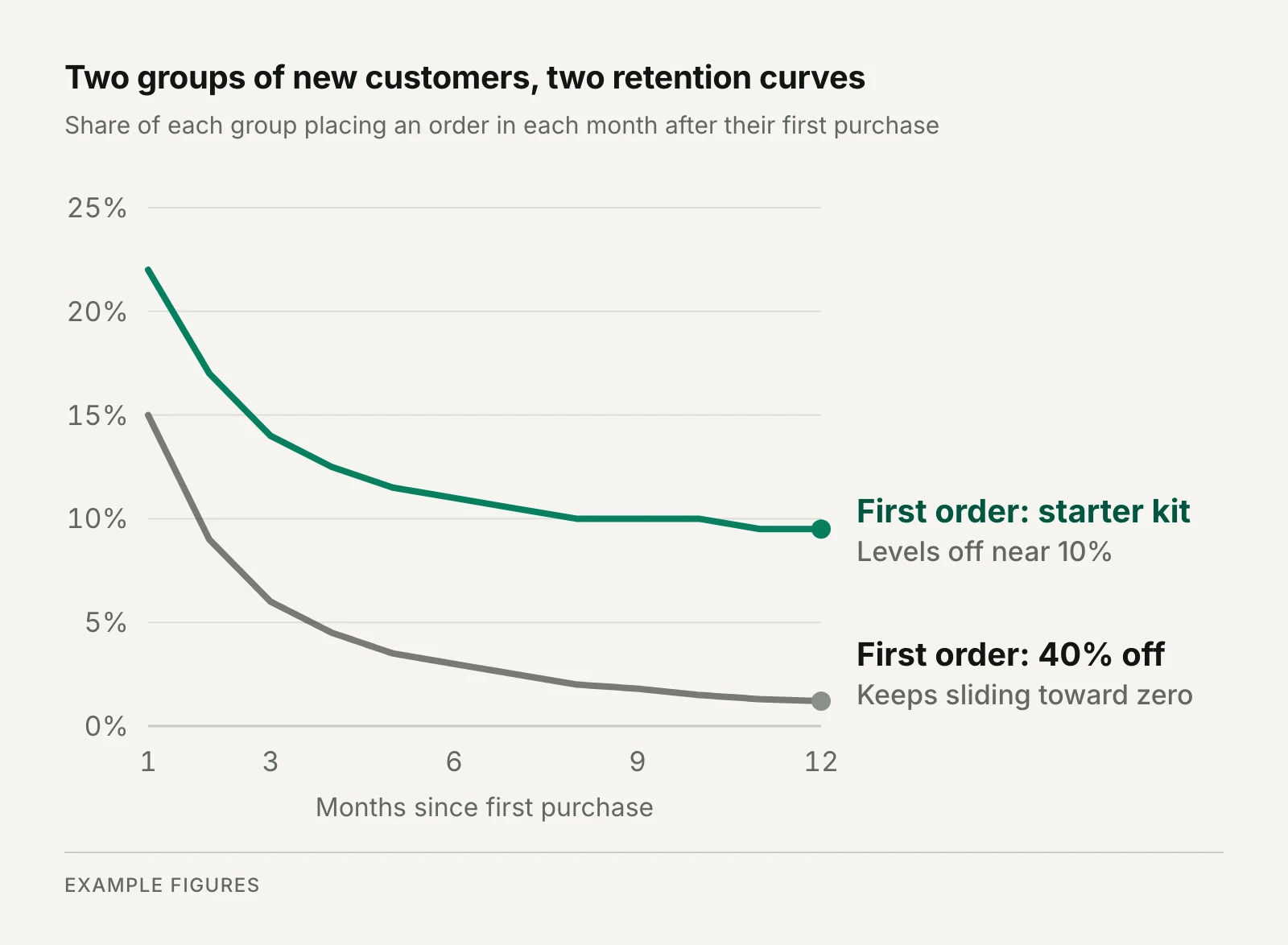
Plot each cohort's retention by month, and the shape of the curve tells you more than any single rate. A curve that levels off means a core of customers has settled into buying from you. A curve that keeps sliding means even the customers who came back are drifting away:
How do you know whether a change worked?
To know whether a retention change worked, compare customers who got it with similar customers who didn't, over at least one full purchase cycle. Compare a new cohort's second-order rate and contribution with earlier cohorts at the same age, such as day 90, rather than this month's orders with last month's.
For bigger changes, such as a new incentive or reminder, hold back a random share of eligible customers and keep them on the existing experience. Count every order from both groups, including orders placed without clicking a message, to separate customers who bought because of the change from those who would have bought anyway.
How to improve customer retention
The most reliable way to improve customer retention is to work through the customer's experience in order, starting with the stage your cohort data says is losing the most people. The strategies below build on one another, but you don't need all of them at once.
1. Find out why customers don't come back
Your order data shows where customers stop buying but not why, so the first step is to pair it with what customers say. Read recent reviews, return reasons and support tickets side by side, looking for patterns such as products that need clearer instructions, sizes that run small or deliveries that arrive later than promised.
A one-question email to customers who haven't reordered after their usual interval will surface reasons a dashboard can't.
Then separate customers who've gone from customers who simply don't need anything yet. Gift buyers and buyers of durable products need a different plan from someone replenishing an everyday item, or they'll get reminders they have no use for.
2. Fix the first-order problems that cost the most customers
The problems you find in step 1 won't all matter equally, so rank them by how many first orders they touch. A size guide that runs small on your best seller can hold down your whole retention rate, while a packaging fault on a slow seller can wait.
Then fix the cause rather than adding more follow-up messages. Many problems start with a promise made before checkout, on a product page, in a size guide or in a delivery date.
If a shirt keeps coming back because it runs small, change the fit guidance. If an order is running late, tell the customer before they have to ask.
Returns belong on the list too. A slow refund or a confusing returns process can sour a first experience that went well until then.
3. Help customers get value from what they bought
A delivered order only turns into a satisfied customer once the product does what they bought it for. Post-purchase messages help by explaining setup, care, sizing or how to use products together, timed to when the parcel arrives and the customer starts using it.
A coffee brand might send a brewing guide for the grind the customer chose, and a cookware brand care instructions for a new pan.
4. Time the next ask to how long the product lasts
The best time to ask for a second order is just before the customer needs one, which depends on the product.
Many post-purchase flows stop after a week or two, long before most customers are ready to buy again. A flow that runs for up to 90 days and leads with a reorder of what the customer bought catches far more second orders.
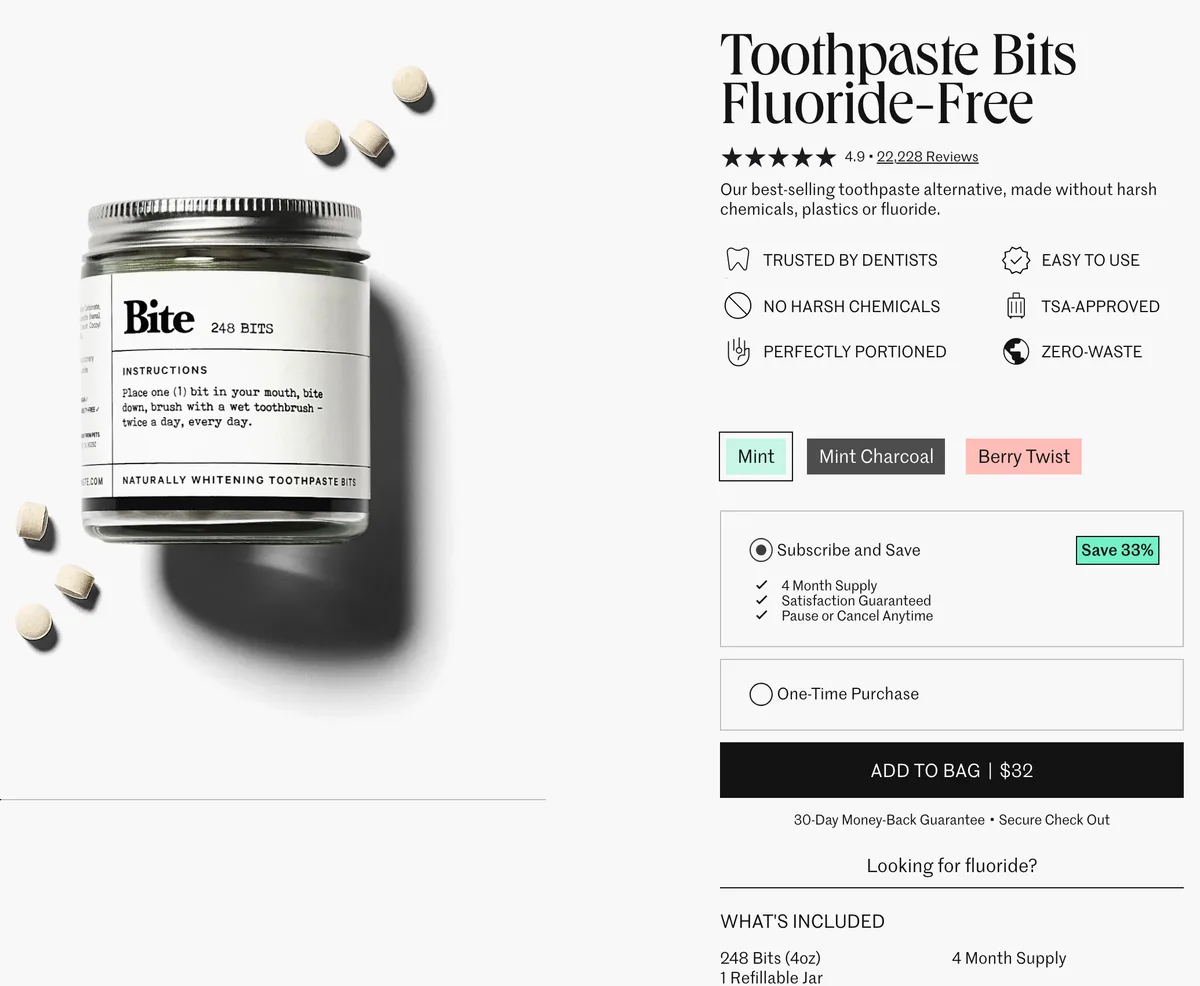
For consumables, the product itself can set the date. Replenishment timing is best suited to products with a predictable rate of use, like Bite's toothpaste bits:
5. Make reordering effortless
Reordering should take a tap or two, not a search. Link reminders straight to the product and variant the customer bought, keep popular repeat items in stock and make past orders easy to find on a phone.
For customers who buy often, an app with push notifications shortens the path further.
Subscriptions go a step further for products people use at a steady rate. Across 20,000 brands on Recharge, subscribers placed nearly three times as many orders as one-time shoppers, according to its 2026 subscription trend report.
Offer sensible intervals and make it easy to skip, pause or change a delivery, because a customer with a cupboard full of unused product will cancel rather than wait.
A subscription still needs work after the sign-up. Andriy Rudnyk, founder of Good Subscription Agency, told our podcast that the real work is getting customers to stay past the first cycle.
6. Reward repeat customers without training them to wait for a sale
A loyalty program helps retention when its rewards are easy to understand, realistic to reach and worth more to customers than a discount they'd have had anyway.
Plenty of programs fall short. In our podcast interview, Omer Hazer, founder of Atlas Studios, explained why many loyalty programs fail, with redemption rates below 1%.
Across 10,766 active Smile.io programs, customers who redeemed rewards were worth 3.1 times as much as those who didn't, in its July 2026 data. Program members were worth 72% more than non-members and bought 47% more often.
The figures are medians, and engaged customers are more likely to join and redeem in the first place, so the program isn't the only cause.
Rewards don't have to be discounts. Early access, free gifts and member-only products reward regular customers without teaching everyone to wait for the next sale.
A points program is ideal for brands whose customers buy several times a year. For a once-a-year purchase, early access or referral rewards usually fit better. Either kind of program runs on a Shopify loyalty app, so check that the one you choose supports the rewards you've planned.
7. Coordinate email, SMS and push
Email, SMS and push notifications work best planned together around each customer rather than as separate calendars. Email has room to explain products. A text or push notification is better suited to a short, timely message, such as a back-in-stock alert or a reorder reminder, for customers who've opted in.
Coordinate the channels so nobody gets a campaign email, a refill reminder and a discount text in the same afternoon.
8. Win back lapsed customers on their own schedule
A lapsed customer is one who has missed their normal buying window, which might be two months for a monthly coffee buyer and several years for someone who bought a sofa.
Define the lapse point by product, then give people something genuinely new to come back for: an improved version of what they bought, a new range that fits or an item that's back in stock.
Check for open returns, refunds and service issues first, because they need resolving before any offer. If someone still doesn't respond, contact them less rather than escalating the discount.
Expect modest numbers. Retailers in Bluecore's benchmarks reactivated 7.3% of their lapsed customers in 2024, with health and beauty the highest at 14%.
Personal, relevant messages can win customers back without a discount. One jewelry brand earned $17 per customer from discount-free win-back messages, according to Nate Okonkwo, co-founder and CEO of Remarkable AI, on our podcast.
How retention strategy changes with your purchase cycle
Retention strategy depends on how often customers need what you sell, because that sets how soon the second order can come and what it's likely to be.
Bluecore's benchmarks show the gap in the first year: new health and beauty customers placed 2.05 orders on average in 2024, against 1.23 in footwear and 1.45 across all its retailers:
Orders per new buyer in their first year, by retail category
2024 data from more than 100 retailers
BS&Co's data from its DTC clients counts customers who place a second order within a year. The data also shows how the second order itself changes from one kind of store to another, and so which strategies to lead with:
| Purchase cycle | Typical repeat purchase rate (BS&Co) | What the second order usually is (BS&Co) | Strategies to lead with |
|---|---|---|---|
| Consumables, such as supplements, food and drink | 30% to 40% | The same product: 82% to 93% of second orders at supplement brands | Reorder timing, subscriptions and one-click reorders |
| Fashion and apparel | 15% to 17% for apparel brands | Often the same item: 48% to 66% of second orders | Restocks and new colors of proven items, then new seasons |
| Durables and home decor | 10% to 15% | A different product: none of the home decor second orders were reorders | Cross-sells, care products, accessories and referrals |
How do consumables brands keep customers reordering?
Consumables brands keep customers reordering with replenishment reminders and subscriptions, because most customers want the same thing again at a predictable interval.
At scale, repeat orders become the business. Online pet retailer Chewy reported $2.8 billion of Autoship customer sales in the quarter to August 2, 2026, 84.6% of its net sales.
The work for a consumables brand is getting the first reorder date right, then making each later one easy.
What brings fashion customers back?
Fashion customers come back for new styles and seasons, but more of them reorder favorites than you might expect. In BS&Co's data, 48% to 66% of second orders at apparel brands were the same product, though BS&Co notes that some may be exchanges processed as new orders.
Reorders like these make core items that fit well and last a retention asset. Menswear brand Mack Weldon puts comfort and longevity ahead of fleeting trends. On our podcast, Mack Weldon's design director, Henry Martinez, described how customer feedback shapes everything from the brand's fabric selection to its photography angles.
Keep proven items in stock in every size, tell customers when a favorite returns and send new-collection emails to the people whose past orders suggest they'll care.
How do durable goods brands earn a second order?
Durable goods brands earn a second order with a different product, because almost nobody buys the same sofa or rug twice. Bluecore found that home goods retailers kept 21.4% of their previous year's buyers in 2024 and jewelry and accessories retailers 19.1%, against 41.2% in health and beauty.
The next purchase is more often for another room, an accessory, a care product or a gift, so cross-sells and referrals do the work that reorders do elsewhere. Judge these customers over a longer window too, such as 12 to 24 months, so a quiet customer isn't mistaken for a lost one.
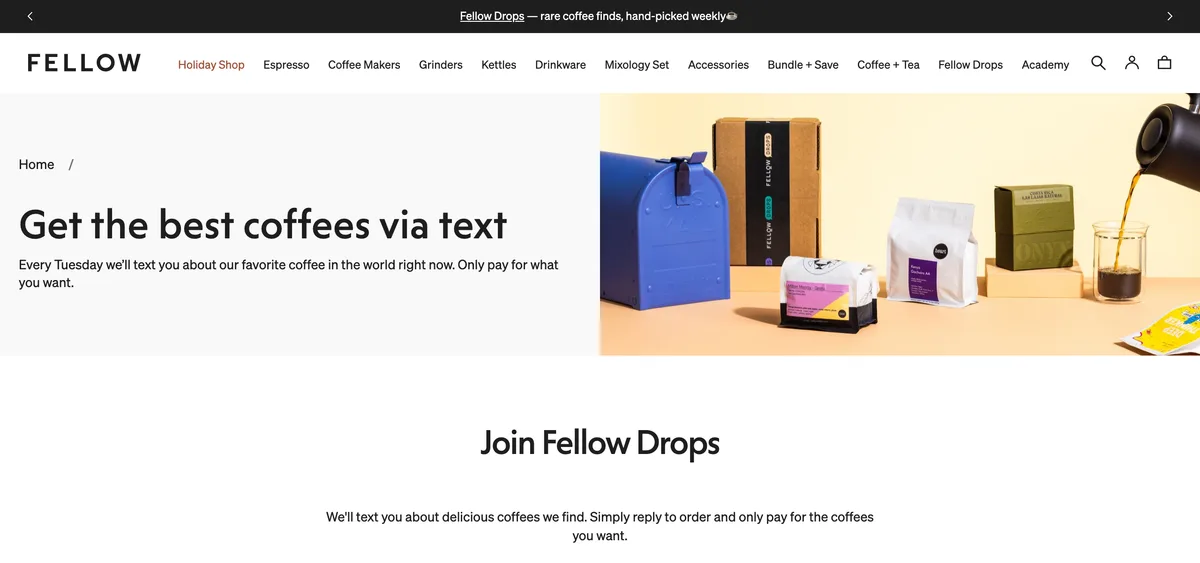
Some brands add something to buy between big purchases. Fellow, which sells kettles, grinders and coffee makers, runs a weekly coffee drop by text:
What if customers want your product but don't need it?
When customers want a product rather than need it, the pull to buy again has to come from the experience around it. BattlBox sells a monthly subscription of outdoor, survival and everyday-carry gear that nobody strictly needs.
In his episode of our podcast, CEO John Roman traced how BattlBox grew into a $20M+ subscription business by leading with content, community and customer experience rather than loyalty gimmicks or endless discounts. The brand's surprise-and-delight moments include $25K golden ticket competitions.
Final thoughts
Improving customer retention starts with knowing why someone would choose your store again, and most of it is decided in the first few months after the first order. The product has to earn the next purchase, the delivery and service have to support it and the follow-up has to arrive when it's useful.
Start with one clear gap in your own cohort data: the first product that rarely leads to a second order, the delivery problem behind your worst reviews or the post-purchase flow that ends too early. Fix it, compare the next cohorts with the last ones and move on to the next gap.
Frequently asked questions
What's the difference between customer retention and retention marketing?
Customer retention is the result, customers buying from you again, while retention marketing is the set of messages, offers and programs you use to encourage it. Retention also depends on things marketing doesn't control, such as product quality, delivery and service.
A brand can run a busy retention marketing calendar and still lose customers if their first order disappointed them.
How long does it take to improve customer retention?
Improving customer retention takes at least one full purchase cycle to appear in your data, because each cohort needs time to reach its usual reorder point.
For many consumable and fashion brands, that means reading second-order rates at day 60 or 90, since most second orders arrive within three months. Durable goods brands should wait longer, often a year or more, before judging a change.
Do discounts improve customer retention?
Discounts can win a second order, but they don't reliably improve customer retention, because customers who arrive for a deal tend to come back less often.
In Tresl's study of 106 high-growth Shopify stores, 13.95% of new customers acquired over Black Friday Cyber Monday 2024 ordered again within six months, against 19.2% of new customers acquired at other times. Tresl puts the gap down to deal-driven buyers.
Test offers against a holdout group, and lean on rewards customers value, such as gifts or early access, where you can.
How do you keep gift buyers coming back?
You keep gift buyers coming back by timing the follow-up to the next occasion rather than to how long a product lasts. Gift buyers bought for someone else, so a replenishment reminder means little to them.
Spot gift orders from gift wrap, a gift message or a delivery address that differs from the billing address. Then leave those customers out of reorder reminders and contact them before the same occasion comes around again.