Email marketing is how most ecommerce brands keep selling to people who've already bought from them. Paid channels charge you again every time you want a past customer's attention, while an email reaches them for a fraction of a cent, with room to explain what to buy next.
Most of what email earns comes from those existing customers. Across more than 183,000 Klaviyo customers, just 16% of the revenue from email campaigns comes from new buyers, according to Klaviyo's 2026 email benchmarks. The rest comes from people who've bought at least once.
Getting that return takes more than a weekly promotion. The brands that make email pay treat it as a system: a list that keeps adding likely buyers, automated flows for the moments every customer goes through, campaigns planned around a calendar and segments that decide who hears what.
This guide shows how an established Shopify or DTC brand can build that ecommerce email marketing strategy, from growing the list and planning campaigns to segmenting customers, reaching the inbox and measuring what email earns.
What is ecommerce email marketing?
Ecommerce email marketing is the use of automated and scheduled emails to turn subscribers into customers and customers into repeat buyers. Flows are the automated part: series triggered by something a person does, such as signing up, leaving a cart or placing an order.
Campaigns are the scheduled part: one-off sends to a list or segment, such as a product launch, a restock or a holiday sale. Most stores need both.
Email is the backbone of retention for most online stores because it's cheap to send and it reaches most of the people who buy from you. Most checkouts already ask for an email address, so email can reach more of your customers than texts or app notifications.
An email also has room for the detail behind a second purchase: how to use the first product, when to reorder and what goes with it.
Email marketing does the most for brands whose customers have a reason to buy again, such as products that run out, ranges people add to and seasonal collections. It's best suited to established brands with a customer file and purchase data to work with.
Email is one part of a wider customer retention strategy, alongside the product, delivery and service.
How to grow a list of subscribers who buy
A healthy ecommerce email list grows at the moments shoppers already have a reason to sign up, and its size matters less than how many subscribers go on to order. Most sign-ups come from a handful of places:
- A sign-up form or pop-up on a first visit, usually with a welcome offer.
- The checkout, where marketing consent sits beside the email field.
- Back-in-stock and price-drop requests on product pages.
- Quizzes and product finders that recommend something in exchange for an email address.
- Account creation, loyalty sign-ups and post-purchase surveys.
A form can collect more than an address. Fly By Jing's pop-up asks how spicy shoppers like it before they can claim the discount, which gives the brand a first segment before the welcome email goes out:
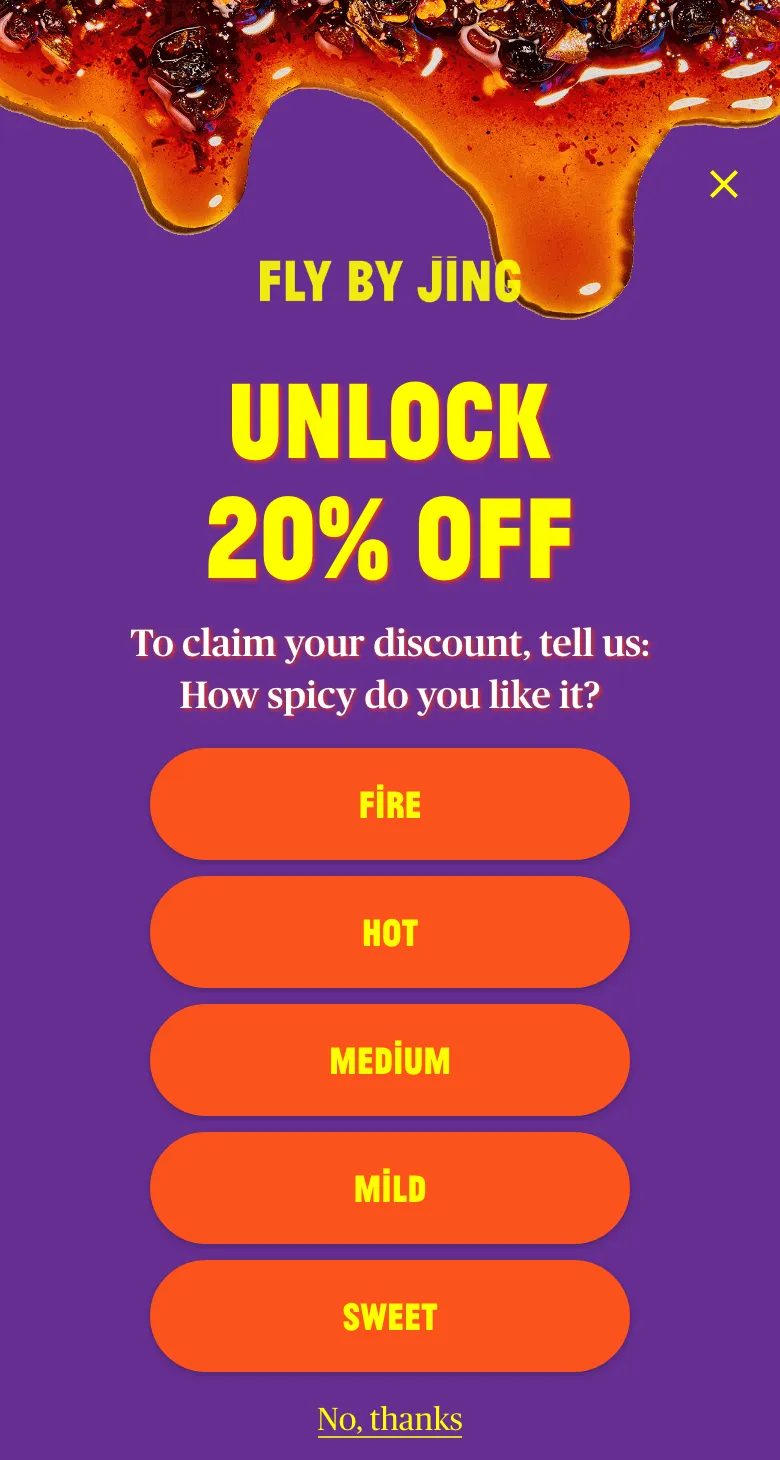
A question like this is ideal for brands whose range splits by taste, size or need, because the welcome series can open with the right products instead of the bestsellers everyone sees.
Judge each form by what its subscribers do afterwards, such as the share who place a first order and the revenue per subscriber, not by the sign-up rate alone. A bigger discount can raise sign-ups while bringing in people who only wanted the code.
The tool behind the form matters as well. Shaan Arora, co-founder and CEO of the pop-up platform Alia, made the case on our podcast that the pop-up bundled with an email platform can quietly hold back list growth. So compare your platform's form with a dedicated popup app before you settle on one.
Ask for email and SMS consent separately, since agreeing to one doesn't cover the other.
The automated flows that matter most
Automated flows earn far more per email than campaigns, because each one arrives just after a customer signs up, leaves a cart, places an order or stops buying. In Klaviyo's 2026 benchmarks, flows made up 5.3% of email sends but earned nearly 41% of email revenue.
The welcome series and abandoned cart reminders earn the most per recipient and win many first orders. For repeat business, though, the post-purchase, replenishment and win-back flows matter most, because they ask for the second order and the ones after it.
Planning email campaigns around a calendar
Email campaigns are the scheduled sends that fill the gaps between automated messages: new products, restocks, seasonal sales and content worth reading. Because most campaign revenue comes from people who've bought before, plan them for existing customers first and the wider list second.
A monthly calendar that mixes these types keeps campaigns from turning into a string of discounts:
| Campaign type | What it does | Send it to |
|---|---|---|
| Launches and new collections | Gives past buyers something new to buy | Buyers of related products first, then everyone |
| Restocks | Sells items people already wanted | The waitlist and past buyers of that product |
| Education and stories | Helps customers get more from what they own | Recent buyers and engaged subscribers |
| Seasonal sales and gifting | Captures demand around fixed dates | Everyone, with early access for repeat customers |
| Customer-only offers and loyalty news | Rewards the people who keep buying | Repeat customers and loyalty members |
Start with the fixed dates, such as holidays, planned launches and Black Friday and Cyber Monday. Then fill the weeks between with restocks, stories and new products, so that not every email is a sale.
Black Friday needs a plan of its own, and its emails shouldn't stop when the sale ends, because the follow-up is what turns holiday buyers into repeat customers.
How should you segment an ecommerce email list?
Segment an ecommerce email list by what people have bought and how recently first, then by how they engage with your emails and what they've told you they want. Purchase history is data every store already has, and it says more about the next order than age or location.
| Segment | Who's in it | What to send |
|---|---|---|
| Subscribers who haven't bought | Signed up, no order yet | Bestsellers, reviews and a reason to try you |
| First-time buyers | One order | How to use the product, then a reorder or the natural next item |
| Repeat customers | Two or more orders | Early access and new products in the categories they buy |
| Lapsing customers | Past their usual reorder window | A reminder, then a win-back offer |
| Unengaged subscribers | No clicks or orders in months | Fewer emails, then a sunset flow |
| Stated preferences | Answered a sign-up question or quiz | Products that match their answer |
What a customer bought should shape what they hear next. BS&Co's analysis of 7,454 second-purchase journeys found that 77% were reorders of the same product, rising to 82% to 93% at its supplement brands.
So group first-time buyers by what they bought, not only by when. Someone who bought a consumable should hear about reordering before new arrivals. A home decor buyer wants other rooms and styles instead, because BS&Co's home decor customers never bought the same item twice.
Don't leave recent buyers out of campaigns by default. In the same data, half of second orders came within 30 days of the first, so the customers who just bought are the ones most likely to buy again soon.
Black Friday newcomers are worth a segment of their own, because they tend to come back at a lower rate than other new customers.
Personalizing emails with what customers bought
The email personalization that earns more orders uses what a customer bought, browsed and told you, rather than their first name in a subject line. Most of it comes from a few kinds of information:
- The product: the item they bought or viewed, in their size or variant.
- The timing: a reorder reminder when their supply is likely to run low, based on the product and quantity they bought.
- What comes next: accessories for what they own, or the next step in a routine, rather than a generic bestseller grid.
- Their answers: preferences they gave at sign-up or in a quiz, like Fly By Jing's spice question.
Personalization matters most in win-back emails, because they go to customers who've stopped paying attention. Nate Okonkwo, co-founder and CEO of Remarkable AI, told our podcast that most brands are stuck at $0.11 per email. Writing to lapsed customers as people rather than segments, he argued, is what lifts that figure.
Personalization also depends on clean data. A reminder to reorder something the customer bought yesterday, or a refill email to someone who bought a gift, does more harm than a generic message. Check that purchase events reach your email platform from every place customers buy, including your app and stores.
How often should an ecommerce brand send emails?
An ecommerce brand should send emails as often as each segment has something worth hearing, which usually means more to recent and engaged customers and fewer to people who haven't clicked or ordered in months. There's no universal number: a coffee subscription and a furniture brand have very different reasons to get in touch.
Volume doesn't stand in for relevance. In BS&Co's data, the typical repeat buyer received about 17 emails between orders and clicked one at most.
Inboxes also make an overloaded sender easy to drop. Gmail's Manage subscriptions view, launched in July 2025, lists a person's subscriptions sorted by the most frequent senders, shows how many emails each sent in the past few weeks and lets them unsubscribe in one click.
To find your own cadence:
- Add sends to your most engaged segment first, and watch revenue per recipient alongside unsubscribes and spam complaints.
- Test a change against a holdout group that keeps the old frequency, and run it long enough to cover a full buying cycle.
- Cap the total each customer receives across email, SMS and push, not each channel on its own.
You've found the right cadence for a segment when one more send stops adding revenue and starts adding unsubscribes and complaints.
What do Gmail, Yahoo and Outlook require from email senders?
Gmail and Yahoo require every sender to authenticate their email and keep spam complaints below 0.3%, and bulk senders must also publish a DMARC policy and offer one-click unsubscribe. The rules took effect in February 2024.
Google says Gmail began ramping up enforcement in November 2025, so messages that don't comply can now be temporarily or permanently rejected, or sent to spam.
Gmail's bulk-sender threshold is close to 5,000 messages to personal Gmail accounts in 24 hours, counted across everything sent from the same primary domain. A single campaign to that many Gmail addresses meets it, and Google says a sender that meets the criteria once is permanently considered a bulk sender.
Microsoft added similar requirements for Outlook.com from May 5, 2025:
| Requirement | Gmail | Yahoo | Outlook.com |
|---|---|---|---|
| Who the strictest rules cover | Close to 5,000 or more messages a day to personal Gmail accounts | Bulk senders (no number given) | Domains sending more than 5,000 emails a day |
| Authentication | SPF, DKIM and DMARC (p=none allowed), with the From domain aligned | SPF, DKIM and a DMARC policy of at least p=none, which must pass | SPF and DKIM must pass; DMARC of at least p=none, aligned with SPF or DKIM |
| One-click unsubscribe | Required for marketing messages | Required for marketing messages | A functional unsubscribe link is recommended |
| Processing unsubscribes | Within 48 hours (recommended) | Within 2 days | Not stated |
| Spam complaint rate | Below 0.10%, and never 0.30% or higher | Below 0.3% | Not stated |
| In force since | February 2024, with enforcement ramping up from November 2025 | February 2024 | May 5, 2025 |
Your email platform supplies the SPF and DKIM records, but someone has to add them to your domain's DNS, and the DMARC policy is yours to publish. US law sets a looser floor: the CAN-SPAM Act allows 10 business days to honor an opt-out.
Deliverability basics beyond the rules
Meeting the Gmail, Yahoo and Outlook sender requirements keeps your email from being blocked, but whether it reaches the inbox also depends on how subscribers react to it. That's why Microsoft's own recommendations for large senders include list hygiene, bounce management and easy unsubscribes.
A few habits protect your sender reputation:
- Send from your own authenticated domain rather than a shared or free address.
- Never buy or rent lists, and remove addresses that hard-bounce.
- Move unengaged subscribers to a lower frequency, then a sunset flow, before they start marking you as spam.
- Make unsubscribing easy to find, so people who've had enough leave rather than reporting you.
- When you change platform or sending domain, ramp up volume gradually, starting with your most engaged subscribers.
Habits like these hold your spam complaint rate well below the 0.3% ceiling that Gmail and Yahoo set, so more of your emails reach the inbox.
Which email marketing metrics matter?
The email marketing metrics that matter most for an ecommerce brand are click rate, placed order rate and revenue per recipient, with unsubscribe and spam complaint rates as guardrails. Open rate still appears in every dashboard, but since Apple Mail Privacy Protection it no longer measures what it used to.
| Metric | What it measures | Use it to |
|---|---|---|
| Open rate | Emails recorded as opened, including automated opens | Spot sudden drops that may signal a deliverability problem |
| Click rate | Recipients who clicked a link | Compare subjects, offers and layouts |
| Placed order rate | Recipients who went on to order | See whether an email sells, not just whether it's seen |
| Revenue per recipient | Attributed revenue divided by recipients | Compare sends of different sizes and test frequency |
| Unsubscribe and spam complaint rates | Recipients who opted out or reported spam | Catch emails that cost you subscribers |
Can you still trust email open rates?
Email open rates are no longer a reliable count of who read an email, because Apple Mail Privacy Protection can record an open whether or not the subscriber looked at it.
Since it launched with iOS 15 in September 2021, the feature has pre-fetched the tracking pixel email platforms use to count opens. Klaviyo says it has no way to tell a human open from an automated one when the feature is on.
Apple accounts for most of the email opens Litmus tracks:
Share of email opens by email client, October 2026
From more than 1.7 billion opens. Litmus counts Mail Privacy Protection opens under Apple and doesn't treat them as reliable.
Automated opens affect more than the open rate. On Klaviyo, an email gets credit for an order when the customer opened or clicked it within the attribution window, five days by default for new accounts, and no later message took the credit.
Automatic Apple opens count unless you exclude them. Use opens only to watch trends in your own data, and consider excluding Apple's automatic opens from conversion tracking so attributed revenue doesn't rest on them.
Email benchmarks for ecommerce
Klaviyo's 2026 benchmarks, drawn from more than 183,000 of its customers, put the average email campaign's open rate at 31% and its click rate at 1.69%, while flows average 32.2% and 5.58%. The top 10% of senders reach about double the average click rate:
Email click rates on Klaviyo, campaigns vs flows
Average and top-10% click rates, 2026 benchmarks from more than 183,000 Klaviyo customers
Category matters too: average campaign click rates in Klaviyo's data run from 1.24% in health and beauty to 2.03% in toys and hobbies. Flows lead on the measures closest to revenue as well, with about 13 times the placed order rate of campaigns and nearly 18 times the revenue per recipient.
Omnisend's 2025 data shows the gap in dollars: automated emails earned $2.87 per send, compared with $0.18 for campaigns.
Compare your numbers with the closest benchmark, then with your own history. A falling revenue per recipient on campaigns is a stronger warning than an open rate below an industry average.
Klaviyo's default model credits an order to the last eligible message across email, SMS and push, and other tools may claim the same purchase. Before deciding email earned the revenue in the dashboard, test what it adds overall with a holdout group.
How email works alongside SMS and push
Email works best as the base of an ecommerce retention program, with SMS and push notifications added for the moments when speed matters more than detail.
A text suits a restock alert or a real deadline for opted-in customers, but SMS platforms charge for every message, so save texts for moments like those. App push gives shoppers a quick way back to a saved product or reward.
The channels work together when a purchase on any of them stops reminders on all of them and one frequency cap covers the total.
Final thoughts
Ecommerce email marketing pays when it's built around the customers you already have. Flows handle the moments every customer goes through, campaigns give past buyers something new between orders and segments match each message to the person getting it.
Start with the core flows and the sender requirements, since one earns a large share of email revenue and the other decides whether anything arrives at all. Then judge the rest on clicks, orders and revenue per recipient, and let your customers' behavior tell you how often they want to hear from you.
Frequently asked questions
What's the difference between an email campaign and an email flow?
An email campaign is a single send scheduled for a list or segment, while an email flow is an automated series triggered by what a subscriber does, such as signing up, abandoning a cart or placing an order.
Campaigns carry news and seasonal offers to many people at once, and flows respond to one person at a relevant moment. Most ecommerce programs need both, with campaigns doing most of the sending and flows earning more per email.
Can you send marketing emails to customers who didn't subscribe?
In the US you can send marketing emails to customers who didn't explicitly subscribe, because the CAN-SPAM Act requires a way to opt out rather than permission in advance. Every email still needs a working unsubscribe and your postal address, and opt-outs must be honored within 10 business days, according to the FTC's compliance guide.
The UK is stricter: the ICO requires specific consent, apart from a "soft opt-in" for existing customers who bought something similar and were given a simple way to opt out. Even where it's legal, emailing people who never asked risks the spam complaints that Gmail and Yahoo track.
How much does ecommerce email marketing cost?
Ecommerce email marketing can cost as little as a tenth of a cent per email in sending fees. Shopify Messaging gives stores on its Basic, Grow, Advanced and Plus plans 10,000 free emails a month, then charges $1 per 1,000 up to 300,000 emails.
On dedicated email marketing apps such as Klaviyo, paid plans scale with the number of contacts and how much you send, so a growing list raises the bill. For most brands, though, the bigger cost is the time to plan, write and test.
When should you stop emailing unengaged subscribers?
You should stop emailing unengaged subscribers once they haven't clicked or ordered for longer than your normal buying cycle, after a last attempt to win them back. A brand whose customers reorder every month can set a shorter cutoff than a furniture brand.
A sunset flow asks whether they still want to hear from you and removes them if they don't respond, which protects the spam complaint rates Gmail and Yahoo monitor.
Is email marketing still worth it for ecommerce?
Email marketing is still worth it for most ecommerce brands, and engagement is holding up. In Omnisend's 2026 report, covering 27 billion emails sent by 150,000 brands in 2025, the average open rate rose for the fifth year in a row to 30.7%, and click-to-conversion rose from 5.9% to 9%.
Open rates are inflated by Apple Mail Privacy Protection, but conversions from clicks aren't. For brands with repeat customers, email remains one of the cheapest ways to ask for the next order.