Set up the right automated email flows and they'll keep selling for your store around the clock, from a small share of the emails you send. Across the 150,000 brands in Omnisend's 2026 ecommerce marketing report, automations made up 2% of email sends in 2025 and brought in 30% of email-driven revenue.
Picture a new subscriber's first months with your store. A welcome email arrives seconds after they sign up, and a cart reminder brings them back that afternoon. Tips follow their first order, a refill reminder lands before they run out and a win-back email notices if they drift away. Nobody on your team pressed send.
Yet many stores run without even the basics. Most brands that come to the Shopify Plus agency eCommerce Today arrive without them, from $1 million stores to $40 million-plus ones, according to its CEO and co-founder, Stefan Chiriacescu, on our podcast. His team installs the same core flows for every client.
This guide covers which flows to set up first, how to build each of the essential ones, how to keep them from overlapping and how to measure what they earn. It's written for established Shopify and DTC brands setting up flows or auditing old ones.
What are ecommerce email flows?
Ecommerce email flows are automated sequences of emails that a store sends when a customer does something, such as subscribing, leaving a cart or placing an order, or when a set amount of time has passed.
Each one starts with a trigger, waits, checks that the customer still qualifies and then sends the next message. The email marketing apps for Shopify name them differently: Klaviyo calls them flows, Omnisend calls them automations and Shopify Messaging calls them marketing automations.
The rest of your email marketing is campaigns: the newsletters and promotions you schedule for a whole list at once. A flow reaches one customer at the moment their own behavior makes the message relevant, which is why automated emails earn so much more per send:
$2.87
Average revenue per automated email in 2025, against $0.18 per scheduled campaign email
Nearly 1 in 3
Clicks on automated emails that resulted in a purchase in 2025
Which email flows should you set up first?
The first email flows to set up are a welcome series and abandoned cart and checkout reminders, followed by a post-purchase flow and then win-back. Klaviyo's getting-started guide puts them in that order.
Omnisend's data points the same way: abandoned cart and welcome messages produced 76% of automation orders in 2025. Klaviyo's 2026 benchmarks also put those two flows ahead on revenue per recipient, the revenue a flow earns divided by the number of people who received it.
Post-purchase and win-back flows earn less per email because their payoff, the customer's next order, can come weeks later, so judge them on repeat purchases too.
The flows to add for your type of store
The email flows to add after the welcome, cart and post-purchase flows depend on how often your customers buy and how quickly your products sell out:
| Your store | Flows to add after the core set |
|---|---|
| Consumables, such as coffee, supplements or pet food | Replenishment, timed to how long a pack lasts, then win-back |
| Fashion and footwear | Back in stock for sizes that sell out, and browse abandonment |
| Considered purchases, such as furniture or electronics | Browse abandonment, a longer cart sequence and setup emails after delivery |
| Subscriptions | A win-back triggered by cancellation |
| Home decor and other one-off purchases | Cross-sell rather than replenishment |
Considered purchases can also earn more from each reminder. In Klaviyo's data, home and garden brands and hardware and home improvement brands averaged around $15 per abandoned cart email recipient, more than twice the overall average.
The essential ecommerce email flows
For each flow below, you'll find what starts it, when to send, how many emails to include and what to measure, then what to say. The timings come from Klaviyo's and Shopify's setup guides, so treat them as starting points to test.
1. Welcome series
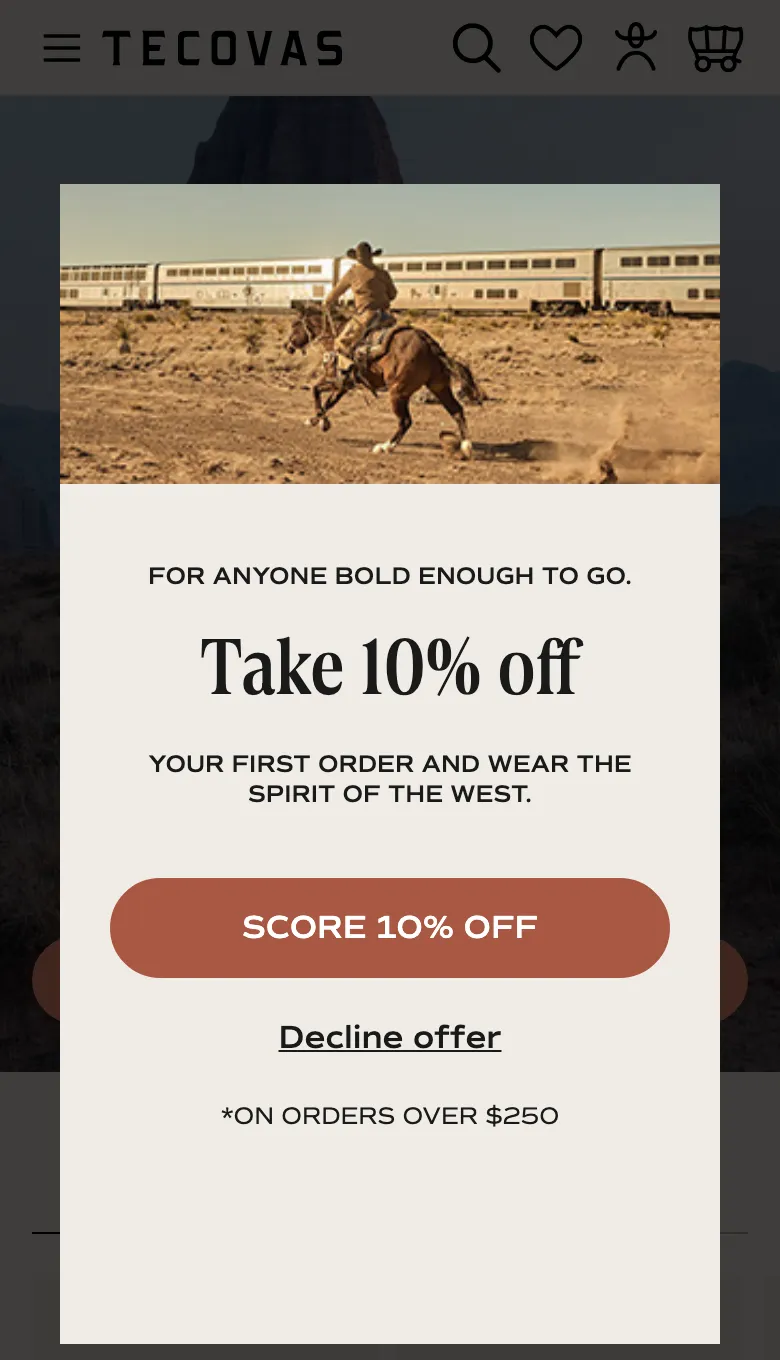
A welcome series introduces your brand to new subscribers, delivers any offer you promised for joining and aims to turn them into first-time customers.
- Trigger: being added to your email list, usually through a sign-up form.
- Timing: the first email immediately. Klaviyo's pre-built series sends the second three days later and the third four days after that.
- Length: three emails over about a week.
- Measure: first orders and revenue per recipient.
Deliver whatever the sign-up form promised and say plainly what makes your products different. Then follow with best-sellers, reviews and a reason to buy now, such as the offer's expiry date.
Klaviyo suggests a longer series for brands with a founding story to tell, and a separate series for SMS subscribers, since people can opt in to the two channels at different times. Anyone who orders should move straight into your post-purchase flow.
2. Browse abandonment flow
A browse abandonment flow follows up with known shoppers who viewed a product but left without adding anything to their cart.
- Trigger: viewing a product, through Klaviyo's Viewed Product event or Shopify Messaging's Convert abandoned product browse template. It only reaches shoppers your store can already identify, such as subscribers.
- Timing: Klaviyo suggests waiting at least an hour, and letting nobody enter the flow more than once in 30 days.
- Length: one or two emails.
- Measure: revenue per recipient.
Keep it lighter than a cart reminder: the product they viewed, a few similar ones and a review or two. Klaviyo suggests keeping any discount for people who've never bought, and stopping the flow as soon as the shopper adds something to their cart.
Each browse email earns less than a cart reminder, but more shoppers view products than add them to a cart, so the flow still pays its way for large catalogs and considered purchases.
3. Abandoned cart flow
An abandoned cart flow reminds shoppers who added products to their cart but never started checkout, and gives them an easy way back.
- Trigger: adding a product to the cart, through Klaviyo's Added to Cart event or Shopify Messaging's Recover abandoned cart template. Klaviyo recommends running it separately from your abandoned checkout flow, with a filter that removes anyone who starts checkout.
- Timing: two to four hours after the shopper leaves. Klaviyo's pre-built flows wait four hours.
- Length: two or three messages. Klaviyo's 2026 report describes an email after two to four hours, a text with a discount after 24 hours and a final message after 48 hours with alternative products or a request for feedback.
- Measure: recovered orders and revenue per recipient.
Show the products and variants they chose and answer the question most likely to have stopped them, such as delivery, sizing or returns. Then link back to a cart that's exactly as they left it.
Keep any discount out of the first message. Klaviyo's report warns that discounts can train shoppers to wait for one, and suggests offering them only on high-value carts.
4. Abandoned checkout flow
An abandoned checkout flow follows up with shoppers who started checkout but didn't complete the order, the point where purchase intent is highest.
- Trigger: starting checkout, through Klaviyo's Started Checkout event or Shopify Messaging's Recover abandoned checkout template. Shopify records an abandoned checkout once the customer has entered an email address and the checkout has stayed incomplete for more than ten minutes.
- Timing: Klaviyo recommends the first message two to four hours after checkout began and a second 20 to 48 hours later.
- Length: two or three messages.
- Measure: recovered orders, checked against a holdout group, and revenue per recipient.
These shoppers have already chosen products and shared contact details, so deal with the last step: delivery cost and date, payment options, returns and a direct link back.
Checkout reminders tend to convert better than cart reminders. In Klaviyo flow benchmarks from the agency BS&Co, covering 14 of its brands over the 12 months to May 2026, the first checkout email converted a median 2.30% of recipients, against 1.82% for the first cart email.
They don't always earn more, though. Across each flow as a whole, the two earned almost the same per recipient: $3.55 for checkout and $3.56 for cart.
If you recover abandoned checkouts with Shopify Messaging, the emails can be set to go to all customers, not only marketing subscribers, and they don't count toward your email sends.
5. Post-purchase flow
A post-purchase flow thanks customers, helps them get value from what they bought and sets up their second order.
- Trigger: placing an order, or the order being fulfilled for later emails.
- Timing: a thank-you on the day of the order, setup or care tips timed to delivery and a review request once they've used the product.
- Length: four or five emails over as long as 90 days, kept separate from order and shipping confirmations.
- Measure: repeat purchase rate at 30, 60 and 90 days, rather than revenue per recipient.
Klaviyo suggests splitting first-time from returning customers, welcoming one and thanking the other for their loyalty. It also suggests splitting by order value to show big spenders your VIP program.
Shopify Messaging's Welcome VIP customers template sends when a customer joins your VIP segment, which by default happens after a third order and $1,000 in total spend.
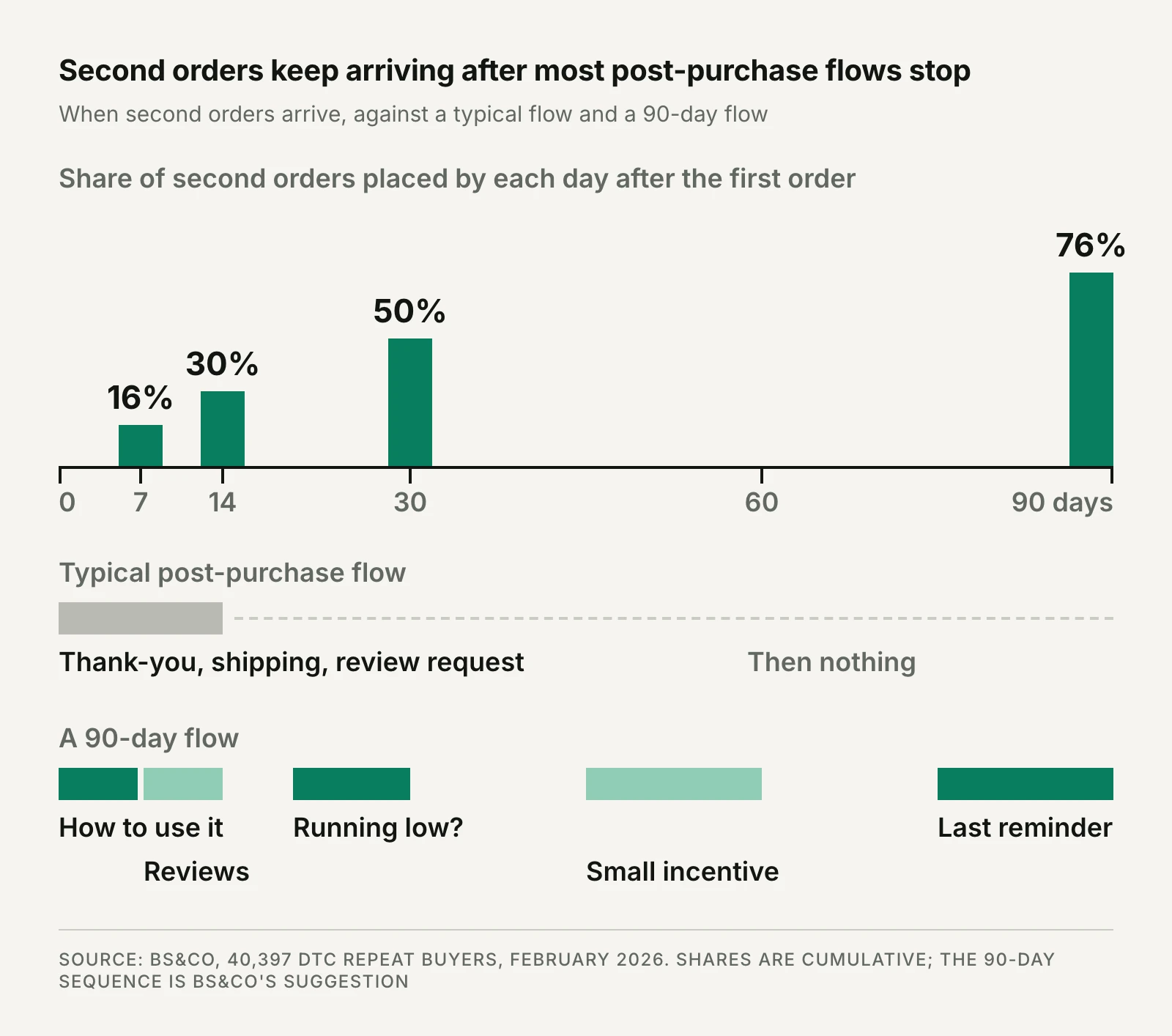
Don't let the flow stop at the review request. In BS&Co's analysis of 40,397 DTC repeat buyers, published in February 2026, 50.3% placed their second order within 30 days of the first and 76.4% within 90 days. Yet BS&Co says most post-purchase flows end after 7 to 14 days.
It suggests running the flow to day 90 instead:
- product education in the first week
- reviews and social proof up to day 14
- a "running low?" or "complete the look" email around days 20 to 30
- a small incentive around days 45 to 60
- a last reminder around days 75 to 90
6. Replenishment or cross-sell flow
A replenishment or cross-sell flow asks for the next order: a refill before a product runs out, or something that goes with a product that won't.
- Trigger: an order containing a specific product, or a fulfilled order for cross-sells.
- Timing: shortly before the product runs out. Klaviyo's example is a reminder about 25 days after an order for a 30-day supply of a supplement, and its built-in cross-sell flow waits 14 days after an order is fulfilled.
- Length: two reminders, then a follow-up with an incentive once the expected buying cycle has passed, which is Klaviyo's rule of thumb for replenishment.
- Measure: reorders within the expected cycle, and revenue per recipient.
Most second orders are a reorder. Of 7,454 second purchases in BS&Co's data, 77% were the same item as the first, and two supplement brands reached 82% and 93%.
A simple "running low?" email with a reorder or subscription link suits that majority better than a grid of recommendations. Home decor was the exception: its customers never bought the same item twice, so durable goods are better suited to cross-sells.
7. Back-in-stock flow
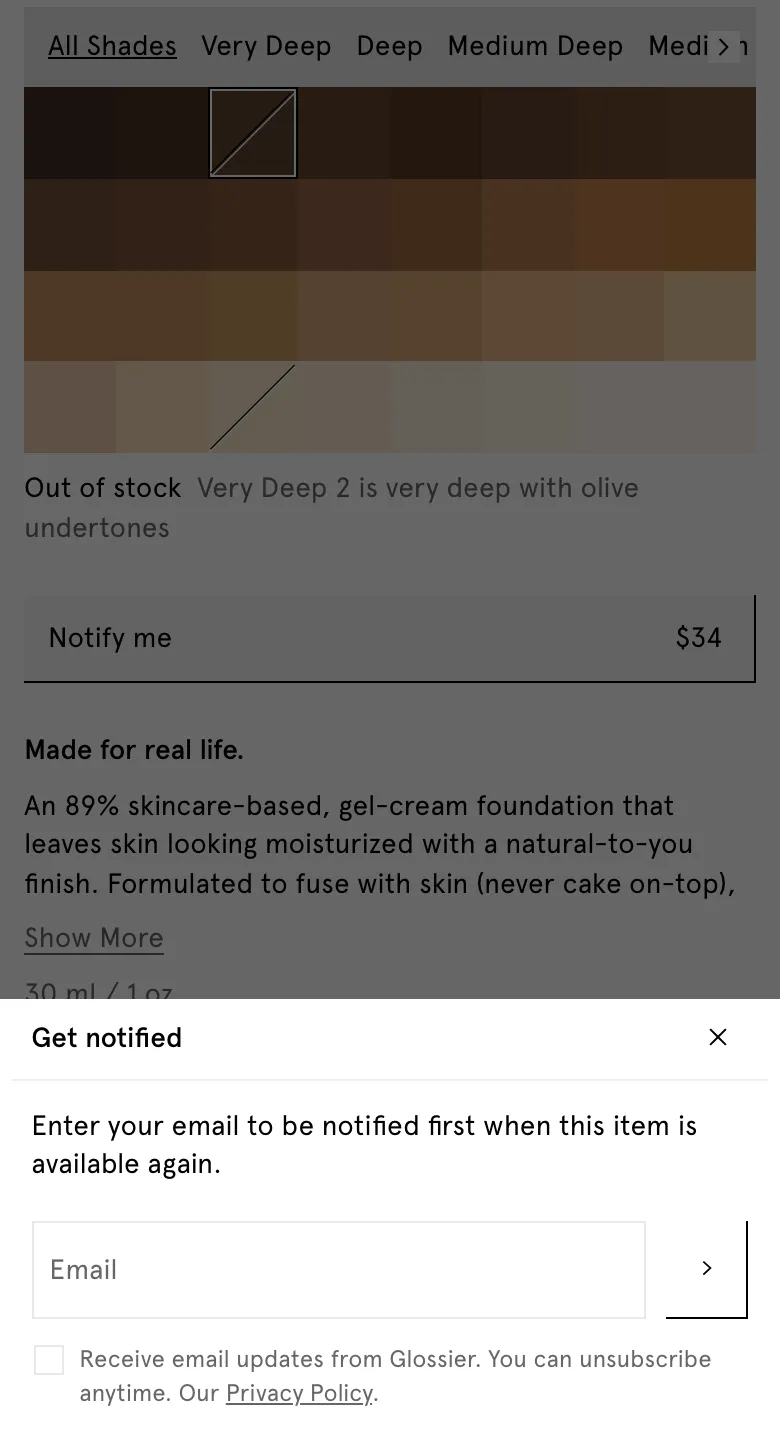
A back-in-stock flow alerts shoppers who asked to hear when a sold-out product returns.
- Trigger: signing up for a restock alert, through Klaviyo's Subscribed to Back in Stock event, which works with Shopify and several other ecommerce platforms.
- Timing: as soon as the item is back. Klaviyo can send alerts in batches, so not everyone hears at once.
- Length: usually one email, since Klaviyo can't check whether the item has sold out again before sending a second.
- Measure: conversion rate. Back-in-stock emails converted at 6.46% across Omnisend's brands in 2025, the highest of any automation type.
Keep the sign-up quick, with an email or phone field on the product page and marketing consent asked separately. When the alert goes out, name the product and the size or color they asked for, link straight to it and be honest about how much stock there is.
8. Win-back flow
A win-back flow tries to bring back customers who haven't ordered for longer than they usually would.
- Trigger: no order for a set period, using Klaviyo's Placed Order event followed by a delay, or Shopify Messaging's Win back customers template. Subscription brands can trigger it on cancellation.
- Timing: a little longer than your average buying cycle, which Klaviyo suggests measuring from customers who've ordered at least twice in the last two years.
- Length: three emails.
- Measure: the share of recipients who order again, and revenue per recipient, which is the lowest of the flows Klaviyo benchmarks.
Klaviyo's suggested pattern starts with a short email showing a few best-sellers or new arrivals, perhaps with an incentive. A second recalls the offer and adds a deadline, and a third is the last chance, with a prominent link to unsubscribe or change preferences.
Klaviyo also suggests varying the messages for customers who've placed three or more orders, since they're in a different place from one-time buyers.
9. Sunset flow
A sunset flow sends a last few emails to subscribers who have stopped engaging, then removes the ones who don't respond so they stop dragging down your deliverability.
- Trigger: joining a segment of long-inactive subscribers. Klaviyo's suggested sunset segment covers profiles at least 180 days old that have received five or more emails in 72 weeks without ever opening, clicking, visiting the site, viewing a product, starting checkout or ordering.
- Timing: after the last email, a grace period of about three days if you email daily, or 7 to 10 days if you send less often.
- Length: one to three emails.
- Measure: the share who re-engage, then your open and click rates once the rest are suppressed.
Write plainly and ask whether they still want to hear from you, perhaps with a subject line like "Is it time to say goodbye?". Make the unsubscribe and preferences links easy to find, then suppress everyone who didn't open or click.
Suppressed profiles also stop counting toward your Klaviyo profile limit. Win-back is for customers who stopped buying, while sunset is for subscribers who stopped reading.
How to keep flows from overlapping
To keep email flows from overlapping, give each one exit conditions and decide which wins when a customer qualifies for two. Otherwise someone who subscribes, browses and buys in one afternoon can land in four sequences:
- Remove anyone who orders from the welcome, browse, cart and checkout flows, with a filter such as Klaviyo's "Placed Order zero times since starting this flow".
- Let the furthest step win: starting checkout ends the cart flow, and adding to the cart ends the browse flow.
- Keep replenishable products out of win-back, as Klaviyo suggests, so customers who are simply between refills don't get a "we miss you" email.
- Decide how to cap the total, with one limit across email, SMS and push if you send all three. Klaviyo suggests Smart Sending, which limits how many messages someone gets in a set period, for post-purchase and browse abandonment flows. BS&Co turns it off in every flow, arguing that it suppresses abandoned checkout emails.
Set up that way, the shopper who subscribes, browses and buys in one afternoon ends up in your post-purchase flow alone.
Adding SMS and push notifications to flows
Texts and push notifications earn their place in email flows where timing matters most: cart and checkout reminders, back-in-stock alerts and replenishment.
In Omnisend's 2025 data, automated texts earned $0.74 per send, against $0.15 for SMS campaigns. Its automated push notifications converted 22.9% of clicks, up from 13.9% in 2024.
Texts cost more to send than emails, so they're best suited to moments when a quick nudge changes the outcome.
How to measure ecommerce email flows
Measure each email flow on revenue per recipient and on the outcome it exists for: first orders for the welcome series, recovered orders for cart and checkout reminders and repeat purchases for post-purchase and replenishment. Compared with click rate, revenue per recipient shows whether clicks turned into orders.
Don't judge flows on opens, because Apple's Mail Privacy Protection can record an open whether or not anyone read the email.
The revenue your platform attributes to a flow also includes customers who would have bought anyway. Hold back a random share of eligible customers to see what the flow really adds.
What's a good revenue per recipient for an email flow?
A good email flow earns more per recipient than Klaviyo's 2026 average for its type, and a strong one comes close to the top 10% of brands:
| Email flow on Klaviyo, 2026 | Average revenue per recipient | Top 10% revenue per recipient | Average click rate | Top 10% click rate |
|---|---|---|---|---|
| Abandoned cart | $6.77 | $13.70 | 6.0% | 11.3% |
| Welcome series | $5.75 | $13.27 | 6.5% | 13.3% |
| Browse abandonment | $2.08 | $4.32 | 5.6% | 9.8% |
| Post-purchase | $1.80 | $2.77 | 5.1% | 10.5% |
| Win-back | $0.82 | $1.60 | 2.8% | 5.8% |
Klaviyo's abandoned cart figures don't separate cart and checkout reminders. Its averages also cover all its customers, which, as BS&Co points out, includes accounts running untouched default flows.
Averages hide a wide spread, too. In BS&Co's benchmarks from actively managed brands, the first welcome email converted anywhere from 0.95% to 18.04% of recipients, with a median of 4.37%.
Revenue per recipient also depends on what you sell, so compare each flow with your own past results and with stores in your category.
Final thoughts
The essential ecommerce email flows follow a customer from sign-up to a first order, from the first order to the second and, if they drift away, back again. Build the welcome series and cart and checkout reminders first, because they earn the most per recipient and catch shoppers while they're still deciding.
Then give the post-purchase flow the full 90 days, since most second orders arrive in that window. Add the rest to match how often your customers buy and how fast your products sell out.
Frequently asked questions
What are Klaviyo flows?
Klaviyo flows are automated sequences of emails, texts and other actions that Klaviyo runs when someone joins a list or segment, takes an action such as starting checkout or reaches a date such as a birthday.
Klaviyo's flow library includes pre-built versions of most of the flows in this guide, and its getting-started guide recommends reviewing and customizing every default message before you set a flow live.
Can you build email flows in Shopify without Klaviyo?
You can build the core email flows in Shopify without Klaviyo, using Shopify Messaging's marketing automations. Its templates cover abandoned product browse, abandoned carts, abandoned checkouts, welcoming new subscribers, thanking customers after their first and second purchases, upselling after a first purchase, win-back, birthdays and welcoming VIP customers.
Dedicated tools such as Klaviyo and Omnisend give you more control over triggers, splits and timing.
Should every welcome email include a discount?
A welcome email only needs a discount if your sign-up form promised one, in which case the first email should deliver it. BS&Co says the welcome flows it sees converting best pair a 15% to 20% first-order offer with a real expiry date.
A brand with a clear story or a subscription to sell can lead with what makes it different instead.
Do order confirmation and shipping emails count as flows?
Order confirmation and shipping emails are automated, but they're transactional flows rather than marketing ones, and Klaviyo recommends keeping them separate from your post-purchase flow. They go to every customer who orders, so they shouldn't carry promotions.
Marketing flows such as post-purchase should go only to customers who've agreed to receive marketing, which is how Shopify Messaging's automations work by default.
Should you pause email flows during a sale?
You don't need to pause email flows during a sale, but check that none of them contradicts it. A cart reminder offering 10% off reads badly when the whole site is 25% off, and a welcome code may not combine with sale prices.
Review the discounts, deadlines and products in each flow before a big promotion such as Black Friday.
How often should you review your email flows?
Review each flow's results every month or two, and its content whenever your products, prices, policies or offers change. Flows run unattended, so an expired code, a discontinued product or an old returns policy can keep going out for months before anyone notices.
Test one change at a time, such as a delay, a subject line or an offer, so you know what moved the result.