Whether a first-time buyer comes back depends on how their first order went: whether the product matched its page, the parcel arrived when promised and a return was easy to make. Those moments make up your ecommerce customer experience, and every one of them is something you can design and improve.
When one of them goes wrong, many customers simply spend less. In Qualtrics' survey of 20,001 consumers in 14 countries, run in the third quarter of 2025, 34% said they cut their spending with a company after a negative experience.
A late parcel or a slow refund rarely reaches you as a complaint. Instead, the damage appears later, in a repeat purchase rate that won't move.
This guide takes the customer journey one stage at a time: what good looks like, a brand that does it well and the number to watch. Later sections cover how to measure the whole experience and which stage to fix first.
What is ecommerce customer experience?
Ecommerce customer experience is everything a customer goes through with an online store, and how they feel about it. That includes finding and judging products, paying, waiting for delivery, using what they bought, getting help, sending things back and hearing from the brand between orders.
Because it covers the whole relationship, customer experience is broader than the website or the support team.
How customer experience differs from customer service and UX
Customer service and user experience (UX) are both parts of customer experience, though the three terms often get mixed up. Each covers a narrower slice of the relationship:
| Customer experience (CX) | Customer service | User experience (UX) | |
|---|---|---|---|
| What it covers | Every interaction, before and after the order | Help when a customer gets in touch | How easy the site or app is to use |
| Who shapes it | Ecommerce, operations, support, marketing and product teams | The support team | Design and ecommerce teams |
| Typical measures | Repeat purchase rate, net promoter score | Customer satisfaction, response and resolution times | Conversion rate, add-to-cart rate |
A store can have a fast site and a friendly support team and still lose customers if parcels arrive late or refunds take weeks.
Why customer experience decides whether customers come back
Customer experience decides whether customers come back because, for a first-time buyer, the first order is the only evidence of what buying from you is like.
Most first-time buyers never place a second order. Nearly three-quarters of a retailer's customers buy once and never return, according to Bluecore's 2025 Customer Growth Benchmarks report. But the same report found that once someone buys twice, the likelihood they buy a third time goes up by 95%.
Late deliveries and difficult returns both put shoppers off buying again:
60%
US online shoppers aged 18 to 29 who say they won't buy again after a late delivery, against 17% of those 60 and over, August 2025
71%
US shoppers who said in 2025 that a poor returns experience makes them less likely to shop with a retailer again, up from 67% in 2024
Neither of those problems is about the product itself. Both happen after the customer has paid, in parts of the business that acquisition budgets rarely touch.
So delivery and returns belong in your retention plan alongside email, loyalty programs and subscriptions.
How shoppers rate each part of the online experience
US shoppers give online retailers their highest scores for mobile apps and checkout and their lowest for customer support, according to the American Customer Satisfaction Index (ACSI).
ACSI's 2026 retail study, based on 31,293 surveys of US customers from January to December 2025, scores each part of the experience on a 0 to 100 scale:
How US customers rate online retailers on each part of the experience, 2026
Selected customer experience benchmarks on a 0 to 100 scale, from surveys in 2025
The study covers the largest online retailers, such as Amazon, Walmart and Nordstrom, plus a group of smaller ones. Read the scores as a picture of what shoppers have come to expect, not as a target for your store.
Even so, the scores show a useful pattern: checkout scores 86, but the help customers get after they've paid scores lower. Ease of returns scores 80, and customer support scores 78, tied with product recommendations for the lowest score of all.
ACSI measured delivery and returns for the first time in 2026, and it notes that scores on both differ by 15 to 20 points from one company to the next. A gap that wide suggests the stages after the order are where one store can still stand apart from another.
How to improve each stage of the customer journey
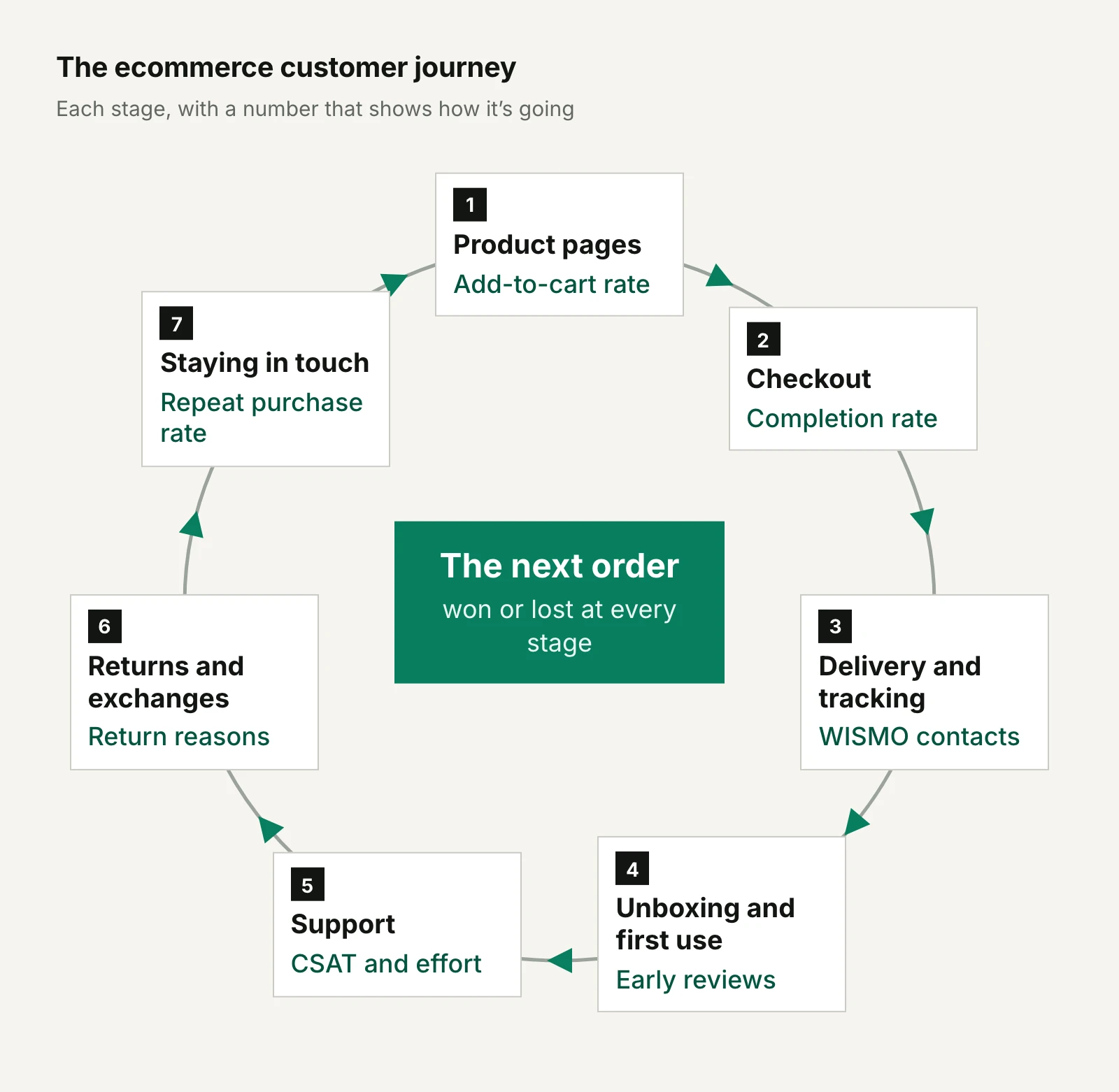
You improve the ecommerce customer experience one stage at a time, because each stage goes wrong in its own way and has its own number to watch. A typical customer journey has the stages below:
1. Discovery and product pages
Product pages shape the experience before anyone has bought anything, because they set the expectations every later stage has to meet.
A good product page answers the questions a shopper would otherwise ask a store assistant: what's included, whether it will fit or suit them, what delivery costs, when it will arrive and what happens if it doesn't work out.
Delivery dates belong here, not just at checkout. In Narvar's August 2025 survey of 3,461 US online shoppers, 73% said estimated delivery dates influence their purchase decisions, and 40% said they won't buy if no date is shown.
Fit is the hardest question for clothing and footwear. Jeff Mergy, VP of growth, partnerships and strategy at Bold Metrics, argued on our podcast that fit may be the most overlooked lever in customer experience, because a poor fit leads to returns and lost customers.
Patagonia makes fit easier to judge with model height and size labels on its product photos and a size guide that explains how to take your own measurements.
Measure this stage with your add-to-cart and conversion rates, and with return reasons: a high share of "not as described" or "didn't fit" returns points back to the page.
The questions shoppers ask in chat before they buy show what your product page leaves out.
2. Checkout
A good checkout lets a customer pay quickly and without surprises: the full cost and delivery date shown before payment, guest checkout as the obvious route and the payment methods they already use.
Extra costs are the most common reason shoppers give for leaving. In Baymard Institute's 2026 survey of 1,083 US adults, 40% of those who left for a reason other than browsing blamed extra costs.
Forced accounts and long forms also cost orders. In the same survey, 18% left because the site wanted them to create an account, and 17% found the checkout too long or complicated.
Rothy's checkout avoids both problems at the start. Shop Pay, PayPal and Google Pay buttons sit above the form, and guest shoppers begin at the email field, with signing in offered as a link rather than a gate.
Measure checkout with your completion rate, the share of started checkouts that end in an order, and watch payment errors and checkout questions to support. Test checkout on a phone, too, where express payment and less typing make checkout easier on a small screen.
3. Delivery and tracking
Delivery is where an online order becomes real, and customers notice at once when it goes wrong. In Narvar's survey, 74% of shoppers had a late delivery in the past year.
A good delivery experience means a realistic promise made before purchase, an order that ships when you said it would and updates that reach the customer before they think to ask.
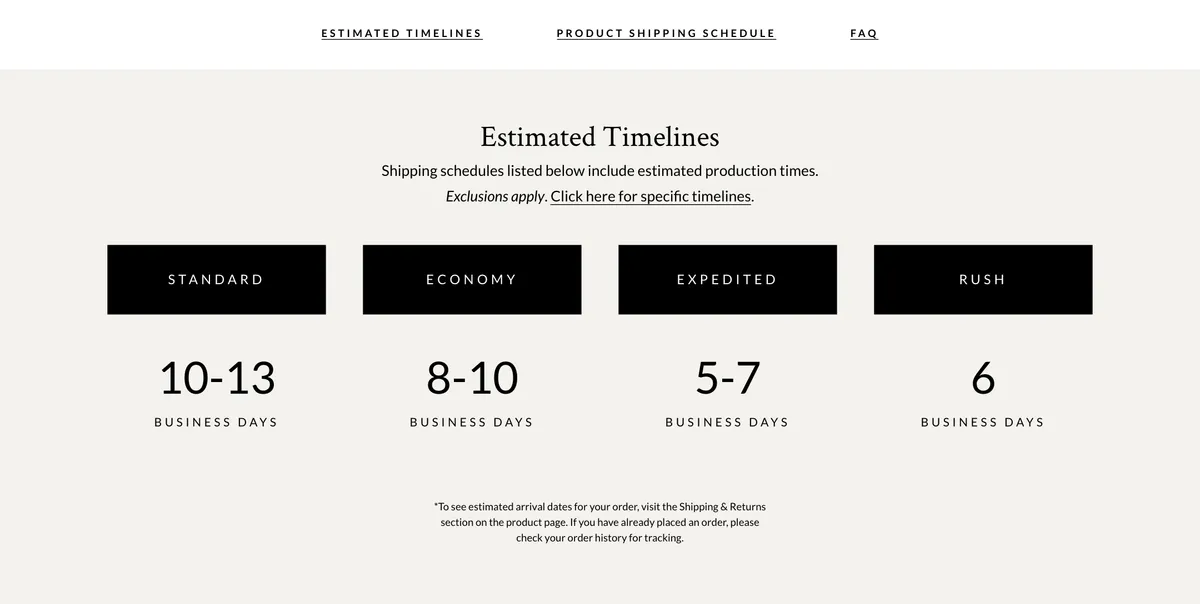
Artifact Uprising, which makes photo books, prints and cards to order, sets that promise in its shipping guide. For most of the year, the guide gives total delivery times with production included, so customers know before they buy that standard delivery takes 10 to 13 business days:
Kira Waite, director of operations and CX at Artifact Uprising, told our podcast that on-time shipping is the company's number one retention metric. Waite's team works to prevent order-status questions before customers send them.
"Where is my order" tickets, often called WISMO, are the clearest sign that customers don't know what's happening with their order. When a delivery does go wrong, the shoppers in Narvar's survey wanted acknowledgment (46%), clear explanations (46%) and real-time updates (45%) before they had to ask.
Measure delivery with your on-time rate against the date you promised, and with WISMO contacts per 100 orders.
4. Unboxing and first use
The first few days with a product decide whether the customer feels they made a good choice. A good start means the order arrives complete and undamaged, and help with setup or first use is there when the customer needs it, not buried in a manual.
If a third-party logistics provider (3PL) packs your orders, its mistakes reach customers under your name. John Heenan, CEO of The Distribution Solution, warned on our podcast that a 3PL that falls short can quietly erode trust and drive customers away, often before the brand notices.
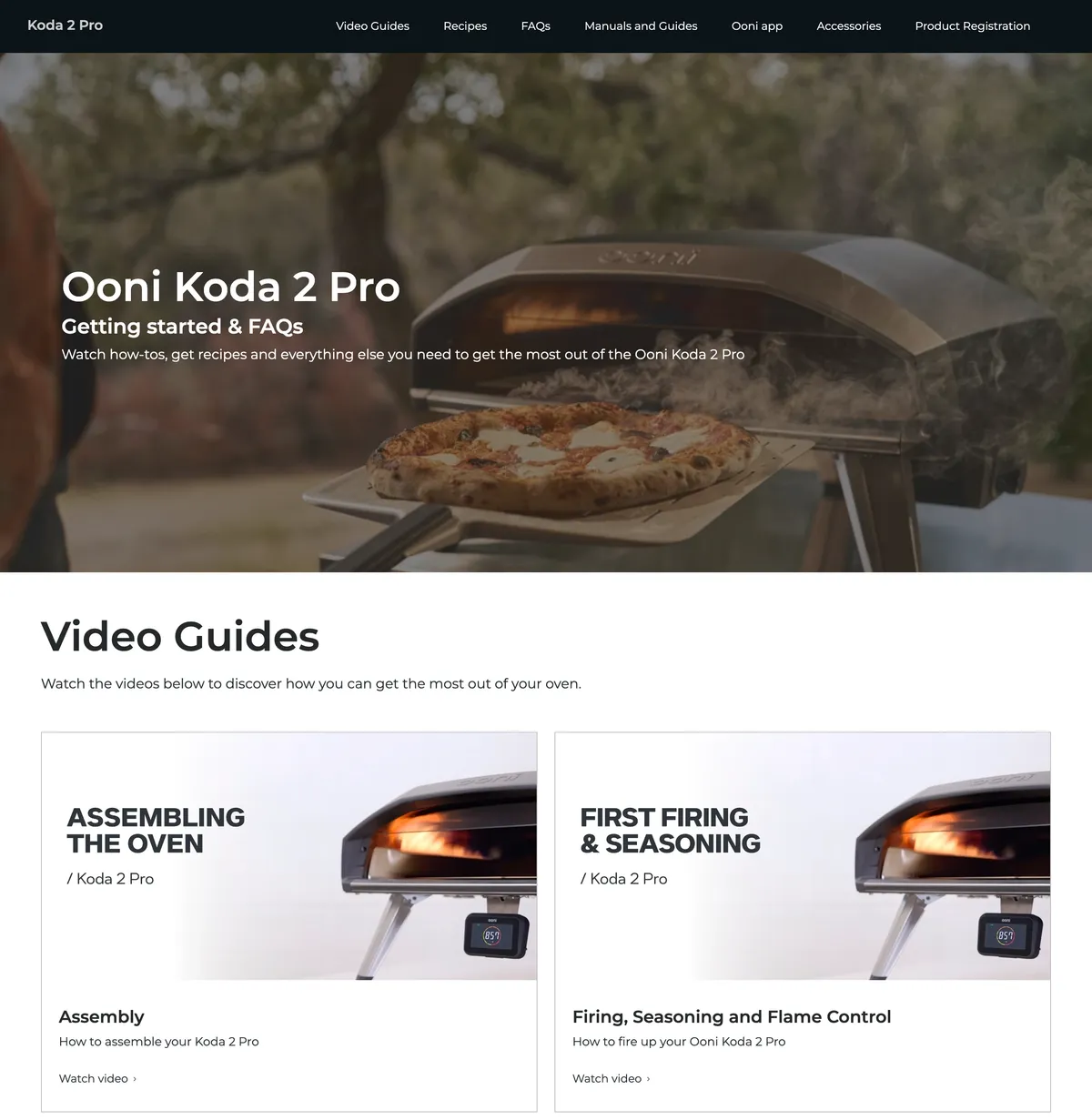
Once the order arrives, help customers get value from what they bought. Ooni publishes getting-started pages for its pizza ovens. The page for the Koda 2 Pro has video guides on assembly, firing it up, its digital temperature hub and looking after the oven, followed by recipes for once it's set up:
A page like this is a strong fit when a product needs assembly, practice or care before it works well, as appliances, furniture and outdoor gear often do. For simpler products, a short email timed to delivery day can do the same job.
Measure this stage with early review ratings and with returns marked "defective" or "didn't work as expected". Setup and how-to questions in the first few weeks after delivery count too. A one-question survey a few days after delivery catches problems while there's still time to fix them.
5. Customer support
Good ecommerce support answers routine questions straight away, gets complex or sensitive ones to a person quickly and gives the same answers as the website. Customers should be able to check an order, start a return or change an address without waiting for anyone.
Online retailers still fall short on support, which tied for the lowest score in ACSI's study, at 78.
In the same study, Nordstrom rose 5% to tie Amazon and Chewy for the highest overall score among online retailers, at 82. ACSI suggested that Nordstrom's strategic use of AI, alongside a commitment to human customer interactions, was paying off.
AI is best suited to routine work, as long as it knows when to step aside. At Dr. Bronner's, when a customer mentions a health concern, Gorgias's AI agent suggests a few products and then hands the conversation to a live agent.
With AI, automated flows and self-service handling routine questions, Dr. Bronner's support team has stayed at five people while ticket volume grew by about a third, according to Gorgias's case study.
Measure support with a satisfaction score after each resolved conversation, an effort score for common tasks and contacts per 100 orders. Read the tickets as well as the scores, because they show which earlier stage caused the question.
6. Returns and exchanges
A good returns experience starts before the purchase, with a clear policy, and ends with a fast refund or an exchange that keeps the sale. In between, the customer should be able to start a return themselves, see their options and know when they'll get their money back.
Exchanges are ideal for size-related returns, where the customer still wants the product in a different size.
Some brands use returns to make the first order feel safe. Under Mack Weldon's Try On Guarantee, a first-time customer who doesn't love their first pair of underwear gets a different size or a full refund, with no return required.
Measure returns by product and by reason, not just as an overall rate. In Loop's returns data, published in February 2026, size or fit drove 56% of apparel returns and 61% of footwear returns, which points back to the product page. Track the share of returns that become exchanges as well.
7. Staying in touch between orders
Between orders, a good experience means hearing from the brand when it's useful: a refill reminder when the product is running low, early access for regular customers and an easy way to manage a subscription or account.
Yon-Ka Paris, the French skincare brand, shows how far useful contact between orders can go: it reached a 50% repeat purchase rate without relying on discounts. On our podcast, Raphael Faccarello, its global ecommerce director, credited that rate to loyalty tiers, app-based rewards and a rebuilt email program.
Too many messages, or messages that ignore what the customer bought, undo the goodwill the earlier stages built.
Measure this stage with your repeat purchase rate and the time to a second order, alongside unsubscribe rates for each channel.
How do you measure ecommerce customer experience?
You measure ecommerce customer experience with a mix of survey scores, operational data you already collect and the repeat purchase rate that shows whether it's all working. No single score covers the whole journey, because each one sees a different part of it:
| Measure | What it asks or counts | Best for |
|---|---|---|
| Customer satisfaction score (CSAT) | "How satisfied were you with…?", usually on a 1 to 5 scale and reported as the share answering 4 or 5 | One interaction, such as a support conversation or a delivery |
| Net promoter score (NPS) | "How likely are you to recommend us to a friend or colleague?" on a 0 to 10 scale | The overall relationship, tracked over time |
| Customer effort score (CES) | "How easy was it to…?" after a task | Checkout, returns and getting help |
| WISMO contacts | Order-status questions per 100 orders | Delivery promises and tracking updates |
| Return rate and reasons | Returns by product and stated reason | Product pages, sizing and quality |
| Repeat purchase rate | The share of customers who order again within a set period | The result of the whole experience |
Survey scores only hear from the customers who answer, and most don't: Qualtrics' 2025 consumer survey found that fewer than one in three consumers provide feedback to companies, an all-time low.
Pair the scores with what customers do: whether they contact you, send things back and order again. If satisfaction looks healthy but the second-order rate is falling, the problem is probably in a stage you're not surveying.
What's the difference between CSAT, NPS and customer effort score?
CSAT measures how satisfied a customer was with one moment, NPS measures how they feel about the brand overall and customer effort score measures how easy a specific task was.
Under Bain & Company's definition, NPS is the percentage of promoters, who answer 9 or 10, minus the percentage of detractors, who answer 0 to 6.
Send CSAT and effort questions straight after the interaction they describe, while it's fresh, and compare results for the same touchpoint over time.
NPS is best suited to a periodic survey a few weeks after delivery, once the customer has used the product. Compare it with your own past scores rather than another company's, since the timing and audience of a survey change the result.
Which stage should you improve first?
The stage to improve first is the one that causes your customers the most trouble, and your support tickets and return reasons will usually point to it.
Tag a few weeks of tickets by stage: the stage with the most is often the place to begin, because each ticket is a customer who had to ask.
What you sell also shapes where the experience is won or lost:
| Your store | Start with | What to watch |
|---|---|---|
| Apparel and footwear | Product pages and returns, because size and fit drive most returns | Return reasons and the share of returns exchanged |
| Consumables, such as coffee, supplements or skincare | Delivery and staying in touch, because customers reorder on a cycle | Time to second order |
| Considered or technical products, such as furniture, appliances or electronics | Delivery, first use and support | Setup questions and early reviews |
| Made-to-order and personalized products | Delivery promises, because production adds time customers can't see | On-time rate and WISMO contacts |
| Gift-heavy categories in the holidays | Order-by dates and gift returns | Late deliveries and January returns |
Whichever stage you start with, measure the result in repeat orders as well as in the stage's own number. If faster refunds don't change how many customers come back, whatever is costing you second orders is somewhere else.
Final thoughts
Every other retention tactic, from win-back emails to loyalty points, has a harder job when a customer's last delivery was late or their refund dragged on. So fix one stage properly before spreading your effort across the whole journey, and let your own data choose the stage.
If order-status questions fill your inbox, start with the delivery date on your product pages and the tracking updates after purchase. Returns marked "didn't fit" or "not as described" send you back to the product pages themselves, while setup questions in the weeks after delivery mean first use needs work.
If nothing in your data stands out, start with delivery, because it touches every order and shoppers weigh the delivery date before they decide to buy.
Frequently asked questions
What are some good examples of ecommerce customer experience?
Good examples of ecommerce customer experience include Artifact Uprising's shipping guide, Ooni's getting-started pages for its pizza ovens and Mack Weldon's Try On Guarantee. Each removes a worry before the customer has it: when the order will arrive, how to set the product up and what happens if it isn't right.
Among the largest US online retailers, Amazon, Nordstrom and Chewy tied for the highest customer satisfaction score in ACSI's 2026 study, at 82.
How can a small team improve the customer experience?
A small team can improve the customer experience by preventing the questions that fill its inbox. Show delivery dates on product pages, send tracking updates before customers ask and let them start returns themselves, since each one removes a routine ticket.
Then use the time saved to answer the remaining questions well, and read those tickets for patterns that point to the next fix.
Does AI improve the ecommerce customer experience?
AI improves the ecommerce customer experience when it answers routine questions accurately and hands off to a person when it can't.
Done badly, it makes things worse: in Qualtrics' Q3 2025 survey, nearly one in five consumers who used AI for customer support saw no benefit at all, almost four times the failure rate of other uses of AI.
If you add an AI agent, set it up so customers can always reach a person, with the conversation history passed along.
Do you need a mobile app to offer a good customer experience?
You don't need a mobile app to offer a good customer experience, but for brands with loyal repeat customers, an app can make reordering, tracking and rewards easier.
In ACSI's 2026 study, 58% of online retail respondents said they use a retailer's app as part of their shopping, and app quality (88) and reliability (87) were the highest-rated parts of the experience.
A fast, easy mobile site comes first.
How often should you survey customers about their experience?
Most stores should survey customers right after the interactions they want to understand, and run a broader survey, such as NPS, no more than a few times a year. CSAT and effort questions work best as a single question sent straight after a support conversation, a delivery or a return.
Keep each survey short and avoid asking the same customer too often, so the customers who reply once are willing to reply again.