
Your ads and product pages work harder when they show real people using your product. A 20-second clip of someone unboxing it, trying it on or using it in their kitchen answers questions your own photos can't.
Getting that footage by hand is slow, though. You find creators on TikTok or Instagram, message each one, agree on a fee, ship it and chase the files. The videos end up in a shared drive, and a few months later nobody can say whether the creator agreed to let you run them as ads.
A UGC platform puts that whole process in one place. You post a brief, pick creators, pay them through the platform and approve their work, and every file comes with usage rights attached. Other UGC tools do the same job for photos and videos your customers already post about you.
We've rounded up the best UGC platforms for ecommerce brands. You'll see what each one does and how they compare, the two kinds of tool, what they cost, who owns the content and how to choose.
What are the best UGC platforms for ecommerce brands?
The best UGC platforms for ecommerce brands include Billo, Insense, JoinBrands, soona and Cohley for content you pay creators to make, and Archive and Bazaarvoice for content customers and creators already post.
Those are two different kinds of tool, so it helps to know which one you're shopping for:
- Creator marketplaces connect you with people who film your product to a brief. You get videos and photos to run in ads, on product pages and in email, and the platforms differ mostly in how they charge and how much of the work they take off you.
- Capture and display tools find posts about your brand on social media, ask the people who made them for permission and turn the content into shoppable galleries on your site and in your emails.
Review apps are a third category. Apps such as Okendo and Loox ask every customer for a review after an order and collect photos and videos alongside their ratings. This roundup leaves them out.
| Platform | Type | How you pay (November 2026) | Best for |
|---|---|---|---|
| Billo | Creator marketplace | Prepaid packs from $1,000, videos from $99 | Paid social ads without a subscription |
| Insense | Creator marketplace | From $400/month plus creator fees | UGC, seeding and partnership ads together |
| JoinBrands | Creator marketplace | Free to $499/month plus creator fees, videos from $25 | High volume and TikTok Shop |
| soona UGC | Creator marketplace | $89 to $259 per video | Set prices with no negotiation |
| Cohley | Creator content platform | Seeding $35 per creator, platform by quote | Content for many channels, retailers included |
| Archive | Capture and rights | Quote | Keeping track of posts you already get |
| Bazaarvoice Social Commerce | Galleries and rights | Quote | Larger brands selling in several markets |
1. Billo
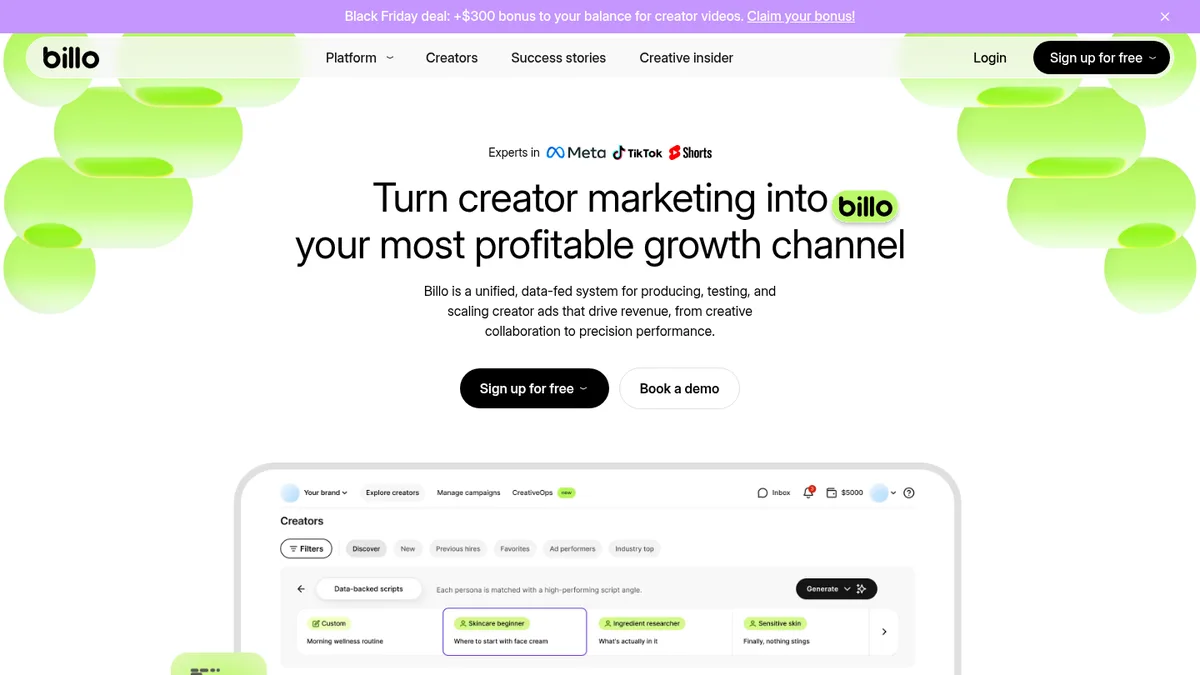
Billo is a creator marketplace built around video ads for Meta, TikTok and YouTube Shorts, with more than 5,000 vetted creators.
You write a brief, or let Billo's script generator draft one from a product link, and Billo's creator matching helps you pick who films it.
A creator can also post the video on their own profile, and you can then run it as a partnership ad from their handle. Billo makes new variations from footage you already have and shows which of your ads perform.
Under Billo's terms, the rights to each video pass to your brand when you accept it, unless you and the creator agree otherwise.
- Pricing: prepaid packs from $1,000 (up to 10 videos), with no subscription and a balance that lasts 12 months. Videos start at $99 for 15 seconds with basic editing. Optional CreativeOps tools start at $149/month, and the managed service at $2,000/month plus videos.
- Rights: ownership transfers to your brand
- Best for: brands that need a steady supply of paid social ads and don't want a subscription
2. Insense
Insense runs UGC and influencer campaigns in one platform. They have more than 115,000 creators in 57 countries, plus an outreach tool for millions of Meta and TikTok influencers.
You build a brief from a template, creators apply within 48 hours and content arrives within 14 days.
For product seeding, the Shopify integration exports creators' shipping details in bulk. You can request Meta Partnership Ads access and TikTok Spark Ad codes from creators, pay affiliate commissions and ask for up to three revisions on each piece.
Creators keep the copyright and grant you perpetual rights to use the content across digital marketing. Full ownership is available through Insense's managed service, with a separate contract.
- Pricing: a one-month trial at $650, then the Brand plan at $500/month billed quarterly or $400/month billed annually. Creator payments are extra, plus a 10% fee, and UGC videos start at $100.
- Rights: perpetual digital usage rights
- Best for: brands that run UGC, product seeding and partnership ads side by side
3. JoinBrands
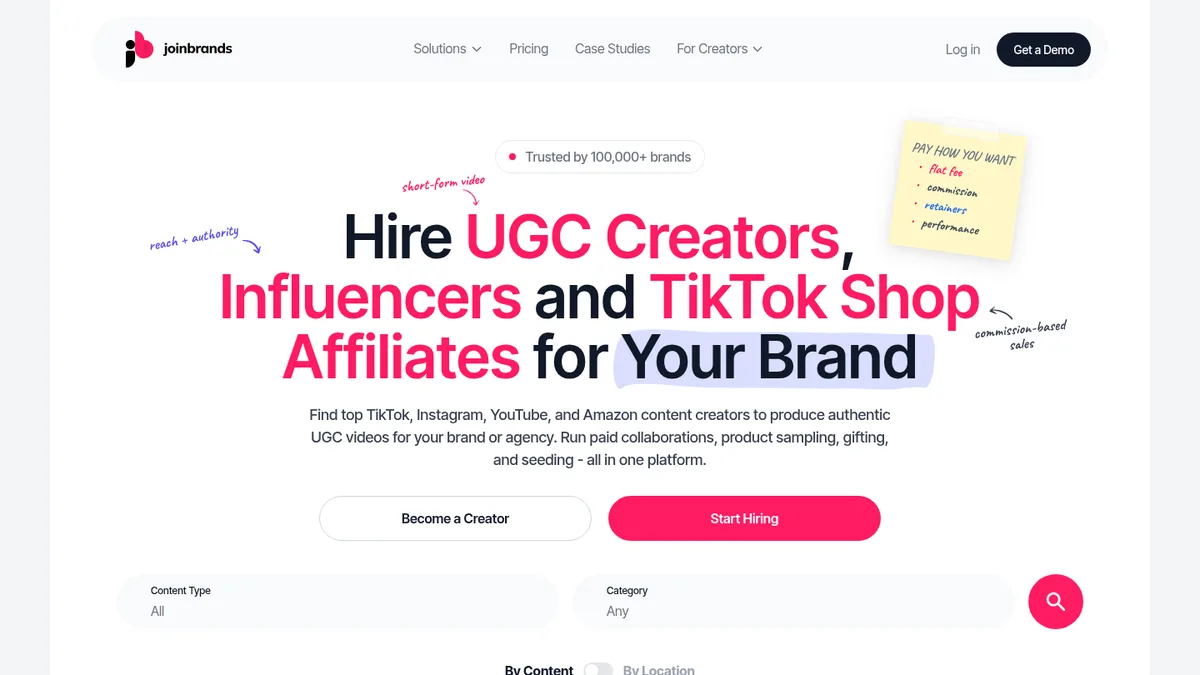
JoinBrands is a creator marketplace with more than 4 million creators and affiliates. They cover UGC, product sampling and gifting, Amazon shoppable videos and TikTok Shop affiliates.
You set your targeting and brief, creators apply and JoinBrands holds your payment until you approve the content. Every TikTok video comes with a Spark code, and every Instagram post with a partnership ad code. A dashboard tracks views, conversions and sales for your TikTok and TikTok Shop creators.
- Pricing: Free, Start-up at $99/month, Pro at $299/month and Max at $499/month. The platform fee on creator payments falls from 15% to 8% as you move up, and paid plans include $30 to $150 a month in credit toward creator payments. UGC videos start at $25 and images at $10.
- Rights: unlimited usage rights on content you buy
- Best for: brands that need a high volume of low-cost videos, especially for TikTok Shop or Amazon
4. soona UGC (formerly Trend)
Trend, the UGC marketplace, is now part of soona, a product photo and video studio, and Trend's pricing page sends brands to soona's UGC service. The same platform sells studio shoots and creator content.
You create a campaign, review applications or invite creators from soona's directory, then ship them your product. Content arrives within seven days of the creator receiving it, and the company says they accept about 35% of the creators who apply.
Prices are pre-negotiated by creator level, so you don't haggle over fees, and every piece comes with an unlimited, worldwide license.
- Pricing: $89 to $259 per video, depending on the creator's level
- Rights: unlimited, worldwide license for all platforms
- Best for: brands that want a set price per video, or studio shots and UGC from one supplier
5. Cohley
Cohley is a creator content platform for mid-market and enterprise brands that sell physical products in the US and Canada. Their 200,000-plus vetted creators make UGC, influencer content and product reviews, and take part in product seeding.
Their AI agent, Finn, vets applicants and checks each submission against your brief before it reaches you, though Cohley notes Finn is still in beta.
Creators are trained on FTC disclosure rules before they join a brief. Approved content goes into a library for paid and organic social, email, your own store and retailers' product pages.
- Pricing: product seeding at $35 per completed creator, pay as you go. The full platform and managed services are quoted, starting with a paid three-month pilot.
- Rights: full, perpetual usage rights
- Best for: brands that need a steady flow of content for several channels, including retailer sites
6. Archive
Archive finds content about your brand on TikTok, Instagram and YouTube Shorts. They catch Instagram Stories, which disappear after a day, and posts that feature your brand without tagging you.
When you want to reuse a post, you request usage rights with a direct message from inside Archive, which records whether each request is approved, rejected or pending. Archive also handles whitelisting, so you can run a creator's post as an ad, plus creator discovery and campaign reporting.
- Pricing: Startup, Growth and Enterprise plans, all quoted
- Works with: TikTok, Instagram and YouTube
- Best for: brands that already get plenty of posts from customers and gifted creators and lose track of them
7. Bazaarvoice Social Commerce
Bazaarvoice Social Commerce pulls content from Instagram, TikTok, YouTube, Facebook, Pinterest and X into one library, where you tag it, clear the rights and publish it to shoppable galleries.
The galleries run on your product pages and in your emails, and a feature called Reveal lets shoppers buy items they see in a lifestyle photo. Google Analytics and Adobe Analytics tie revenue back to each post. If you sell in several countries, galleries show the right products and currency for each region.
Rights requests run inside the platform, and the Advanced and Enterprise packages add automated rights detection and tracking for when rights expire.
- Pricing: Essentials, Advanced and Enterprise packages, quoted by the sales team and paired with an implementation service
- Works with: six social networks, plus an add-to-cart integration for Shopify
- Best for: larger brands that sell in several markets, especially those already using Bazaarvoice for reviews
How much do UGC platforms cost?
A UGC platform's cost is the platform's own charge plus what you pay creators, and your product and its shipping come on top. Most creator marketplaces publish their prices, while the capture and display tools all quote.
The marketplaces charge in three ways:
- A prepaid balance. Billo sells packs from $1,000, and each video comes out of the balance.
- A subscription plus a fee. Insense and JoinBrands charge a monthly plan, then add a percentage to every creator payment.
- A set price per piece of work. A soona video costs $89 to $259, depending on the creator, and Cohley charges $35 per creator for product seeding.
$25
JoinBrands starting price per UGC video, November 2026
$89
soona starting price per UGC video, November 2026
$99
Billo starting price per 15-second UGC video, November 2026
$100
Insense starting price per UGC video, November 2026
The starting price is rarely what you pay. Billo's $99 covers a 15-second video from a regular creator, with their fees included, and a longer video or a more experienced creator costs more. On JoinBrands and Insense, $25 and $100 are the floor for a video, before the platform fee and any monthly plan.
A subscription gets better value the more you order. Paid JoinBrands plans cut the fee and add monthly credit that goes toward creator payments, so a brand ordering every month gets back part of the plan price.
If you only need a batch of videos for a launch, a prepaid pack or a set per-video price is simpler.
The capture and display tools quote their prices. Bazaarvoice pairs each package with an implementation service, so budget for that setup work alongside the subscription.
Who owns the content you get from a UGC platform?
Who owns the content you get from a UGC platform depends on its terms, and the difference matters when you want to edit a video or run it as an ad for years.
Billo's creator terms transfer the rights in each video to your brand once you accept it, including use in paid ads, on your website and on social.
Insense works differently: the creator keeps the copyright and grants you perpetual rights to use the content in digital marketing. Cohley, JoinBrands and soona each promise perpetual or unlimited usage rights on what you buy.
Content that customers post on their own accounts is another matter. There you only hold the permission you asked for, which is why Archive and Bazaarvoice log every request, and Bazaarvoice also tracks when rights expire.
Running an ad from a creator's own account needs separate permission again. Meta Partnership Ads and TikTok Spark codes give you that access, and Billo, Insense and JoinBrands request them as part of a campaign.
Before you sign up, put the same questions to every vendor on your list:
- Can you run the content in paid ads, and for how long?
- Can you edit it and cut new versions?
- Does your license continue if you cancel the platform?
- Who signs the contract with the creator and pays them?
Clear answers now save you from pulling a winning ad later because nobody can show you had permission to run it.
How to choose a UGC platform
The right UGC platform depends on where the content will run and how much of the creator work your team wants to do. These checks narrow the list quickly:
- Start from where the content will run. Paid social needs a steady supply of fresh videos, which is what a creator marketplace is built for. Product pages and email campaigns can also draw on what customers already post.
- Decide who manages the creators. Self-serve plans need someone to write briefs, review applicants and give feedback. Billo, Insense and Cohley also sell a managed service.
- Price a year of content. Multiply the videos you expect to order by a realistic per-video price, then add the subscription and fees.
- Get the rights in writing. Read the terms for paid ads, editing and what happens if you cancel.
- Check how content reaches your ads. Partnership ad and Spark code support saves you a manual step every time a video performs.
Paid social is usually where brands feel the need first, because ad creative wears out fast and creator videos can bring down what you pay to win a customer.
Final thoughts
Video of real people using your product is some of the most useful content a brand can have, because the same clip works in ads, on product pages and in email. A UGC platform turns that footage from a favor you chase into something you can order, approve and reuse with the rights settled.
For most brands, the first tool is a creator marketplace, because ads need the most content. Billo is the simplest way in if you'd rather buy videos as you need them than pay a subscription.
Insense and JoinBrands suit brands that also run influencer, seeding or TikTok Shop campaigns. JoinBrands is ideal for high volume at a low price per video.
For a fixed price per video, look at soona, while Cohley fits brands that need content for retailers and several channels at once.
A capture tool earns its place once customers post about you regularly. Archive keeps track of those posts and the permissions behind them, and Bazaarvoice turns them into shoppable galleries on your site.
Frequently asked questions
What's the difference between a UGC platform and a review app?
A UGC platform gets you creator videos and social posts to use in ads, galleries and email, while a review app collects ratings and reviews from customers after they buy. Review apps also gather customer photos and videos, but always attached to a review on a product page.
What is whitelisting in UGC?
Whitelisting in UGC means running your ads from a creator's own social account, with their permission, so the ad appears under their handle. Meta now calls this Partnership Ads, and TikTok uses Spark Ad codes for the same thing.
Billo, Insense and JoinBrands request this access as part of a campaign, and Archive handles it for posts you find.
How long does it take to get UGC videos back?
UGC videos usually arrive within about two weeks of launching a campaign. JoinBrands says most brands get content within three to seven days of launching a campaign, soona says seven days after the creator receives the product and Insense says 14 days. Shipping times and revisions add to that.
Do you have to send creators free product?
You usually have to send creators your product, and its cost isn't included in what the platform charges. Billo, for example, says their video price doesn't cover the product or shipping it. Budget for one unit for every creator you hire.
Is UGC the same as influencer marketing?
UGC isn't the same as influencer marketing, although the two overlap. UGC creators make content for you to publish, in ads and on your site, while influencers post to their own audience. Several platforms, including Insense, JoinBrands and Cohley, run both kinds of campaign.