
Your customers already recommend you. A friend asks where a jacket came from. Someone passes on the name of the pet food their dog finally eats, or drops a link to a suitcase into a group chat. Most of those conversations happen where you can't see them, and nobody gets anything for them.
A referral program gives that recommendation a link to share, a reward for both people and a record of who brought in whom. The friend gets a reason to place a first order now. The customer who recommended you gets a reason to come back and place another.
Below are referral program examples from ecommerce brands, grouped by the kind of reward they use. For each one you'll see what the friend gets, what the referrer gets and the rules behind the offer.
After the examples come the decisions you'll make to set up a referral program for your own store.
What makes a referral program work?
A referral program works when both people get a reward worth acting on and the referrer's reward brings them back to your store. It also needs rules: a referral counts only when a real first order goes through, and limits in the terms stop people gaming it.
Brands put those parts together in very different ways. Here's what each of the current programs below offered in November 2026:
| Brand | The friend gets | The referrer gets | Main limit |
|---|---|---|---|
| Away | $40 off a first purchase of $125+ | A $40 discount code | Five referrals per customer |
| Mack Weldon | $20 off a first order of $75+ | $20 in store credit | New customers only |
| Dovetail Workwear | $10 off | A $10 code that never expires | First-time customers only |
| Grove Collaborative | A free gift set with the first order | $25 in rewards | 39 friends a year |
| Bartesian | $25 off | 2,500 points, worth $25 | New customers only |
| The Honest Kitchen | 20% off a first order of $30+ | 400 points, worth $20 | Order kept for 30 days |
| AG1 | $15 | $15 in credit | Only subscribers can refer |
| Thrive Market | 40% off the first order, up to $30 | $40 in Thrive Cash | Friend stays a paid member for 30 days |
| Dollar Shave Club | 30% off a new subscription | 50%-off codes, then a free product | 10 referrals per customer |
Every one of them rewards both sides, and none pays the referrer in cash. The differences are in the size of the reward, what has to happen before it's paid and how far a single customer can take it.
10 referral program examples from ecommerce brands
These referral programs are grouped by the reward they lean on. Some give the same dollar amount to both people, one gives the friend a product and some pay the referrer in loyalty points. Others limit referrals to subscribers or save their best reward for the customers who refer the most.
Give-and-get discounts
The simplest referral setup gives the friend and the referrer the same amount. It fits in one line on a product page or in an email, which makes it easy for a customer to explain to a friend.
1. Away
Away, the luggage brand, gives a referred friend $40 off their first purchase and gives the referrer a $40 discount code. Under Away's US referral terms, the friend's first purchase has to be worth at least $125, not counting taxes, discounts, shipping and returns.
Each customer can earn rewards for up to five referrals, so the most anyone can collect is $200. The codes can't be combined with welcome offers, bundle discounts or sale items. The terms also rule out using the program for affiliate lead generation or posting the link on discount sites.
For a brand whose customers buy rarely and spend a lot, a large round number gets noticed. The $125 minimum keeps the friend's $40 discount to less than a third of the order.
2. Mack Weldon
Mack Weldon, which sells men's basics, gives friends $20 off their first order of $75 or more and gives the referrer $20 in store credit for every successful referral. There's no limit on how many friends a customer can refer.
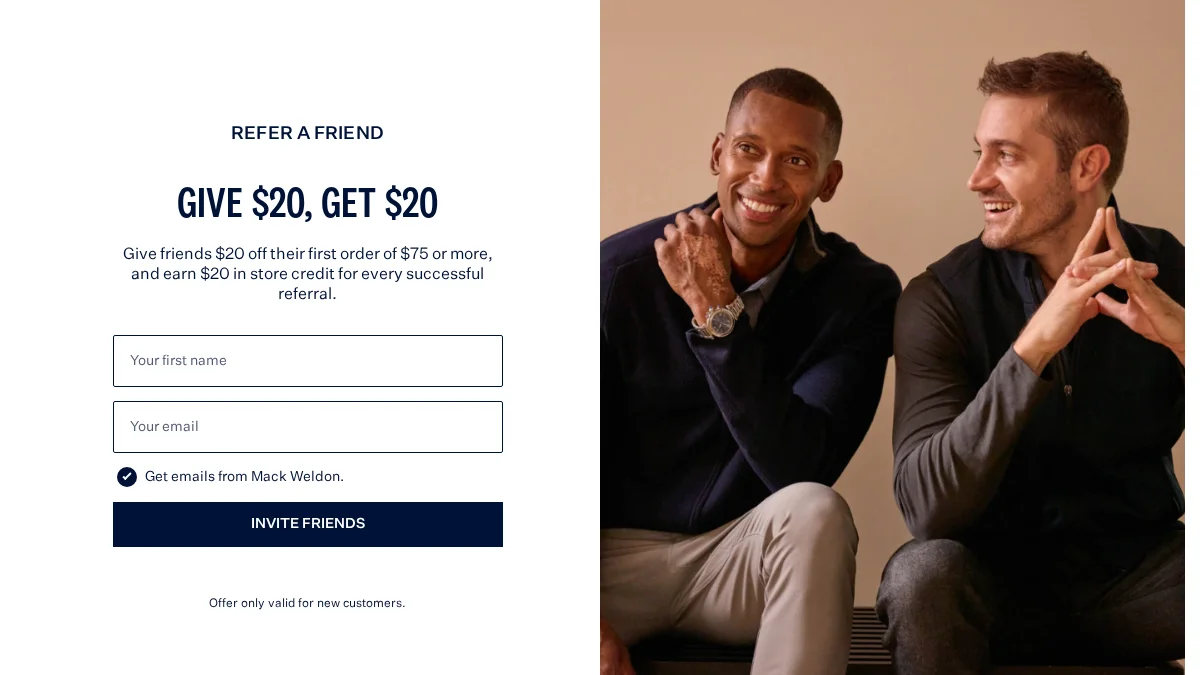
Store credit can only be spent at Mack Weldon. So the reward does a second job: every friend who buys sends the referrer back to the store with credit to spend.
3. Dovetail Workwear
Dovetail Workwear, which makes workwear for women, offers $10 for the referrer and $10 for the friend. Its referral page says the referrer's code never expires and that customers can save up several codes for a bigger purchase. There's no cap on referrals.
The terms rule out self-referrals, including orders from someone in the same household. If a referred customer returns or cancels their order, Dovetail can reverse the reward.
A $10 reward is small, but the program is easy to use: one link for every friend, a code with no deadline and no limit. That suits workwear, where a customer might recommend the brand to one coworker now and another next year.
A free gift for the friend
A discount isn't the only first-order reward. Giving the friend a product lets them try more of your range than they'd have bought on their own.
4. Grove Collaborative
Grove Collaborative, which sells household and cleaning products, gives a referred friend a free gift set with their first order. The 14-piece set includes bamboo toilet paper, a refillable spray bottle with cleaning concentrate, scrubber sponges and laundry sheets. The page shows it as a $46 value.
Once the friend completes their purchase, the referrer gets $25 in rewards to spend on their next Grove order. Customers can earn rewards for up to 39 friends a year, or $975. If the friend cancels the order, the gift isn't valid and the referrer gets nothing.
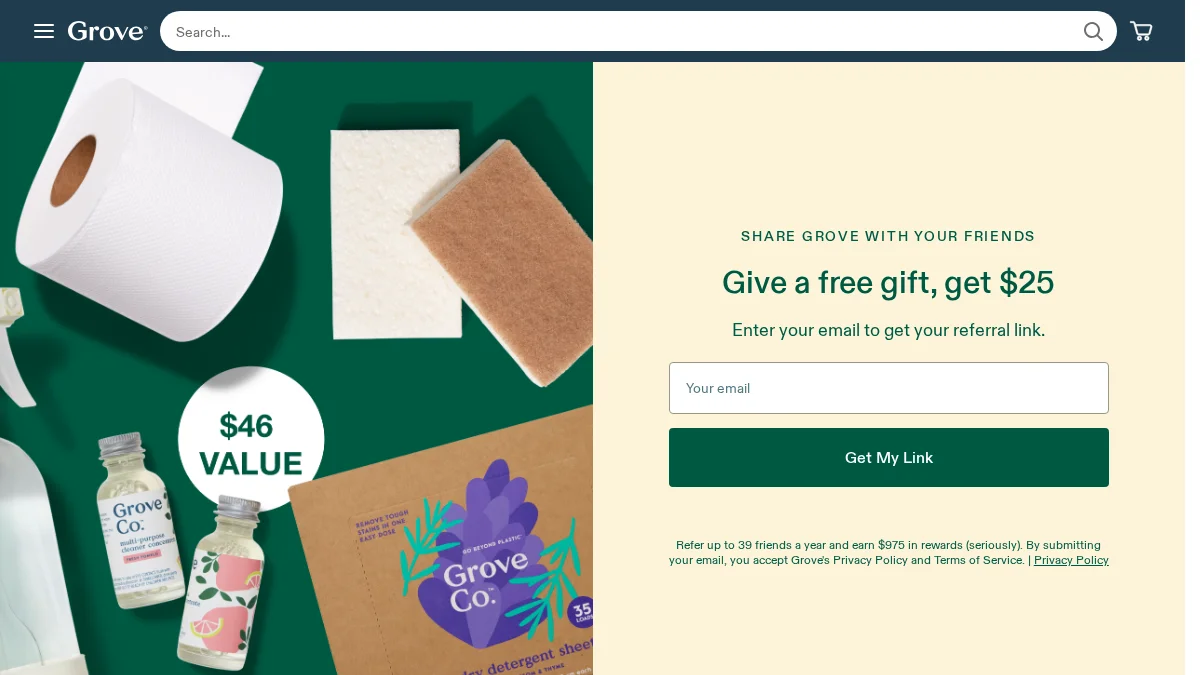
A gift set puts several Grove products in a new customer's home at once, including a refillable spray bottle, and every refill the customer buys later is another order. And the set costs Grove less than the $46 retail value shown on the page.
Referral rewards paid in loyalty points
Some brands pay the referrer in points from their loyalty program instead of a separate code. The reward then sits in the same balance as the points the customer earns on orders, and a customer already collecting toward a points reward gets there sooner.
5. Bartesian
Bartesian, which makes cocktail machines and the capsules that go in them, gives the friend $25 off and the referrer 2,500 points. Its help center says 1,000 points can be redeemed for a $10 reward, so a referral is worth $25 to the referrer.
Referrers can spend the points at checkout or on their next cocktail subscription shipment. There's no limit on referrals, and if the friend's order is canceled before it ships, the referrer gets no reward.
The capsules are the part of a Bartesian that customers buy again and again. Points that can go toward a capsule subscription keep the referral reward pointed at that repeat purchase.
6. The Honest Kitchen
The Honest Kitchen, a pet food brand, gives friends 20% off their first order of $30 or more and gives the referrer 400 reward points, worth $20, for each successful referral.
A referral counts only if the friend's order isn't returned or canceled within 30 days, according to The Honest Kitchen's referral terms. So the brand doesn't pay a referral reward on an order that comes back in the first month.
Referrals for subscribers and members
Subscription and membership brands can tie the referral to the thing they sell: an active subscription or a paid membership.
7. AG1
AG1 runs its referral program inside The 1 Club, the loyalty program for customers with an active subscription. Members can give a friend $15 and get $15 in credit, and the referral reward is included at every tier of the club.
Only subscribers can refer, so the people sharing the link are customers who already take AG1 regularly and can speak for it.
8. Thrive Market
Thrive Market, an online grocery store that sells annual memberships, gives a referred friend 40% off their first order, up to $30 off. The referrer gets $40 in Thrive Cash for each friend who becomes a paid annual member, once that friend has been a member for 30 days.
Members can share their referral link directly, post it to Facebook with a prewritten message or send it by email.
Thrive Market pays for the event that earns it money: a paid membership that lasts past its first month. A friend who signs up and cancels straight away earns the referrer nothing.
Milestone rewards for top referrers
A few customers will refer far more people than the rest. A milestone reward gives those customers something bigger to aim for.
9. Dollar Shave Club
Dollar Shave Club gives a referred friend 30% off a new subscription. The referrer gets a code for 50% off one non-razor product for each valid referral, up to nine. At the tenth, they get a free product chosen by Dollar Shave Club instead, and the rewards stop there.
Unlike the other current programs here, Dollar Shave Club rewards the referral itself: a friend's email address, submitted through its form with the friend's consent.
Its terms let it take a reward back if the friend's order is canceled, refunded, returned or charged back. Referrers also have to tell friends that they get a reward for referring them.
Rewarding the referral rather than the purchase makes the program feel generous, because the referrer sees a reward straight away. The ten-referral cap and the right to claw rewards back are what keep it affordable.
10. Harry's pre-launch campaign
Before Harry's opened its online store in March 2013, it ran a one-week referral campaign to build an email list. Co-founder Jeff Raider described it the following year in a post on Tim Ferriss's blog.
Visitors entered their email address, got a unique link and earned free Harry's products as more friends signed up through it. A tracker on the page showed each person how many friends they'd referred and which reward they'd reached. The first reward came quickly, and each one after it took more referrals:
Referrals needed for each reward in Harry's pre-launch campaign, 2013
The campaign brought in nearly 100,000 email addresses in a week. These were sign-ups before launch, not orders, but they show how far a tiered reward can carry a list:
77%
Share of Harry's pre-launch email sign-ups that came through referrals, 2013
65,000
Approximate number of friends referred by about 20,000 people, more than three each on average
200+
People who referred more than 50 friends and reached the top reward
Free products attract people who game the system, and Harry's saw the most fraud in its top tier. Once an IP address had registered two emails, it blocked any more sign-ups from that address. It also sent a simple email to every new address and treated the ones that bounced as fake.
How to set up a referral program for your store
To set up a referral program, you'll make a handful of decisions, from the app that runs it to how you'll judge whether it's working. The examples above show the range of answers, so use them as a menu rather than a template.
1. Choose the app that will run it
Most Shopify brands run referrals through an app rather than building their own. Most Shopify loyalty apps include a referral program alongside points and VIP tiers, so if you already use one, check what it includes before you add another app.
A standalone referral app makes more sense when you want referrals without a points program.
2. Set a reward for each side
Give both people something. The friend's reward gets the first order placed, and the referrer's reward gives them a reason to share and then to come back.
A fixed amount, such as $20 or $40, is easy to say in one line. A percentage grows with the order, so cap it the way Thrive Market caps its 40% at $30. For the friend, a gift like Grove's can work better than a discount when you want them to try several products.
Pay the referrer in store credit, codes or points rather than cash, so the reward returns as an order.
Then add up the cost of both rewards and compare it with what you pay to win a customer through ads. A referral reward is only cheap if it costs less than the ad spend it replaces.
3. Decide what counts as a successful referral
Most programs count a referral only when a new customer places a first order through the referrer's link. A minimum order value, such as Away's $125 or Mack Weldon's $75, keeps the friend's discount in proportion to the sale.
Timing matters too. If you pay the referrer as soon as the order is placed, you'll pay for some orders that come back. The Honest Kitchen waits out a 30-day return window, and Thrive Market waits until the friend has been a paid member for 30 days.
4. Put limits and fraud rules in the terms
The terms behind these programs cover much the same ground:
- A cap per customer, if you want one. Away stops at five referrals and Grove at 39 a year, while Mack Weldon and Dovetail have no cap.
- No self-referrals, including second accounts and other people in the same household.
- No coupon sites or mass posting, so the link reaches people the customer knows.
- A disclosure rule, so referrers tell friends they get a reward. Stanley 1913's terms describe this as a legal requirement.
- The right to reverse a reward when the friend's order is canceled, returned or charged back.
Rules like these let you offer a generous reward without it being drained by a few people. Harry's saw the most abuse where the prizes were biggest, so tighten the rules most around your top reward.
5. Put the referral link where customers will see it
Customers can only share a link they can find. Put it in your post-purchase email flow, on the order confirmation page and in the customer account, where people look after they've bought, not only on a page linked from your footer.
Make sharing quick. Grove lets customers share by text, email or social, and Dovetail uses one link for every friend, so a customer never has to generate a new one.
6. Track what referred customers do next
Count more than referral sign-ups. Track how many referred friends place a first order, how many return it and how many buy again. Work out the reward cost for each new customer too. Then compare those figures with customers who arrived through paid ads.
If referred customers buy again more often, you can afford a bigger reward. If many of them only buy once with the discount, a smaller friend reward or a higher minimum order may suit you better.
Final thoughts
Customers recommend the products they like whether or not you run a referral program. A program turns some of those conversations into first orders you can see, and gives the customer who started them credit to spend with you.
The right model depends on what you sell. If your product is expensive and bought rarely, a round dollar reward with a minimum order, like Away's, gets noticed without giving away the margin.
If you sell consumables or subscriptions, paying the referrer once the friend has stayed, as Thrive Market does, protects you from one-and-done sign-ups.
If you already run a loyalty program, paying referrals in points keeps the reward in the balance customers are already watching. And if you're launching something new, Harry's tiers show how a few keen referrers can do much of the early work.
Frequently asked questions
Are referred customers more valuable than other customers?
Referred customers were worth more in a study that tracked about 10,000 customers of a German bank for almost three years. The researchers found that a referred customer's average value was at least 16% higher than that of a similar customer who wasn't referred.
Referred customers brought higher margins at first and stayed longer. The study covers a bank, not a store, so check the lifetime value of your own referred customers before you plan around it.
What's the difference between a referral program and an affiliate program?
A referral program rewards customers for recommending you to people they know, usually with store credit or a discount. An affiliate program pays publishers and creators a commission on the sales they send from their audience. Many brands keep the two apart in their terms: Away's referral terms, for example, rule out affiliate lead generation.
What is a client referral program?
A client referral program rewards existing clients for introducing new ones. The term is used mostly by service businesses such as agencies, accountants and consultants. For a store selling products, the same idea is usually called a customer referral program or refer-a-friend program.
Do referrers have to tell friends they get a reward?
Some referral programs require referrers to tell friends they get a reward. Dollar Shave Club's terms make it a rule, and Stanley 1913's terms call it a legal requirement under laws the Federal Trade Commission enforces.
Put the rule in your terms and in the message your referral app sends.
Should referral rewards expire?
Referral rewards don't have to expire, and some brands make a point of it: Dovetail Workwear's referral codes never do. An expiry date can bring customers back sooner, but a reward that lapses unused feels taken away. If you set one, make it longer than a customer's normal buying cycle.