From the shopper's side, most loyalty programs work the same way. You make an account and get a point for every dollar you spend. Every so often, a discount turns up at checkout.
That routine does its job, but it's also why so many programs blur together. The ones shoppers remember change one part of it: what members earn, what they're working toward or what it means to join.
We've collected loyalty program examples from ecommerce brands, from the biggest beauty retailers to mid-size online brands. They're grouped by type: points programs, VIP tiers, gamified programs, paid memberships and a community club. You'll also find a table comparing them, how much each one gives back and which ideas suit which kind of store.
The loyalty program examples at a glance
The loyalty programs below cover every common format, and all but three are free to join. Here's how they compare:
| Program | Type | Cost to join | What members get |
|---|---|---|---|
| Sephora Beauty Insider | Points and tiers | Free | Points for products, experiences or money off, plus free shipping |
| The North Face XPLR Pass | Points | Free | A $10 reward for every 100 points, plus free shipping |
| Ulta Beauty Rewards | Points and tiers | Free | Faster earning and points that never expire at the top tiers |
| Brooklinen Rewards | Points and tiers | Free | Longer returns, priority service and input on launches at the top |
| Lululemon Membership | Perks-only tiers | Free | Free hemming, receipt-free returns and early access, with no points |
| Princess Polly Rewards | Gamified tiers | Free | Concert-ticket tiers and bonus points on every third order |
| tentree Rewards | Points with achievements | Free | Extra points for one-off achievements |
| Chewy+ | Paid membership | $59/year | Free shipping and 5% back on food and pharmacy |
| REI Co-op membership | Paid once, member-owned | $30 one time | A yearly reward, typically 10% of eligible purchases |
| Rapha Cycling Club | Paid community | $95/year | Weekly club rides, members-only kit and events |
Most of these programs still run on points or spending tiers. What sets them apart is the part they change. The tier programs add service and access, the paid ones charge a fee for a richer reward and the club offers something a discount can't buy.
Points programs
Points are the most common way to run a loyalty program, and the easiest for shoppers to understand. Sephora and The North Face both start from a point per dollar, then take that in very different directions.
1. Sephora Beauty Insider
Sephora's Beauty Insider is free and gives every member 1 point for each dollar spent. It had 45 million members in North America in 2025, according to Sephora.
Members spend their points in the Rewards Bazaar, where rewards run from 50 to 100,000 points and are usually deluxe samples, product bundles or experiences. New rewards drop every Tuesday and Thursday. Members who'd rather have money off can trade 500 points for $10 in Beauty Insider Cash.
On top of the points sit three tiers. Under the program terms, a member reaches VIB by spending $350 in a calendar year and Rouge at $1,000, and keeps the status through the following year.
Every member gets free shipping and a choice of birthday gift, and VIB and Rouge members can also pick from limited-edition birthday gifts that change through the year.
The idea worth copying here is letting points buy products and experiences, not only discounts. A sample of something new introduces a member to a product they might buy at full price later. And a reward shelf that changes twice a week gives members a reason to keep checking in.
2. The North Face XPLR Pass
The North Face's XPLR Pass is free. Members earn 1 point per dollar, and every 100 points becomes a $10 reward, so every $100 spent comes back as $10.
Members also get free shipping on every order and 15% off when they join. Through members-only field testing, they can take gear outside and return it within 30 days if it isn't right. There's a birthday surprise, too, and a members-only customer service line in the US.
What's worth borrowing is a single, generous rule. A shopper can work out what the program is worth in their head: spend $100, get $10. The field-testing promise does a different job, taking some of the risk out of buying an expensive jacket.
VIP tier programs
Tiers set aside extra rewards for the customers who spend the most. All three programs below start at a free entry level, but they differ in what the higher tiers give: faster earning, better service or perks with no points at all.
3. Ulta Beauty Rewards
Ulta Beauty Rewards, which Ulta renamed from Ultamate Rewards, is free and has more than 46 million members. A member reaches Platinum by spending $500 in a year and Diamond at $1,200.
The earn rate rises with each tier, from 1 point per dollar for Members to 1.25 for Platinum and 1.5 for Diamond. Points expire for regular Members about a year after they're earned, but they never expire while a member keeps Platinum or Diamond status.
Diamond members also get a full-size gift, $25 off a beauty service and free shipping on orders of $25 or more. Any member can stack the bonus-point offers they activate in the Ulta app.
The idea to copy is letting status protect the points. A Platinum member who drops back to the base tier puts their balance on an expiry clock again, so there's a reason to reach the threshold every year.
4. Brooklinen Rewards
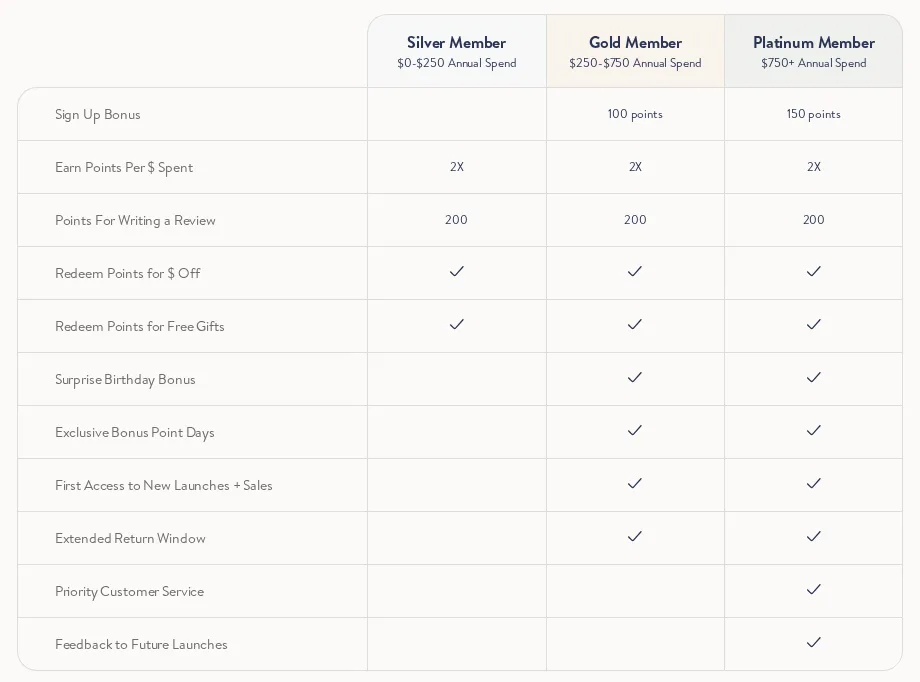
Brooklinen, the bedding brand, runs three tiers based on yearly spend: Silver up to $250, Gold from $250 to $750 and Platinum above $750. Every tier earns 2 points per dollar and 200 points for writing a review.
What changes as members move up is the service, not the earn rate. Gold members get first access to new launches and sales and a longer return window. Platinum members add priority customer service and a chance to give feedback on future launches.
Building tiers around service suits a product people rarely buy. Most people replace their sheets only now and then, so a slightly faster earn rate would barely register. A longer return window and a say in new products mean more to that customer.
5. Lululemon Membership
Lululemon Membership has no points at all. It's free to join and has three levels based on yearly spend: Collective, Collective Plus at $500 and Collective Pinnacle at $1,000.
Every member gets free hemming, receipt-free returns, early access to product drops, select Peloton classes, member-only experiences and perks from partner brands such as Oura and AG1.
Collective Plus adds exclusive products and a personal shopper, and Pinnacle adds first access to restocks and free customization in the US. Once a member reaches a level, they keep it for the rest of that year and all of the next.
Lululemon shows you can reward loyalty without discounts. A brand that sells at full price can thank its best customers with service and access, and avoid teaching them to wait for money off.
Gamified loyalty programs
Some programs make earning feel like a game, with levels to climb, bonuses to collect and goals to finish. Both examples here come from mid-size brands, which shows the idea doesn't need a big budget.
6. Princess Polly Rewards
Princess Polly, the fashion brand, names its tiers like concert tickets: general admission, then front row at 300 points, vip at 700 and backstage pass at 2,500. Members earn 1 point per dollar, plus points for following the brand on social media, referring friends and signing up for texts.
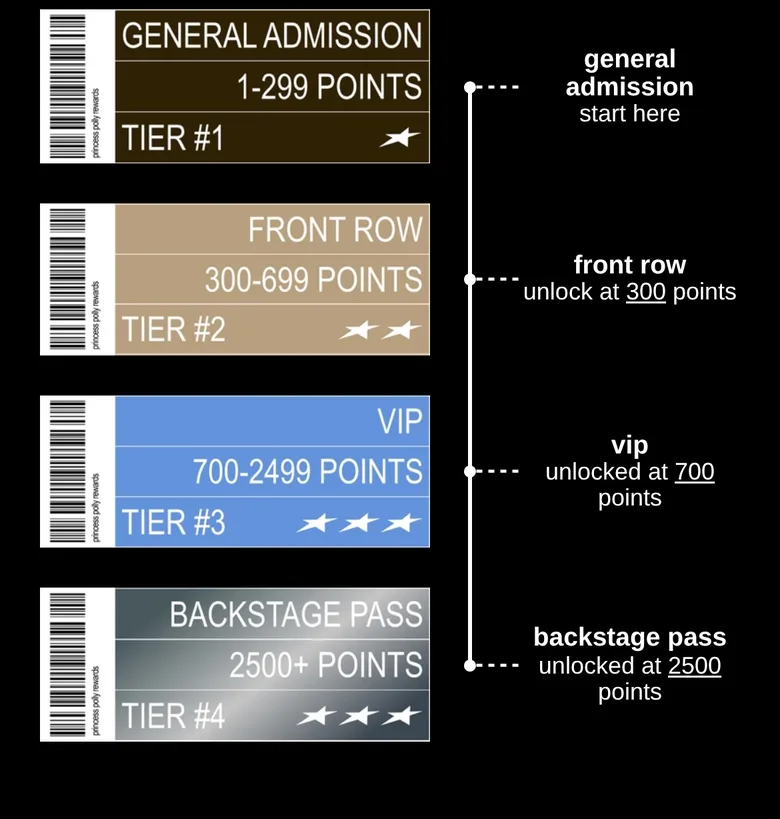
Every third purchase earns 50 bonus points. Each tier comes with an entry discount from 15% to 30%, a birthday reward from $10 to $25 and an anniversary reward from $5 to $20.
Other perks in the tier table include a monthly $100 gift card draw and a chance to be featured on the brand's channels. The backstage pass tier adds free merch, event invites and major prizes.
The idea to copy is naming tiers in your customers' own language and rewarding the habit, not just the spend. The ticket names suit a young audience that follows the brand on social media, and the bonus on every third order rewards members for coming back, whatever they spend.
7. tentree Rewards
tentree, the clothing brand, gives 1 point per dollar, and 100 points are worth $4. Members redeem in steps, from $10 at 250 points to $40 at 1,000, and their tier depends on what they've spent in the last 12 months.
Members also earn points for liking the brand on Facebook and referring a friend. On top of that, they can complete achievements, which together are worth more than 500 points.
For a smaller brand, the lesson is to give new members achievements to complete. At tentree's rates, 500 points is enough for a $20 reward, so a new member can reach a first reward before they've spent much at all.
Paid loyalty programs
A fee changes how a program works. Customers who pay to join have already decided they'll shop with you, and the fee helps cover benefits a free program couldn't afford.
8. Chewy+
Chewy+ costs $59 a year after a 30-day free trial. Members get free shipping with no minimum and 5% back on cat and dog food and on health and pharmacy items. Everything else earns 2% back. Membership also includes a pet poison helpline, which Chewy values at $99.
The part to copy is putting the best reward rate on the products customers buy again and again. Pet food runs out on a schedule, so free shipping and 5% back on it make the fee easy to justify and make Chewy the obvious place to reorder.
For a smaller store, a subscribe-and-save option does a similar job for the same kind of product.
9. REI Co-op membership
REI's co-op membership costs $30 once and lasts for life. By March each year, members receive a Co-op Member Reward on the previous year's eligible full-price purchases, and REI says 10% back is typical but not guaranteed.
Members earned more than $202 million in rewards on their 2025 purchases, and REI's lifetime membership grew to 26 million that year.
Members also get up to 33% off rentals, 20% off bike and snow shop services, trade-in credit for used gear and a vote in the co-op's board elections. REI donates $5 to its Cooperative Action Fund for each new membership.
What other brands can borrow is the yearly payout. A reward that arrives once a year is easy to look forward to and big enough to notice. The co-op side is harder to copy, since it depends on members owning the business and voting for its board.
Community loyalty programs
Some brands build loyalty around what their customers do, not what they buy. The cycling apparel brand Rapha has built one of the best-known examples.
10. Rapha Cycling Club
The Rapha Cycling Club costs $95 a year in the US. Its core is weekly club rides with ride leaders, which start and end at a Rapha clubhouse or a partner cafe, across 29 chapters.
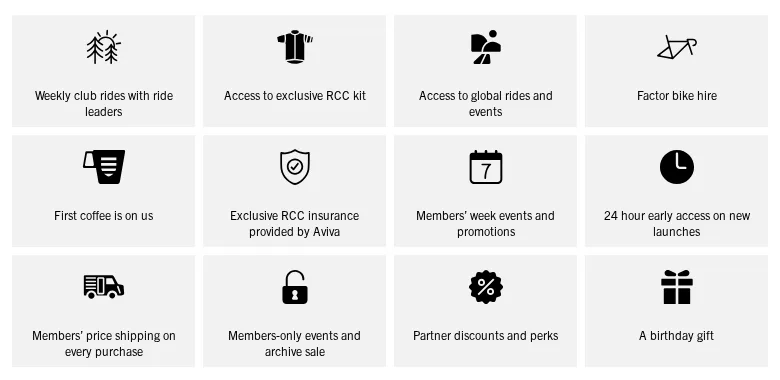
Members can also buy RCC-only kit and get 24-hour early access to new launches, members' price shipping, a members-only archive sale, RCC insurance from Aviva and partner discounts.
Rapha's lesson is to build a club around what customers already do. Rapha's customers ride, so the club gives them people to ride with and places to meet. No discount can do that.
Which loyalty program ideas suit your store?
The right idea for your store depends on what you sell and how often people buy it. A brand whose customers reorder every month needs a different program from one that sells a jacket every few years. This table matches each kind of store with the examples to look at first:
| If your store… | Ideas to borrow | Look at |
|---|---|---|
| Sells products people reorder | Free shipping for members and a higher reward rate for regular buyers | Chewy+, Ulta |
| Sells products people buy once or twice a year | A simple, generous points rule, risk-free returns and a yearly reward | The North Face, REI |
| Sells at full price | Service, perks and early access instead of discounts | Lululemon, Brooklinen |
| Has a young, social-first audience | Named tiers, points for social actions, bonuses and prize draws | Princess Polly, tentree |
| Sells to people with a hobby | A club with events and members-only products | Rapha, REI |
You don't need a custom build for most of these ideas. Points for actions beyond purchases, VIP tiers and bonus-point events are standard features of the leading loyalty apps for Shopify.
How much should a loyalty program give back?
How generous a program is matters as well. The chart below shows what each program's base reward is worth on $100 of spending, when points are taken as money off:
Base reward value per $100 spent, loyalty program examples, November 2026
Ulta and Brooklinen don't publish a fixed dollar value per point, so they're left out. Sephora's points can also go on product rewards instead of cash.
Most of these programs give back between 2% and 10% of what members spend. You don't need to match The North Face's rate.
A smaller reward works when members can reach it quickly and the rest of the program offers something else, such as free shipping or early access. Settle what your points are worth and how soon a customer reaches a first reward before you launch.
What shoppers want from a loyalty program
Two figures from Attentive's 2026 survey of 600 US shoppers support ideas from the examples above:
81%
US shoppers who said seeing their progress toward rewards motivates them, January 2026
65%
US shoppers who chose free or faster shipping as a loyalty perk they want, January 2026
So show members how close they are to their next reward, as Princess Polly does with a bonus on every third order and tentree does with its achievements.
And build free shipping into the program, as The North Face, Sephora and Chewy do. Free shipping tops the list of perks shoppers want from a loyalty program, ahead of points.
Final thoughts
A loyalty program is one of the few parts of your store you can design specifically to bring customers back. These examples show how far it can move from a point per dollar and a coupon.
If your customers reorder, start with points and put your best rate and free shipping on the products they buy most, as Chewy does. If you sell at full price, take a lead from Lululemon and Brooklinen and reward your best customers with service and access rather than bigger discounts.
A young, social audience will respond to a program that feels like a game, and customers who share a hobby may value a club more than any reward. Whichever you pick, judge it by how often members come back, not by how many sign up.
Frequently asked questions
What's the difference between a loyalty program and a paid membership?
A free loyalty program rewards customers after they spend, while a paid membership charges a fee up front and gives benefits from day one, such as free shipping. Chewy+, REI's co-op and the Rapha Cycling Club are paid; the other examples above are free.
Should loyalty points expire?
Loyalty points don't have to expire, but many programs set a limit so balances don't build up forever. Ulta's points expire about a year after they're earned for regular members, but never for Platinum and Diamond members.
Pura Vida's PV Rewards points expire only after 12 months with no account activity, which rewards members who keep shopping.
Can you rename or change a loyalty program without losing members?
You can rename or change a loyalty program without losing members if you carry their points and status across. Ulta renamed Ultamate Rewards as Ulta Beauty Rewards, and existing members kept using their accounts. Pura Vida renamed its Shore Club program PV Rewards and moved members' points over automatically.
Should a loyalty program include referrals?
A loyalty program can include referrals as one more way to earn points. Princess Polly and tentree both give points for referring a friend. A dedicated referral program usually goes further, with a reward for the new customer as well as the person who referred them.
What's a good loyalty program for a small Shopify store?
A good loyalty program for a small Shopify store is a simple points program with a first reward customers can reach in one or two orders. Add one perk that isn't a discount, such as early access or a longer return window.
Most loyalty apps have a free or low-cost plan to start on, so you can launch small and add tiers once you know who your regulars are.